



[Webinar Key Q&A] How to connect all the ever-increasing number of IoT devices? Simultaneous execution of wireless protocols is the answer!
 Published2019.09.30 11:05
The STM32WB platform is a dual-core wireless MCU suitable for a wide range of IoT devices, including smart homes, wearables, smart lighting, smart building controllers, computer peripherals, drones, and smart sensors.
It integrates a fully featured Arm Cortex-M4-based MCU capable of running mainstream applications, and an Arm Cortex-M0+ core capable of offloading the main processor and operating BLE 5 and IEEE 802.15.4 wireless functions in real time.
Offering more options for connecting IoT devices by being able to run wireless protocols including Bluetooth 5, OpenThread, and ZigBee simultaneously, the STM32WB platform helps improve the end-user experience by delivering new features and enhanced performance while extending battery life.
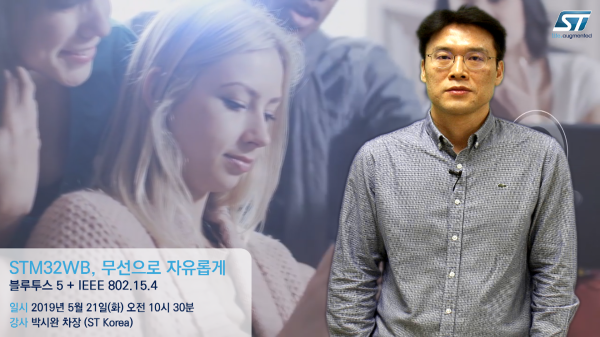
On May 21, 2019, e4ds EEWebinar hosted a webinar by Siwan Park, Deputy Manager at STMicroelectronics Korea, explaining the STM32WB platform that can run multiple wireless protocols simultaneously.
Below are some questions from webinar viewers about how the STM32WB platform can be used in embedded environments, and answers from Vice President Park Si-wan.
<strong>Q. Is there a model among the STM32 family that can be used by porting embedded Linux? (ID: wo**)
A. I have STM32MP1. Among Linux, only μClinux is supported.
Q. Does it also support NFC? (ID: da**)
A. NFC is not supported. You need to add a separate NFC controller.
Q. Are Nucleo boards widely used for field work? (ID: fo**)
A. The Nucleo board is used for development, and if the meaning of field use is mass production, then it is not. The Nucleo board is widely used for preliminary testing of functions required for development.
Q. What is the software development environment like? (ID: na**)
A. We provide STM32CubeMX and various IDEs and software tools.
Q. You said the maximum range is 100m, but is that without any speed reduction? (ID: em**)
A. There is no speed reduction in theory, but testing must be done in a controlled environment. Since this is a maximum range, actual usage may vary.
Q. When developing with an STM32 product and using an embedded OS, is it possible to upgrade the OS via LAN communication or USB? (ID: wo**)
A. Yes, it is possible. STM32WB products support OTA firmware updates via RF as well as USB. However, the Ethernet port is not supported, so updates cannot be made via LAN communication.
Q. The data says that it can be used for several years with the battery installed, but how many years exactly? (ID: ne**)
A. It depends on the application configuration. It can be calculated with the STM32CubeMx tool. However, for example, depending on the type of battery and the operating mode, it can be designed to be used for 10 years when advertising at 10-second intervals with a beacon.
Q. If you can design it to be used for 10 years when advertising at 10-second intervals with a beacon, is the cr2032 coin battery on the board the standard? Or what is the battery capacity required to make it possible? (ID: lo**)
A. It is based on a coin battery, and the exact calculation can be done using the power tool in STM32CubeMX.
Q. Do you have a communication security device? This is important for medical application development. (ID: na**)
A. Security features included in STM32WB include PCROP, PKA, TRNG, AES 256-bit, and CKS.
Q. How many mW of RF output is possible? Is there a way to increase the output further? (ID: bb**)
A. It supports up to 6dB and allows the use of an external PA.
The STM32WB platform provides integrated wireless connectivity from ST’s STM32 family. The low-power 2.4GHz radio consumes just 5.5mA in transmit mode and 3.8mA when receiving. The STM32WB offers a stable RF link budget of -102dBm and supports output power of +6dBm. The integrated balun, leveraging ST's technology for single-chip baluns, reduces external components by up to nine.
Q. What should I consider when replacing RS-485 (EIA-485)? (ID: fo**)
A. Since BLE does not have SPP, you need to implement the service yourself, but you can download related example code from st.com.
Q. Is there a program that calculates power consumption? (ID: zo**)
A. STM32CubeMX has a function to calculate power consumption in the 'tools' tab.
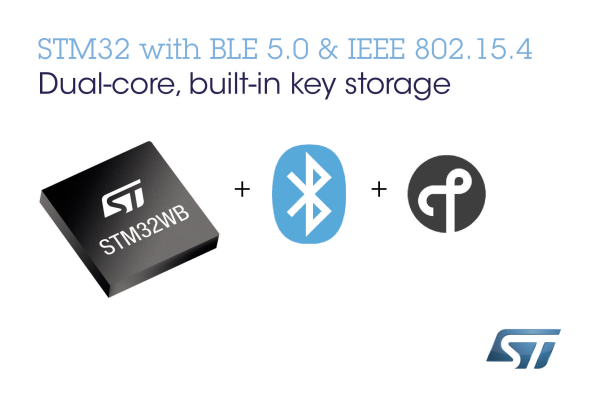
Q. Can BT, Thread, and IEEE 802.15.4 be stacked simultaneously on one chip? (ID: dd**)
A. It supports dynamic concurrent, which runs two stacks simultaneously, such as BLE 5.0+Thread or BLE 5.0+ZigBee.
Q. It seems that multiprotocol chips came out a bit later than other companies, is there a reason to adopt STM32WB? (ID: lo**)
A. It is suitable for applications with complex functions because it can utilize the STM32 MCU ecosystem. Not only does it have good RF performance, but it is unified with the existing STM32 development environment, so it can flexibly shorten the time when expanding the application.
Q. Are there any plans to support AoA/AoD in the recently announced Bluetooth 5.1? (ID: ro**)
A. Not at the moment, but we are considering supporting it in the future.
Q. I understand that STM32WB is designed with dual cores of M1 and M4. If I enable the RF function, will the RF-related functions be automatically compiled to use M1? (ID: em**)
A. M0+ & M4, and RF binary written on M0+ chip will be provided later.
Q. Since STM32WB is a dual-core product, do I need to use both M0 and M4 libraries when developing firmware? (ID: in**)
A. Yes. Since M0+ is a radio controller, you can use the provided stack. It is provided in binary form for M0+. Users only need to develop the M4 core.
Q. If I want to connect to a wired LAN with the STM32 family, is there a separate UART port? (ID: wo**)
A. It is equipped with a total of 2 ports.
The STM32WB leverages digital and analog peripherals designed for extended battery life and complex functionality, including timers, ultra-low-power comparators, 12/16-bit SAR ADCs, capacitive touch controllers, LCD controllers, and industry-standard connectivity including crystal-less USB 2.0 FS, I2C, SPI, SAI audio interfaces, and Quad-SPI ready for implementation.
Q. If there are two UART ports, is one of them used wirelessly by default? If the remaining one is configured as a wired LAN port, is LAN communication possible? (ID: wo**)
A. The STM32WB product is an SoC product that integrates 2.4G RF+STM32 on a single chip. Therefore, you do not need to sacrifice the UART port for wireless use.
Q. How much RAM and flash space does the stack take up? (ID: bb**)
A. It depends on the stack version, but flash is about 50kB and RAM is about 20kB. Always check for the latest stack updates to be accurate.
Q. When configuring a Bluetooth speaker with STM32WB, is it possible to configure it with only STM32WB without the need for the existing STM32 + external BLE module configuration? (ID: wa**)
A. Normally, Bluetooth speakers are not implemented with BLE, but if you use STM32WB, you can configure it without an external BLE module.
Q. Do you provide a Zigbee stack? If not, when will it be available? (ID: de**)
A. It is currently being tested internally and is scheduled to be released in Q4 of this year.
Q. Can you test the disconnection phenomenon after Bluetooth connection? The dongle I am using is frequently disconnected in the field, so I am interested in the new Bluetooth 5.0. I would like to know the connection reliability. (ID: Ju**)
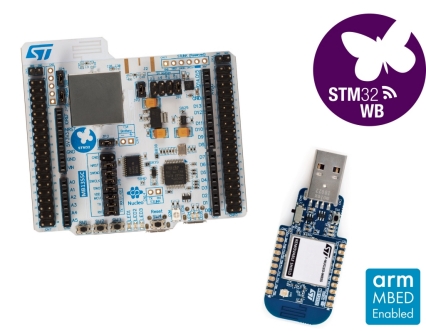
A. You can review it using P-NUCLEO-WB55.
Q. Is it okay to wake up with the internal RTC when implementing sleep mode? I heard that third-party products require a separate external 32.768Khz configuration due to internal errors. (ID: kk**)
A. The internal oscillator is not very accurate, so for applications that require precise timing, you will need to add an external crystal.
Q. Long Range Mode is not supported? (ID: hy**)
A. It is not supported in the currently released version. We plan to support this from the next version.
The STMicroelectronics webinar 'STM32WB, Wireless Freedom; Bluetooth 5 + IEEE802.15.4', where this Q&A took place, is available for replay.
Comments
Related news
ST Launches Multiprotocol Bluetooth & 802.15.4 SoC for IoT Devices
STMicroelectronics (ST) has launched an advanced dual-processor-based wireless chip that enhances the performance of next-generation smart connected devices such as digital home products, wearable electronics, smart lighting, and smart sensors. The device extends battery life while delivering new features and improved performance to enhance the end-user experience. The STM32WB wireless SoC device integrates an Arm Cortex-M4-based microcontroller with full capabilities to run key applications, and an Arm Cortex-M0+ core that offloads the main processor and can operate BLE (Bluetooth Low Energy) 5 and IEEE 802.15.4 wireless functionality in real-time.
2018.03.26by 김지혜 기자
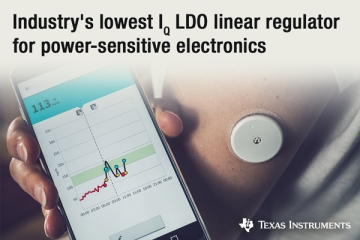
TI Unveils LDO Linear Regulators That Extend Battery Life
As demand for smaller and smarter connected devices increases, attention to battery life is also growing. To maintain extended battery life, ultra-low quiescent current is required. The TI TPS7A02 linear regulator enables ultra-low quiescent current control under light load conditions, improving battery life by at least twice in applications using standard battery compounds such as lithium-ion. Additionally, with a low shutdown quiescent current of 3nA, it can extend battery life by up to 5 times compared to competing devices in portable medical and wearable applications.
2019.09.19by 최인영 기자
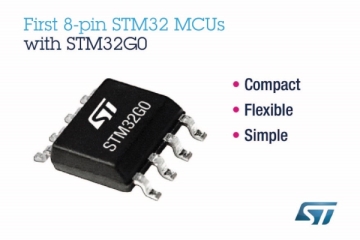
ST Unveils its First 8-Pin STM32 MCU Series, the STM32G0
ST Microelectronics supplies STM32 MCUs in an 8-pin package. The new four types of STM32G0 devices are based on an 8-pin package and feature a 64MHz Arm Cortex-M0+ CPU delivering 59 DMIPS, up to 8Kbyte RAM and 32Kbyte on-chip flash, 2.5Msps ADC, high-resolution timer, and high-speed SPI. Designers can map I/O pins and internal MCU functions to upgrade the functionality of the final product. The internal oscillator maintains stability with ±1% accuracy across wide temperature and voltage ranges, eliminating the need for external clock components.
2019.09.24by 최인영 기자
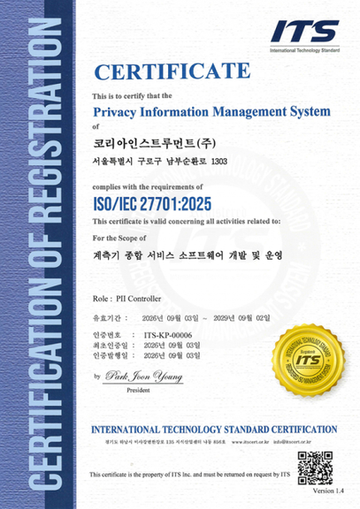
Korea Instrument, KOLAS Accredited Calibration Agency First to Simultaneously Acquire ISO/IEC 27,001·27,701
Korea Instrument has become the first among KOLAS accredited calibration agencies to simultaneously acquire ISO/IEC 27,001 and ISO/IEC 27,701 certifications. Through its proprietary platforms CWIZ Enterprise and CWIZ Partners, the company has embedded information security and personal data protection requirements across all business processes including customer information, equipment data, and calibration reports, with plans to continuously advance its management system through regular audits and security inspections.
2026.10.12by 배종인 기자

TeamViewer One, IT Incident Automation Workflow and Resolution Center Enhanced
TeamViewer has added IT incident automation capabilities and an advanced Resolution Center to its integrated digital workplace management platform 'TeamViewer ONE'. Recurrent service disruptions, configuration errors, and capacity shortages are automatically handled according to preset policies, and device status verification through script deployment can be managed in a unified interface, significantly reducing repetitive tasks for IT teams.
2026.10.12by 배종인 기자











