


[5G Now] 28 billion wavelengths per second, how far has the development of 5G 28GHz come?
 Published2019.10.08 08:35
As a result of large-scale base station installation and investment in 5G communication infrastructure, KT has currently opened 36,210 base stations nationwide, LG U+ has built 30,365 base stations, and SKT has built 21,954 base stations to provide 5G communication services.
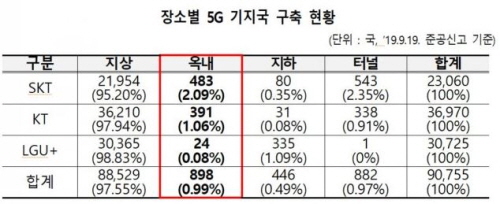
5G base station construction by location reported nationwide
However, the 5G frequency band currently in use is 3.5GHz, which feels a bit slow to be called 5G, and in addition, there are complaints from users about the continuous communication speed due to NSA (Non Stand Alone) that is used simultaneously with LTE.
To solve this problem, the three telecommunications companies are currently accelerating investment in 28GHz band repeater base station facilities. However, consumers who have already purchased 5G products will not be able to make calls in that band even if the 28GHz service is available. This is because the frequency of the devices already released is set to the 3.5GHz band. In any case, the three telecommunications companies are preparing to install 5G base stations and provide services in the 28GHz band according to their specifications.
LG Uplus announced that it has verified a speed that is up to three times faster than the existing 5G in the allocated 28GHz band. The maximum download speed was 4.2Gbps, and the upload speed was 1Gbps. It is more than 10 times faster than the current maximum upload speed of LG U+ 5G.
KT also plans to complete the development of 28GHz transmission and reception equipment this year with Samsung Electronics, aiming for commercialization next year. KT is developing base station equipment that combines the antenna and base station into one. This will show higher performance in a smaller size than existing 3.5GHz equipment.
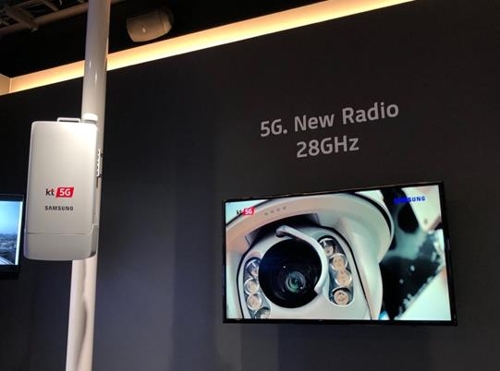
KT's 28GHz base station equipment
SKT is also conducting tests by installing a 28GHz 5G ultra-high frequency commercial base station in cooperation with Samsung. Last August, at the Yeongam F1 Circuit, the technology was verified by conducting a live 5G broadcast from a racing car running at 213km using 28GHz ultra-high frequency 5G.
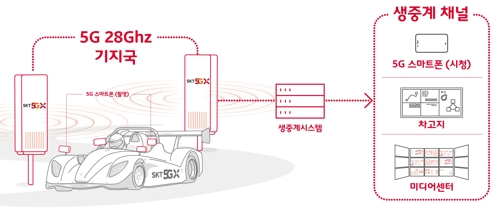
SKT's 28GHz racing car broadcasting architecture
All three mobile carriers are targeting 2020 as the start of their 28GHz services. When the 28GHz service is launched, it is expected that the development of high-speed communication-based devices will gain momentum in various fields such as autonomous vehicles, smart factories, and intelligent CCTVs, which are currently under continuous development, as well as consumer communication complaints that are currently a problem.
However, due to the low diffraction characteristic of the fast straight-line signal characteristic of 28GHz, there is a burden of having to build more base stations than the existing 3.5GHz band base stations to overcome obstacle avoidance. In addition, developing a chipset that supports the 28GHz band is also a task for smartphones that use 5G the most.
Qualcomm's communication chips, which are currently most widely used in smartphones, are tuned for 3.5GHz. Qualcomm said it will release a chipset that supports 28GHz by the end of this year.
The current 5G communication method is called NSA (Non Stand Alone). It minimizes inconvenience by using the existing 4G LTE network instead of just 5G.
The 28GHz 5G, scheduled to be launched next year, will be based on 28GHz from chipsets to repeaters. It is said to be implemented in a true SA (Stand Alone) manner.
When applying any new technology, the most important thing to consider is the social value cost. It is a welcome thing that faster and newer technologies are being applied to the market. However, for market value, rather than speed battles, it seems necessary to apply 28GHz ultra-high-speed communication technology based on sequential communication base station network stability that can minimize user complaints.

Comments 1
1 Comments:
Related news
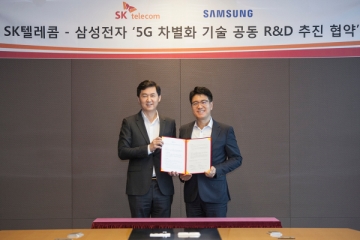
SKT and Samsung Electronics Sign 5G Technology R&D Agreement to Expand 28GHz Band Coverage
SK Telecom is strengthening its cooperation with Samsung Electronics to provide high-quality 5G services following the commercialization of 5G. SK Telecom has signed an agreement with Samsung Electronics on "Joint R&D Promotion of 5G Differentiation Technology." The two companies have agreed to collaborate on developing mobility enhancement technologies in the 3.5GHz and 28GHz bands, developing coverage expansion solutions for the 28GHz band, and identifying use cases for 5G applications.
2018.11.23by 이수민 기자

5G infrastructure revenue in 2020 is expected to double from 2019.
Global 5G wireless network infrastructure revenue is expected to reach $4.2 billion in 2020, representing an 89% increase from $2.2 billion in 2019. Gartner forecasted that investments in 5G NR network infrastructure in 2019 would account for 6% of telecom operators' total wireless infrastructure revenue. This figure is expected to increase to 12% in 2020. 5G services are scheduled to launch in several major cities in 2019 and 2020. Starting with the United States and South Korea, several European countries including Switzerland, Finland, and the United Kingdom have already implemented 5G services. Telecom operators in Canada, France, Germany, Hong Kong, Spain, Sweden, Qatar, and the UAE have announced plans to accelerate 5G network deployment by 2020.
2019.08.24by 이수민 기자
Sejong City to Demonstrate 5G Autonomous Shuttle Service Starting This October
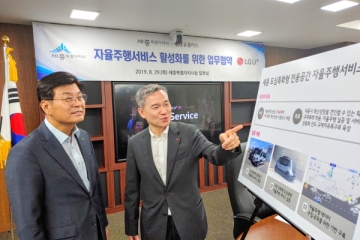
In July, LG Uplus and Sejong Special Self-Governing City attended a regulatory sandbox city governors' meeting chaired by President Moon Jae-in in Haeundae, Busan, and unveiled 5G technology to enhance autonomous driving safety and plans for autonomous driving business demonstration projects. Sejong City was selected as a regulatory sandbox at the event and has been promoting a project to build an autonomous driving specialized city with LG Uplus through 2021. The two parties met at Sejong City Hall on August 29, concluded a memorandum of understanding to activate autonomous driving services, and agreed to establish mutual cooperation and support relationships for carrying out demonstration tasks.
2019.08.30by 최인영 기자

Three 5G NR Challenges That Can Be Solved Right Now
Korea's 5G is preparing for a step-by-step upgrade to meet market demands. This represents a leap from the 3.5GHz frequency band, known as 4.5G since its initial launch in 2018, to true 5G via 28GHz. By simultaneously utilizing the 3.5GHz band and existing LTE networks to bring the entire nation within 5G coverage, the NSA (Non Stand Alone) designation is expected to be removed after 2020. However, the introduction of 28GHz is adding further challenges to the already complex 5G development landscape, placing additional tasks before development engineers. This technical article addresses the challenges of 5G New Radio as presented by Keysight and discusses methods for resolving the current issues at hand.
2019.10.07by 명세환 기자
European Patent Applications Surpass 200,000 for the First Time… South Korea Maintains 5th Place, Led by Batteries and Telecommunications
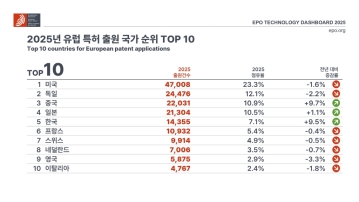
According to the European Patent Office (EPO)'s 'Technology Dashboard 2025', European patent applications last year reached 201,974, surpassing 200,000 for the first time. Korean companies and inventors filed 14,355 applications, representing a 9.5% increase from the previous year and maintaining 5th place by country. Battery, digital communication, and semiconductor technologies led the growth, with Samsung ranking as the top EPO applicant for the second consecutive year and LG reaching 3rd place. The presence of major domestic cities such as Seoul, Suwon, and Yongin was also confirmed. It was also revealed that Korea's European patent strategy is expanding beyond individual technologies to span the entire industry.
2026.03.24by 명세환 기자












좋은 정보 감사합니다