



How Far Has AI Semiconductor Technology Come? [Electronic Warfare Keynote Issues]
 Published2019.10.14 17:01
The 50th Korea Electronics Show 2019, held for four days from October 8 to 11, was an opportunity to grasp the present state of the Korean electronics industry, which is celebrating its 60th anniversary, and to look toward its future.
The Korea Electronics Show (KES), marking its 50th anniversary this year since its first 개최 in 1969, features a total of 443 companies, including 104 overseas companies, occupying 1,100 booths.
On the first day of the opening, LG Electronics’ A&B Center Head Lee Sang-yong, Samsung Electronics’ AI&SW Center Head Shim Eun-soo, and Futuresource Consulting’s Executive Analyst Jack Wetherill delivered keynote speeches to share trends and insights in the electronics industry.
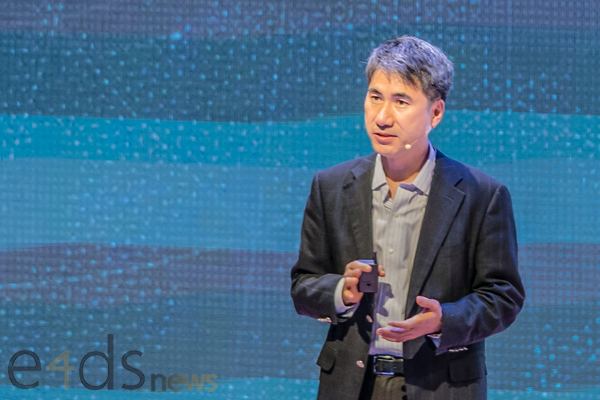
Shim Eun-soo, Head of the Center at Samsung Electronics, who served as the second keynote speaker, addressed the topic of "Development Prospects for Intelligent Semiconductor Technology." He examined the current status of intelligent semiconductor technology in light of the spread of AI technology and forecasted its future development direction.
AI is more accurate than humans
Center Director Shim Eun-soo explained how much AI technology is advancing, citing the ILSVRC case.
The ILSVRC (ImageNet Large Scale Visual Recognition Challenge) is a competition that evaluates the performance of image recognition algorithms by providing large image sets, and it has been held since 2010.
20AlexNet, a CNN-based deep learning algorithm that won in 2012, reduced the recognition error rate from approximately 26% to 16%. Since then, as deep learning-based algorithms became more widespread, recognition errors have gradually decreased.
In 2015, it recorded an error rate lower than the human recognition error rate of 5%. SENet, which won in 2017, had an error rate of only 2.3%, making it more accurate than humans.
Intelligent semiconductors must now perform AI computations autonomously.
Samsung Electronics' voice recognition-based personal assistant application, Bixby, sends the user's voice to the cloud. The cloud performs voice recognition using an AI engine and sends the results to Bixby. This is because AI computation could not be performed on the smartphone itself.
With the growing movement to run AI engines on devices themselves without the aid of the cloud, the Intelligent Semiconductor Forum was launched in Korea last July. To realize intelligent semiconductors optimized for AI, chip manufacturing technologies including packaging, chip design technologies, and the development of suitable software are required.
Semiconductors are divided into memory semiconductors and non-memory semiconductors. "System semiconductor" is the Korean term for non-memory semiconductors. Most memory semiconductors are related to AI, and among non-memory semiconductors, processors such as CPUs, GPUs, accelerators, and APs are particularly related to AI.
The AI processor market is developing rapidly. According to AMR, the AI processor market is expected to record an average annual growth rate of 45.4% from 2018 to 2025. Through this, the market size is projected to reach $91.185 billion, or approximately 109.42 trillion won, by 2025.
Semiconductors optimized for AI computation, NPU
The CPU is a general-purpose processor, not a processor optimized for AI operations. Dedicated AI processors are 100% more efficient than CPUs. The efficiency of AI processors can be seen through Google's example.
In 2015, the distributed version of the first AlphaGo used 1,920 CPUs and 280 GPUs. Google subsequently developed TPUs suitable for deep learning. AlphaGo Lee, equipped with 48 TPUs, won its match against Lee Sedol with a record of 4 wins and 1 loss. AlphaGo Zero, released in 2017, uses a single TPU module equipped with four TPUs; despite the improved performance, its power efficiency was improved by approximately 30 to 80 times compared to the first AlphaGo.
Along with performance improvement, power efficiency is a critical factor in semiconductors. In particular, a primary goal of data centers is to reduce power consumption. If power efficiency can be increased by approximately 30 to 80 times compared to the same performance, more tasks can be performed.
(Photo = Samsung Electronics)
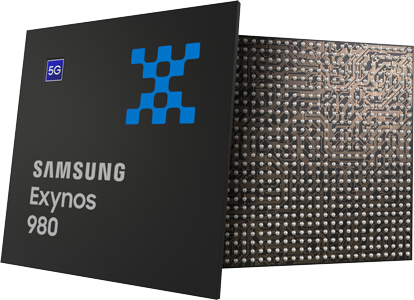
The Neural Processing Unit (NPU), a flagship product of Samsung Electronics, is a processor optimized for deep learning algorithm computations. Deep learning algorithms require parallel computing technology capable of processing thousands of operations simultaneously. The NPU can efficiently perform such large-scale parallel computations.
The NPU can be manufactured as a separate chip or integrated as a component into a mobile AP. Samsung Electronics has been using mobile APs equipped with a self-developed NPU since the Galaxy S9.
Implementation technologies and application fields of AI semiconductors
Semiconductor technological prowess cannot be considered high simply by manufacturing a single chip well. In particular, AI requires various layers of technology to be stacked one on top of another to operate effectively. One must possess overall capabilities across diverse fields, including AI hardware, compilers, libraries, frameworks, platforms, applications, and services. Without this software stack, it is impossible to create value in AI.
Center Director Shim Eun-soo explained how NVIDIA secured its competitiveness in the AI market. NVIDIA manufactures chips, boards, and servers equipped with GPUs, and has even configured clusters. By proving that it can build systems using chips, rather than just making chips, NVIDIA has enhanced its competitiveness.
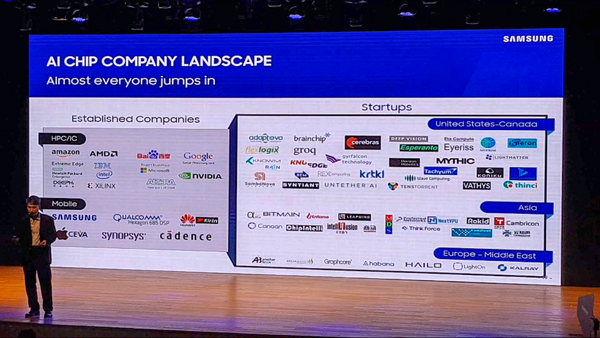
The fields in which AI can be applied are diverse. From wireless earphones to smartphones, TVs, delivery robots, autonomous vehicles, servers, and data centers, AI can be utilized in everything. This is why the number of companies developing AI technology is increasing. Having core AI application technology makes it easier to enhance the value of a company's products and services.
Movement to compensate for the shortcomings of AI processors
As technological advancements bring people closer together without spatial constraints, speech recognition—or natural language processing—is developing rapidly. To utilize Multilayer Perceptrons (MLPs) and Recurrent Neural Networks (RNNs) technologies employed in natural language processing, Facebook and Google are extensively adopting dedicated AI processors.
However, AI processors have the disadvantage of frequent memory access. Therefore, there are inevitably limitations to performance improvement with existing memory bandwidth. Furthermore, memory access consumes a significant amount of power. This is another reason why power-efficient AI processors must be developed.
The industry is considering various technologies to improve the power efficiency of AI processors. They are primarily exploring ways to reduce the distance between memory and the processor or to integrate the processor into the memory.
The semiconductor industry is currently researching in-memory computing technology using NVM crossbar arrays, technology that reduces data to be transmitted from 32 bits to 8 bits while maintaining accuracy, Spiking Neural Networks (SNN) technology, photonics technology that calculates with optical signals, and Software-defined hardware (SDH) technology.
(Photo by Reporter Lee Su-min)
Concluding his keynote speech, Center Director Shim Eun-soo advised, “The AI semiconductor market holds tremendous potential, and despite the numerous players already having entered the market, that number will continue to grow,” adding, “To survive in the market within a few years, companies must secure competitiveness in terms of power efficiency and software stacks.”
Comments
Related news
Samsung Electronics Launches Exynos 980, a 5G Modem + Mobile AP
Samsung Electronics has unveiled the Exynos 980, a 5G mobile processor that integrates a 5G communication modem and mobile AP into a single chip. The Exynos 980 implements two chips in one, improving power efficiency and reducing the physical footprint of components, thereby enhancing design convenience for mobile devices. Additionally, by applying advanced 8-nanometer FinFET process technology, it supports a wide range of mobile communication standards from 2G to 5G with a single chip, and features an integrated high-performance NPU that enhances AI performance.
2019.09.05by 이수민 기자
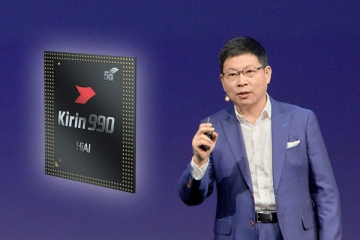
Huawei Unveils 5G Smartphone SoC Smaller Than Samsung and Qualcomm
Huawei unveiled new Kirin SoCs at IFA 2019, introducing the Kirin 990 and Kirin 990 5G. In particular, the Kirin 990 5G integrates a 5G modem to reduce size and power consumption, and supports both 5G NSA and SA. It supports both TDD and FDD across all frequency bands, while delivering maximum downlink speeds of 2.3 Gbit/s and maximum uplink speeds of 1.25 Gbit/s. Manufactured using a 7nm EUV process, the Kirin 990 5G also features a dual-core NPU based on the Davinci architecture, which consists of large and small NPU cores.
2019.09.08by 이수민 기자
AI Factory Conference 2019: The AI Wind Blowing in Manufacturing
The Korea Smart Manufacturing Industry Association held the 'AI Factory Conference 2019' for the first time at COEX in Samseong-dong, Seoul, with the theme of AI-based industrial intelligence. KOSMIA Chairman Kim Tae-hwan stated in his opening remarks, "To fully implement smart factories, it is necessary to collect required data at the right time and create value by applying the secured data to operations." He further emphasized, "Companies must secure talent and capabilities to utilize not only newly collected data but also accumulated existing data."
2019.10.02by 이수민 기자

[e4ds Tech Day 2026 ⑨] Sim Sang-gyu, Autocrypt CTO: "In the Physical AI Era, Automotive Security Must Extend Beyond the Vehicle"
At e4ds Tech Day 2026, Sim Sang-gyu, CTO of Autocrypt, explained automotive cybersecurity strategies in the era of Physical AI and SDV (Software-Defined Vehicle). Automobiles are evolving as part of an ecosystem connected to AI, cloud, chargers, IoT, and robots, and he emphasized that the scope of security must expand beyond the vehicle interior to the entire connected environment. In particular, AI model tampering, adversarial attacks, OTA updates, and EV charger hacking were identified as major threats. He explained that response measures require zero trust, AI model integrity protection, intrusion detection, Security by Design and Default, and full lifecycle security management, and that proactive security system establishment beyond regulatory compliance is critical for securing future mobility competitiveness.
2026.10.12by 배종인 기자
NVIDIA to Invest $1 Billion in U.S. Science Over Next Five Years
NVIDIA has announced plans to invest $1 billion over the next five years to strengthen U.S. scientific and technological competitiveness. The company will enhance cutting-edge artificial intelligence research and development capabilities in key areas including quantum computing, healthcare, and energy security, while expanding support for higher education research institutions and cloud service providers. NVIDIA is participating as a major industry partner in the White House Office of Science and Technology Policy's Genesis Mission, and is promoting supercomputer construction in collaboration with national laboratories including Argonne and Los Alamos.
2026.10.12by 배종인 기자











