


Microchip Launches Low-Power Radiation-Resistant FPGA for Space
 Published2019.10.24 13:39
Withstand total ionization dose exposure exceeding 10 kRad
Configuration switches can be implemented in the architecture
Developers of space devices utilize radiation-resistant FPGAs when building onboard systems that must operate continuously in space.

(Image = Microchip Technology)
Microchip Technology announced on the 23rd that it has launched the radiation-resistant 'PolarFire FPGA'.
Space applications are increasingly transmitting processed data rather than simple data. In addition, superior computing performance is required to make the most of the limited downlink bandwidth.
Radiation-resistant PolarFire FPGAs provide 1.5 times the performance, 3 times the logic elements, and SERDES (SERializer-DESerializer) bandwidth in space applications requiring up to 5 times the computing throughput.
It provides 6 times higher embedded SRAM to handle more complex systems compared to existing FPGAs, and withstands exposure to Total Ionizing Dose (TID) exceeding 100 kilorads, which is commonly encountered in most satellites orbiting the Earth and many deep space projects.
Compared to an SRAM-based FPGA with equivalent density and performance, the power consumption of the radiation-resistant PolarFire FPGA is half.
Developers can implement configuration switches in the architecture using the SONOS non-volatile technology of the radiation-resistant PolarFire FPGA. This enables simpler designs than SRAM-based FPGAs and reduces power consumption.
The radiation-resistant PolarFire FPGA is scheduled to undergo standard processes to meet QML standards, including V-grade certification. The certification requires the performance of extensive and continuous testing, including inspection of each wafer and package assembly lot.
Bruce Weyer, Vice President of Microchip’s FPGA business unit, commented, “PolarFire FPGAs have made progress in computing throughput required by applications such as process-intensive neural networks for object detection and recognition, high-resolution passive and active imaging, and high-precision telescience measurement, while maintaining the path toward QML certification.”
The Microchip PolarFire RTPF500T FPGA is packaged within a sealed Ceramic Column Grid Array (CCGA) containing integrated decoupling capacitors and is scheduled to be certified for use in spaceflight implementations in 2021.
Developers can start designing using Microchip's Libero software tool suite and the PolarFire MPF500T FPGA. The tool suite includes optional Triple Mode Redundancy (TMR) for SEU mitigation used in control circuits, etc.
Development boards are available on commercial PolarFire FPGAs, and radiation-resistant PolarFire will be included in future engineering model forms. Available radiation data includes TID, Single-Event Latchup (SEL), configuration upset, unprotected D Flip-Flop (DFF) upset, and memory.
Comments 1
1 Comments:
Related news
Microchip simplifies hardware-based IoT security with pre-provisioning solution
Hardware-based security is the only method that can protect secret keys from physical attacks and remote data extraction. However, setting up and provisioning each device requires extensive security expertise, development time, and costs. Microchip Technology has announced a pre-provisioned trust platform solution that provides secure key storage when building devices of all sizes using the ATECC608A SE. By using the trust platform for Microchip's CryptoAuthentication product family, enterprises can easily implement secure authentication regardless of scale.
2019.10.04by 이수민 기자
Microchip Launches Bluetooth 5.0 Certified Dual-Mode IC and Module
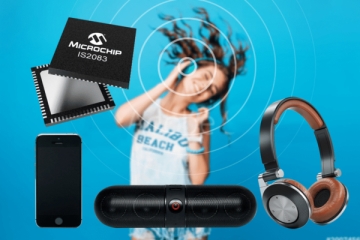
Microchip Technology has launched the IS2083, a Bluetooth 5.0 certified dual-mode audio IC, and the BM83 module, which has received certification with speakers and headphone manufacturers in mind. Both products are equipped with a power amplifier and flash memory, enabling support for LDAC technology, Sony's audio codec technology, and reducing the bill of materials. Through embedded mode, the IS2083 IC and BM83 module maintain application functionality without an external host MCU and provide maximum power output of +9.5dBm, eliminating the need for a separate external power amplifier.
2019.10.08by 이수민 기자

Lattice Begins Samples of FPGAs for Embedded Vision Systems
Lattice announced a CrossLink Plus FPGA product family for MIPI D-PHY-based embedded vision systems. CrossLink Plus features embedded flash memory hardware-based MIPI D-PHY and high-speed I/O for instant-on panel displays, and is a low-power FPGA that enables on-device programming. Ready-to-use IP and reference designs are also provided.
2019.10.15by 이수민 기자

Intel Unveils Next-Generation 'Core Ultra Series 3' and vPro Platform for Enterprise PCs
Intel has officially unveiled the "Intel Core Ultra Series 3" for next-generation enterprise PCs and the latest vPro platform, addressing a wide range of demands from enterprise notebooks to high-performance workstations.
2026.03.26by 배종인 기자

ROHM Launches ESD Protection Diode Compatible with High-Speed Interfaces of 10Gbps or Higher
Semiconductor specialist ROHM has developed the 'RESDxVx series' of ESD (electrostatic discharge) protection diodes capable of responding to next-generation high-speed data communication environments exceeding 10Gbps, simultaneously enhancing both signal quality maintenance required in high-speed interfaces and IC protection performance.
2026.03.26by 배종인 기자












좋은 정보 감사합니다