


KT Announces Transformation into an AI Specialist, But AI Services Are Not Yet Commercialized
 Published2019.10.30 12:01
Cultivating Insufficient AI Talent Pool Starting from Elementary and Middle School Students
Over 20 core AI technologies, but services still a long way off
As AI establishes itself as the foundation of all industries, KT has announced an AI-centric business strategy.
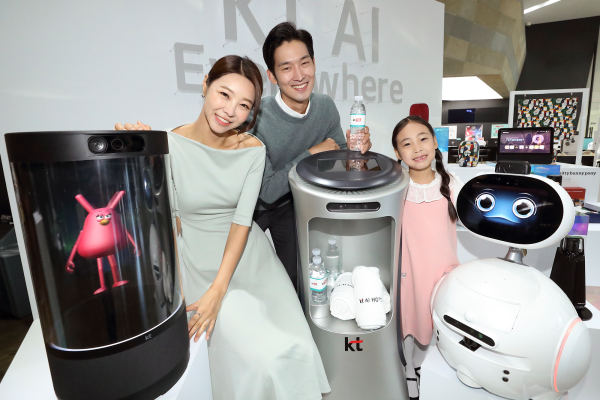
On the 30th, KT held a press conference at KT Square in Gwanghwamun, Jongno-gu, Seoul, and announced that it would transform into an AI specialized company.
KT plans to invest 300 billion won over the next four years and train 1,000 AI specialists. Currently, KT's AI specialist workforce is known to be around 200 people.
AI Business Expands from Home to Four Major Sectors
GiGA Genie, launched in late January 2017, is KT's flagship AI service that became the first domestic AI device to reach 2 million subscribers.
In its early days, GiGA Genie provided services only in the form of a TV set-top box, but it has diversified its devices and services into LTE speakers and is expanding its reach into apartments, hotels, and cars.
KT is currently supplying AI apartments in cooperation with 73 construction companies and 7 home network companies, and is providing AI hotel services in over 1,200 rooms across 13 hotels.
Not content with GiGA Genie, KT plans to expand its current home-focused AI business into the global, industrial/energy, office, and education sectors.
First, the reach of GiGA Genie is being expanded globally. KT plans to pilot an AI hotel in Cebu, Philippines in November and is preparing services across Asia and the Middle East. It also plans to provide GiGA Genie technology consulting to MTS, Russia's largest mobile operator.
Next, in the industrial sector, AI is applied in areas such as factories, security, energy, and customer centers. In factories, a smart factory platform combining KT's 5G network, big data, and intelligent video analysis technology with AI is used to increase productivity and prevent safety accidents. In security, AI is utilized for the selective recognition of people and objects, as well as for detecting intrusions or unauthorized access.
In the energy sector, energy efficiency of buildings is enhanced based on the AI-based integrated energy management platform (KT-MEG). The AI customer center, currently in pilot operation, will also be fully launched in 2020. The AI customer center is equipped with features such as a consultation assistant, voice-based customer recognition, and automatic classification of Voice of Customer (VOC).
KT plans to utilize its AI customer center for late-night consultations and fault reporting, as well as for customer consultations during peak hours.
We are also increasing efficiency by introducing AI into the office. We are preparing an AI task processing service that can replace simple, repetitive tasks, and this service applies Robotic Process Automation (RPA), chatbots, and STT technology.
KT announced that it has achieved annual cost savings of over 7 billion won through robot process automation services, such as Ma-seosa and Jeon-daeri, which have already been applied to the company.
Unmanned convenience store solutions are also under development, including a service that automatically generates meeting minutes through speaker separation and voice extraction, an AI-based service for identifying defective products, and a service for extracting usage statistics.
Cultivating AI talent is key in the education sector. The domestic AI talent pool is so narrow that there are even claims that there are only seven competent AI professionals.
KT already launched the 'AI Makers Kit' last July, which allows anyone with coding skills to create an AI voice recognition device. The AI Edupack intermediate version, an AI coding education package, was released in June of this year, and the beginner version in October of this year.
We have also launched the AI Vitamin Project to provide AI coding education to underprivileged children and youth, and aim to educate more than 5,000 people by 2020.
Demonstration of AI services based on core AI technologies in 4 areas
At this meeting, KT unveiled about 20 source AI technologies that are under development or have been completed in four areas: emotion and language, video and behavior, analysis and judgment, and prediction and reasoning.
In the emotion and language domains, they demonstrated Speech Separation technology, which accurately recognizes voices even in noisy environments and cleanly separates the voices of multiple people, as well as English Personalized Text-to-Speech (English P-TTS) technology, which generates English speech from just a single recorded sentence.
We plan to develop Machine Reading Comprehension technology that identifies questions and topics in a conversation and provides simple answers based on knowledge retrieval, and apply it to various fields.
In the video and behavior domain, a 3D avatar (Navatar) that follows me in real time was unveiled by combining deep learning-based G-Motion technology, which predicts 3D human movements from 2D video, and GiGA Beam technology, which projects video onto moving objects.
In the analysis and judgment domain, technologies were introduced to find hidden information from massive amounts of data and make accurate judgments in real time. These included web agent technology that analyzes and judges web pages in real time to perform actions desired by the user, and Dr. Lauren, an AI that analyzes communication failures to identify their causes and restores them quickly. Lauren) The technology demonstration fell through due to KT's circumstances.
In the prediction and inference domain, KT introduced GiGAtwin technology, which derives problem solutions by generating realistic twin models through self-learning based on small data. KT stated that GiGAtwin technology is being utilized for the optimization of Seoul's traffic signal system and building energy.
AI Service Commercialization Still Has a Long Way to Go
While AI has so far been limited to enjoying content through TVs or speakers and controlling home IoT devices, in the future, it will play a role in improving the quality of life in all areas.
KT also announced its ambition to solve various social problems using data-driven AI. The predictive and reasoning intelligence of AI can be utilized to prevent lonely deaths among the elderly living alone, block the spread of infectious diseases, and aid in disaster prevention and recovery. Furthermore, the company plans to contribute to enhancing Korea's AI competitiveness by fostering specialized AI personnel and expanding AI coding education for elementary and middle school students.
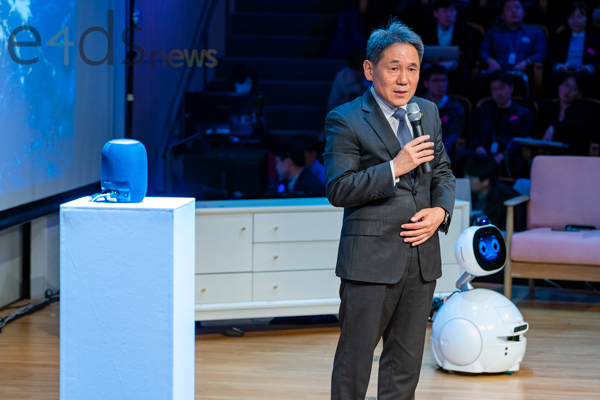
Lee Pil-jae, Executive Vice President and Head of Marketing at KT, stated, “Gigagenie, capable of recognizing Korean, English, Chinese, and Japanese, is receiving high praise overseas,” adding, “KT declares its transformation into an AI company to serve as the foundation for building ‘Korea, an advanced AI nation.’”
At this meeting, KT unveiled its core AI technology as if it were determined. Speech separation and personalized English speech synthesis technologies were particularly impressive, but they did not yet feel fully polished. AI technology in the analysis and judgment domains was not even demonstrated. It appears that more time is needed for domestic companies, including KT, to fully commercialize B2C AI services.
Comments
Related news
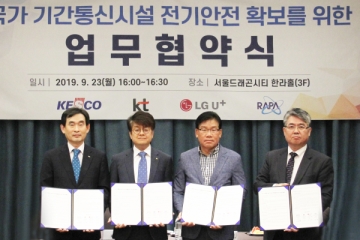
MOU Signed to Secure Electrical Safety in National Key Telecommunications Facilities
The Korea Electrical Safety Corporation, Korea Radio Promotion Association, KT, and LG Uplus have signed a memorandum of understanding to secure electrical safety at national critical telecommunications infrastructure. This agreement was undertaken to ensure stability of electrical facilities at national critical telecommunications infrastructure for preventing communication disasters in the 5G era. The four parties plan to strengthen cooperative relationships for preventing electrical hazards at national critical telecommunications infrastructure and diversify activities to secure electrical safety at national critical telecommunications infrastructure.
2019.09.25by 이수민 기자
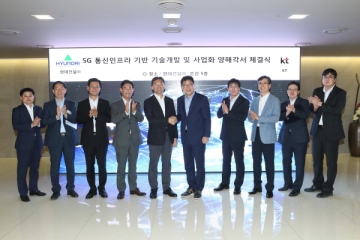
"Automating Construction Sites with 5G": KT Signs MOU with Hyundai E&C
KT and Hyundai Engineering and Construction have announced that they have signed a memorandum of understanding on technology development and commercialization of 5G-based smart construction automation, and agreed to cooperate in developing 5G construction automation technology. Through this MOU, the two companies plan to proceed with technology development for productivity and quality improvement in the 5G-based construction field, development of 5G smart construction technology, development of 5G construction site monitoring technology, and information exchange. Additionally, they plan to establish a working-level task force to rapidly commercialize the developed technologies and achieve digital innovation at construction sites, while continuing 5G collaboration.
2019.10.08by 이수민 기자

KT and Hyundai Mobis Host 5G Connected Car Technology Demonstration
KT conducted a 5G connected car technology exchange demonstration with Hyundai Mobis and Hyundai N Software at Hyundai Mobis's driving test facility located in Seosan, South Chungcheong Province. The Hyundai Mobis Seosan driving test facility spans approximately 340,000 pyeong in total area and includes an advanced driving test facility capable of autonomous vehicle research and development. The event was held to commemorate the completion of the first phase of cooperation between KT and Hyundai Mobis, demonstrate developed technologies, and share cooperation results. The first phase development completion tasks are real-time navigation update technology and C-V2X technology.
2019.10.30by 최인영 기자
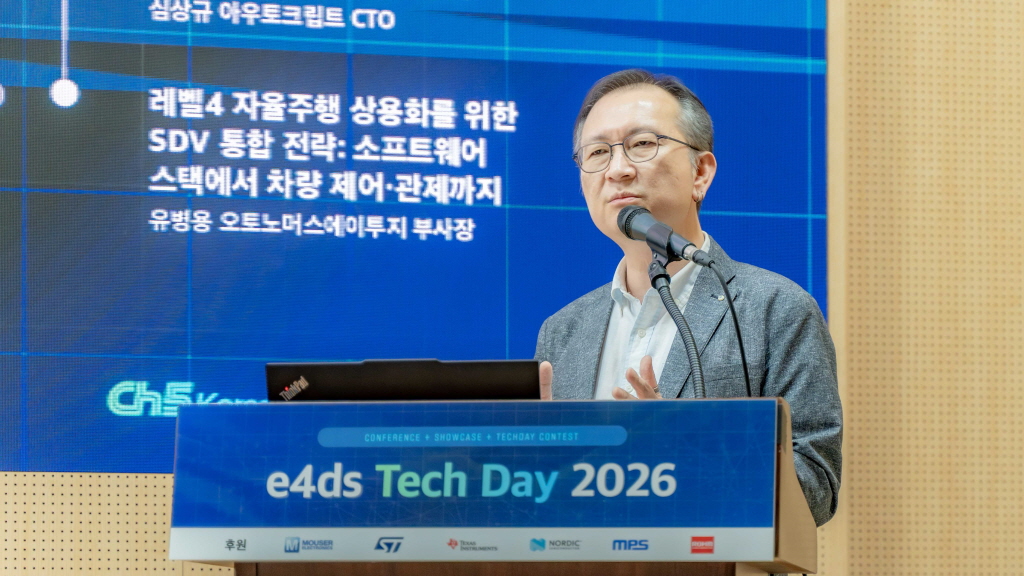
[e4ds Tech Day 2026 ⑨] Sim Sang-gyu, Autocrypt CTO: "In the Physical AI Era, Automotive Security Must Extend Beyond the Vehicle"
At e4ds Tech Day 2026, Sim Sang-gyu, CTO of Autocrypt, explained automotive cybersecurity strategies in the era of Physical AI and SDV (Software-Defined Vehicle). Automobiles are evolving as part of an ecosystem connected to AI, cloud, chargers, IoT, and robots, and he emphasized that the scope of security must expand beyond the vehicle interior to the entire connected environment. In particular, AI model tampering, adversarial attacks, OTA updates, and EV charger hacking were identified as major threats. He explained that response measures require zero trust, AI model integrity protection, intrusion detection, Security by Design and Default, and full lifecycle security management, and that proactive security system establishment beyond regulatory compliance is critical for securing future mobility competitiveness.
2026.10.12by 배종인 기자
NVIDIA to Invest $1 Billion in U.S. Science Over Next Five Years
NVIDIA has announced plans to invest $1 billion over the next five years to strengthen U.S. scientific and technological competitiveness. The company will enhance cutting-edge artificial intelligence research and development capabilities in key areas including quantum computing, healthcare, and energy security, while expanding support for higher education research institutions and cloud service providers. NVIDIA is participating as a major industry partner in the White House Office of Science and Technology Policy's Genesis Mission, and is promoting supercomputer construction in collaboration with national laboratories including Argonne and Los Alamos.
2026.10.12by 배종인 기자











