



Samsung Electronics Hosts 'Samsung AI Forum 2019', Marking Its 3rd Anniversary
 Published2019.11.04 12:33
On-site demonstration of on-device AI interpretation technology, etc.
A poster session for outstanding domestic papers has also been organized.
Samsung Electronics will hold the 'Samsung AI Forum 2019' from the 4th to the 5th.
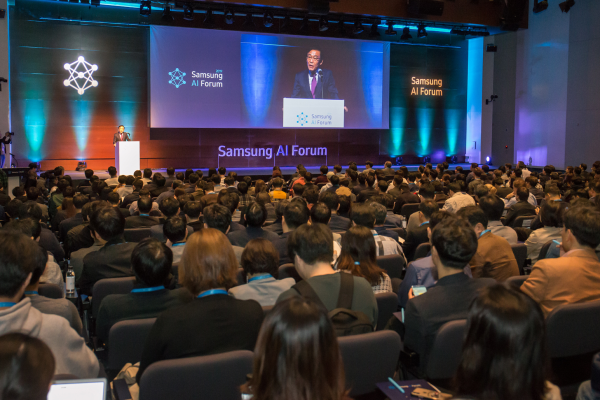
(Photo = Samsung Electronics)
The first day of the Samsung AI Forum 2019 will be held at the Samsung Electronics Seocho Building, hosted by the Samsung Electronics Advanced Institute of Technology, and the second day will be held at the Samsung Electronics Seoul R&D Campus, hosted by Samsung Research.
The Samsung AI Forum, now in its third year, is a venue that invites world-renowned AI scholars to share the latest research trends and explore future innovation strategies.
This year, approximately 1,700 people, including AI experts, professors, and students, are expected to attend.
In his opening remarks, Samsung Electronics Executive Vice Chairman Kim Ki-nam stated, “AI technology is already having a widespread impact on society as a whole,” adding, “I hope that through this forum, we can present the future direction of AI technology development and contemplate strategies that can benefit the world.”
Day 1 of Evolved and Expanded AI Technology Announcements
On the first day of the forum, leading authorities in the field of deep learning participated and presented research achievements in evolved and expanded AI technologies, such as deep learning-based world understanding and autonomous systems.br />
Speakers on the first day of the forum included Professor Yoshua Bengio of the University of Montreal, Canada; Professor Trevor Darrell of UC Berkeley, USA; Professor Kyunghyun Cho of New York University, USA; and Professor Simon Lacoste-Julien of the University of Montreal, Canada, who is also the head of the Montreal AI Lab at Samsung Electronics Advanced Institute of Technology.
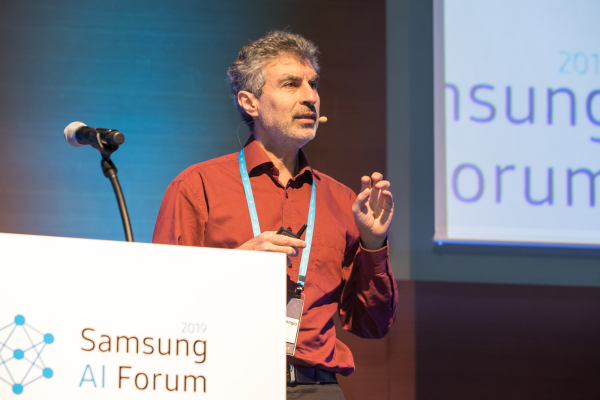
(Photo = Samsung Electronics)
At a seminar titled 'Towards Compositional Understanding of the World by Deep Learning,' Professor Bengio proposed key technologies in the field of deep learning, such as meta-learning and reinforcement learning, that enable AI agents to understand the world, much like a young child comes to understand the world through experience. Meta-learning is a method of training a model that can effectively solve new problems even when they are given.
Professor Darrell gave a lecture on the topic of 'Adapting and Explaining Deep Learning for Autonomous Systems'. He introduced the latest research trends on technology that enables systems, such as autonomous vehicles that plan and operate based on sensor information, to analyze and make decisions on their own when faced with unexpected and complex situations.
At a seminar titled 'Three Flavors of Neural Sequence Generation,' Professor Cho Kyung-hyun proposed techniques to improve sentence generation speed during machine translation, such as parallel decoding and insertion-based generation.
Professor Lacoste-Julien gave a presentation on the topic of "New Perspectives on Generative Adversarial Networks." Generative Adversarial Networks are deep learning algorithms that generate and learn data through competition between a Generator and a Discriminator. He also presented reasons why Generative Adversarial Networks are suitable for high-dimensional data such as images and introduced optimization theories that can resolve the difficulties of training Generative Adversarial Networks.
Samsung Electronics demonstrated deep learning technology on-site. While machine translation was demonstrated in 2017 and end-to-end speech recognition technology in 2018, this year, 'On-Device AI interpretation technology' was introduced, which performs AI functions on the device itself without going through a server.
Day 2 to present distinctive and diverse AI technologies
On the second day, hosted by Samsung Research, you can enjoy various lectures by AI experts from around the world. The keynote speeches will be delivered by Professor Noah Smith of the University of Washington and Professor Abhinav Gupta of Carnegie Mellon University.
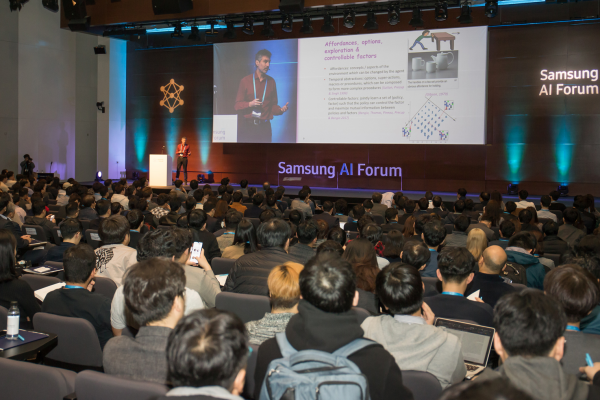
(Photo = Samsung Electronics)
In his keynote address, Professor Smith will present on the topic of "Rational Recurrences for Empirical Natural Language Processing." We will explain the vulnerabilities of existing natural language processing deep learning models and introduce a rational Recurrent Neural Network (RNN) as a new model capable of deep language processing while also being capable of linguistic understanding.
In his lecture "Supersizing and Empowering Visual and Robot Learning," Professor Gupta proposes a large-scale self-visual learning method that overcomes the limitations of existing supervised learning and shares strategies for applying it to future agents.
Professor Vaishak Belle of the University of Edinburgh, UK, introduces a method for integrating human knowledge and data-based learning to apply AI to a wider range of fields in people's daily lives.
Following this, Professor Joan Bruna of New York University will present research findings on Graph Neural Networks (GNNs), which are recognized as a breakthrough technology for the realization of Artificial General Intelligence (AGI), as well as her views on various applications such as personalization.
In the afternoon, two tracks themed 'Vision & Image' and 'On-Device, IoT & Social' will be held simultaneously.
In the Vision and Image track, the following topics are covered: △Projects focused on deep network capabilities to bridge the perception gap between humans and deep learning; △Deep learning-based real-time tracking and synthesis technologies for building realistic 3D telepresence; △Recent research trends and new deep learning-based imaging pipelines to address the limitations of existing mobile device video capture; and △Inferring the overall flow based on a portion of the data and situations from various perspectives.A lecture on AGI-based object recognition and context description technology that can interpret and utilize [it] will be held.
In the On-Device, IoT, and Social tracks, lectures will cover: deep learning technologies that mobile embedded devices must overcome for on-device computing in the era of general artificial intelligence; methods for high-resolution location tracking based on deep learning and Wi-Fi; methods for applying deep learning-based inference and control technologies to solve various problems in 5G and IoT wireless systems; and recent trends in conversational modeling, which is gaining attention in the field of social sciences.
Meanwhile, in addition to lectures by distinguished scholars, this forum also features a poster session showcasing selected outstanding papers from domestic universities and graduate schools chosen by major global academic societies in the field of AI.
Comments
Related news
KT Announces Transformation into an AI Specialist, But AI Services Are Not Yet Commercialized
KT announced its transformation into an AI-specialized company. KT plans to invest 300 billion won over the next four years and cultivate 1,000 AI specialists. KT currently intends to expand its AI business from a home-focused approach to global, industrial·energy, office, and education sectors. The company disclosed approximately 20 AI core technologies across emotion·language, image·behavior, analysis·judgment, and prediction·reasoning domains. KT is committed to contributing to South Korea's AI competitiveness through nurturing AI specialists and expanding AI coding education for elementary and middle school students.
2019.10.30by 이수민 기자

The autonomous vehicle market will grow explosively starting in 2025
Recent advances in AI technology have been significantly driven by deep learning technology. Accordingly, big data based on high-quality data has emerged as an important factor, and major advanced nations are strengthening policy support by incorporating the big data sector into their AI technology development strategies. On the 29th, IRS Global published a report analyzing domestic and international core technology development trends and business analysis for artificial intelligence (AI) in the automotive and robotics sectors. According to the report, AI technology is growing into a core technology that will transform not only industry but human life itself, and the ability to secure and leverage AI technology will now determine the competitiveness of companies, nations, and individuals.
2019.10.30by 이수민 기자

"Analyzing Video with AI Following Voice" Xilinx and SKT Strengthen Cooperation in AI Inference
To realize AI-based physical unauthorized access detection, it is necessary to monitor millions of commercial and residential camera systems in real time. For this, fast and accurate AI accelerators are required. Xilinx announced that its data center accelerator card is used in SK Telecom's unauthorized access detection service 'T-View'. This marks the third instance of SK Telecom using Xilinx's FPGA-based accelerator card in its services, following the ASR-based AI speaker Nugu and call center SST solution. Xilinx's Alveo U250 data center accelerator card is mounted on SK Telecom's AI inference accelerator AIX and runs on SK Telecom's data center servers.
2019.11.01by 이수민 기자
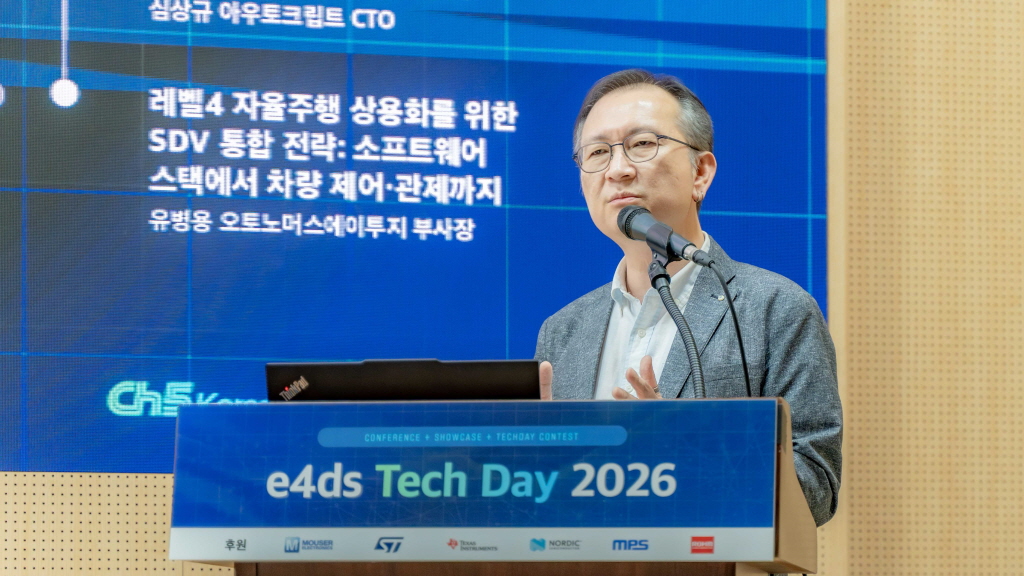
[e4ds Tech Day 2026 ⑨] Sim Sang-gyu, Autocrypt CTO: "In the Physical AI Era, Automotive Security Must Extend Beyond the Vehicle"
At e4ds Tech Day 2026, Sim Sang-gyu, CTO of Autocrypt, explained automotive cybersecurity strategies in the era of Physical AI and SDV (Software-Defined Vehicle). Automobiles are evolving as part of an ecosystem connected to AI, cloud, chargers, IoT, and robots, and he emphasized that the scope of security must expand beyond the vehicle interior to the entire connected environment. In particular, AI model tampering, adversarial attacks, OTA updates, and EV charger hacking were identified as major threats. He explained that response measures require zero trust, AI model integrity protection, intrusion detection, Security by Design and Default, and full lifecycle security management, and that proactive security system establishment beyond regulatory compliance is critical for securing future mobility competitiveness.
2026.10.12by 배종인 기자
NVIDIA to Invest $1 Billion in U.S. Science Over Next Five Years
NVIDIA has announced plans to invest $1 billion over the next five years to strengthen U.S. scientific and technological competitiveness. The company will enhance cutting-edge artificial intelligence research and development capabilities in key areas including quantum computing, healthcare, and energy security, while expanding support for higher education research institutions and cloud service providers. NVIDIA is participating as a major industry partner in the White House Office of Science and Technology Policy's Genesis Mission, and is promoting supercomputer construction in collaboration with national laboratories including Argonne and Los Alamos.
2026.10.12by 배종인 기자











