


"Data is more valuable than oil": Why manufacturing needs to become smart
 Published2019.12.03 17:59
To win the competition, smart manufacturing must be realized
Data is a resource greater than oil, depending on how it is utilized.
"What will happen if we don't do smart manufacturing?"
The 'Smart Manufacturing Best Practice Conference 2019,' hosted by the Korea Smart Manufacturing Industry Association (KOSMIA) and the Electronics and Telecommunications Research Institute (ETRI), was held on November 21 at Hall E of COEX in Samseong-dong, Seoul.
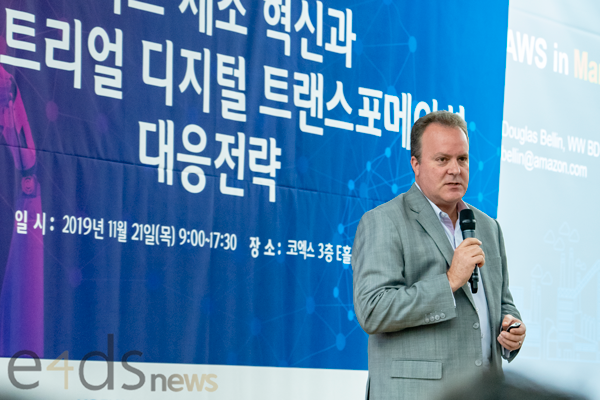
(Photo by Reporter Lee Su-min)
The keynote speech at this conference, held under the theme of 'Advanced Smart Factory Strategies in Response to Smart Manufacturing Innovation and Industrial Transformation,' was delivered by Douglas Bellin, Head of Smart Factory Business Development at Amazon Web Services (AWS).
General Manager Bellin delivered a speech on the topic of "The Digital Role in Smart Manufacturing," stating that we must ask the question, "What will happen if we don't start?" His point was that smart manufacturing is now unavoidable.
The reason we must realize smart manufacturing lies in reality. The challenges include a shortage of manpower and connectivity between equipment, cybersecurity threats, and the rise of emerging markets.
To attract the workforce learning cutting-edge technologies such as AI, big data, machine learning, and IoT to the manufacturing sector, these technologies must be applied to production. Although the commercialization of 5G networks has begun in earnest, there are still many unconnected devices. Furthermore, due to cybersecurity concerns, they cannot be connected indiscriminately.
Demand in emerging markets differs from that of established markets. They have different tastes and require different products. Companies must be able to respond immediately to this demand to win in competition with other firms.
Smart manufacturing can be the key to solving the above problems.
New Manufacturing Trend: "Data is More Than Oil"
General Manager Bellin highlighted the changing value of data as a resource as the first of the shifting trends in the manufacturing industry. He stated that "Data is now more than the New Oil." While oil can only be used once, the value of data increases with use. The manufacturing industry produces more data than any other sector, yet consumes the least.
The second is 'Digitally “Executed” Manufacturing'. It means that we need to move beyond understanding the production line situation through data and instead require automation capabilities where robots produce autonomously.
The third is 'Product-as-a-Service,' which means that equipment is no longer purchased with an upfront payment, but rather usage fees are paid based on results. The fourth is transforming everything within the factory into 'Connected Products,' and the fifth is improving production 'Sustainability' through data-driven initiatives.
Manufacturing Industry Challenges
To keep up with or lead new manufacturing trends, manufacturing transformation must be implemented. There are eight challenges that the manufacturing industry must address in this process.
The first is ▲Responding to Business Demands, which involves cultivating the ability to respond appropriately to the changed market environment. The second is securing capabilities to meet the increasing need for ▲24x7x365 Operations. The third is the introduction of solutions tailored to the respective ▲Asset Lifecycles of the numerous assets within the factory. The fourth is ▲Enabling the Workforce, which involves strengthening the capabilities of employees who must operate the smart factory.
The fifth is the strengthening of ▲Protecting and Security IP capabilities for connected assets. The sixth is ▲Unleashing Data and Bringing Insight for appropriate ▲Data disclosure and insights for executives and partners. The seventh is the efficient implementation of global and regional collaboration, and the eighth is cost reduction, which is humanity's eternal aspiration.
These eight challenges can be solved with several advanced technologies. These include big data analysis, automation and robotics, cloud-based manufacturing simulation, IIoT, cybersecurity, AR, vertical and horizontal integration, and 3D printing. If these technologies are utilized effectively, smart products and services will be launched in smart factories in the future.
A new paradigm based on cloud computing
Many companies know that data is generated in factories, but they do not know how to obtain it. This is possible with a cloud-based data platform. Processes, workers, and equipment upload production data to the platform, while customers and the market upload consumption data.
If data is analyzed through a data platform, processes are optimized and workers become skilled faster. Equipment status is shared in real-time, making maintenance easier. Sharing is also possible via a smartphone application.
Customers can suggest desired product forms through a smartphone application, and market feedback on released products is also accumulated. When factories utilize this, it becomes easier to improve product quality and launch new products that better suit customer preferences.
Factories of the past were designed for isolation and optimization. Therefore, data existed only within the factory. The factory of the future is different.
By sharing data with suppliers of materials, parts, and equipment, proactive measures can be taken to prevent production disruptions. Interactions between humans and machines, machines and humans, and machines and machines are also enhanced, which can improve work efficiency. It is also possible to integrate factory environments with different protocols, software levels, and languages while collecting and converting data.
Smart Manufacturing as Seen Through the Case of a Paper Company
General Manager Bellin cited the cases of Georgia-Pacific and Valmet. In particular, the U.S. paper company Georgia-Pacific is using AWS to optimize processes and save millions of dollars annually.
More than 150 Georgia Pacific plants across North America produce hundreds of paper and toilet paper parent rolls daily. If these parent rolls are not produced uniformly, it can cause problems when they are converted into retail products. Stopping production lines for reasons such as replacing parent rolls can result in millions of dollars in annual losses.
Georgia Pacific decided to create a cloud-based analytics solution to solve this problem.
During the first six months of adopting AWS, Georgia Pacific transmitted over 50 TB of production data generated from more than 150 factories to AWS. Through Amazon Kinesis, they were able to collect and analyze structured and unstructured data by streaming real-time data from manufacturing equipment to a central data lake based on Amazon S3 (Simple Storage Service).
Georgia Pacific used Amazon EMR (Elastic MapReduce) to transform data before delivering it to data analysts in a structured manner via Amazon Redshift. The analyst queried raw data containing various manufacturing information using Amazon S3 and Amazon Athena.
In addition, Georgia Pacific built machine learning models using the machine learning solution Amazon SageMaker to train employees and deploy them in the factory. Using machine learning models built with raw production data, Amazon SageMaker provided real-time feedback to equipment operators regarding optimal machine speeds and other adjustable variables, enabling less experienced operators to detect breakdowns early and maintain quality.
By leveraging data in this way, Georgia Pacific was able to reduce losses by one million dollars at each plant. In addition, it was able to efficiently utilize the entire organization's talent pool while reducing its reliance on a small number of experienced workers.
The first step is important.
You must propose a business plan to management based on a single selected implementation case. For smart factories, the start comes first. There is no longer the luxury of grasping every single implementation case before beginning. Once you start, you must first build a small team. General Manager Bellin advised following Amazon's "Two Pizza Rule." This means forming a team with only enough personnel to make do with two pizzas.
All team members must participate in every process for success and share the same goal. Furthermore, you should proceed with the mindset of a 3- to 6-week project, rather than a 3-year one. It may not be perfect. Reviewing the completed project allows you to identify areas that need fixing. Then, you start the project again. Innovation is sustained through rapid iteration. At the same time, you must always keep in mind how to expand the project.
Concluding his keynote speech, General Manager Bellin stated that to build a smart factory and realize smart manufacturing, one must simply start. He emphasized, “People ask which project should be done first, but that is the wrong question,” adding, “You should ask, ‘What will happen if you don’t start?’”
Rather than following successful examples, it is most important to build a system tailored to your own company.
Comments
Related news
The 1st Smart Factory Construction and Production Automation Exhibition closes on the 22nd
The 1st Smart Factory Construction and Production Automation Exhibition, Smartec 2019, concluded after a four-day run. The exhibition, which brought together 130 companies with 340 booths, was held alongside various supporting events including a Smart Factory Conference on the 20th and seminars on new products and technologies by participating companies on the 21st and 22nd. At the conference held on the 20th, experts from various fields of smart factory construction took the stage as speakers to discuss the current state and future of smart factories.
2019.11.22by 이수민 기자
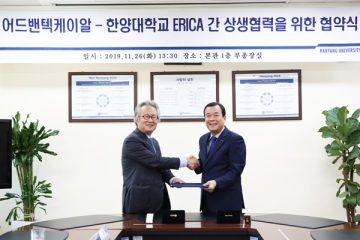
Advantech and Hanyang University ERICA Sign MOU for IIoT Industry-Academic Cooperation
Advantech Korea and Hanyang University's ERICA Campus have signed a Memorandum of Understanding for industry-academia cooperation in the fields of IoT and smart factory. Through this business collaboration, Advantech and Hanyang University ERICA will pursue mutual cooperation by leveraging their respective human resources and infrastructure to foster talent development in the IoT and smart factory fields, as well as to promote educational programs and projects.
2019.11.27by 이수민 기자
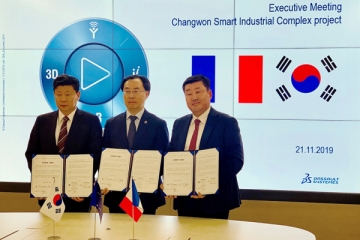
Gyeongsangnam-do Province to Become a Smart Manufacturing Outpost? It signed a smart factory business MOU with France's Dassault Systèmes.
Dassault Systèmes has signed an MOU with Gyeongsan-gnam Province to advance the ICT industry and promote the dissemination and expansion of smart factories in the region. Dassault Systèmes plans to establish a Gyeongnam headquarters and relocate partner companies, and will support not only the promotion and expansion of smart factories but also the global smart factory market entry of ICT supply companies in the province.
2019.11.27by 이수민 기자

Korea Instrument, KOLAS Accredited Calibration Agency First to Simultaneously Acquire ISO/IEC 27,001·27,701
Korea Instrument has become the first among KOLAS accredited calibration agencies to simultaneously acquire ISO/IEC 27,001 and ISO/IEC 27,701 certifications. Through its proprietary platforms CWIZ Enterprise and CWIZ Partners, the company has embedded information security and personal data protection requirements across all business processes including customer information, equipment data, and calibration reports, with plans to continuously advance its management system through regular audits and security inspections.
2026.10.12by 배종인 기자

TeamViewer One, IT Incident Automation Workflow and Resolution Center Enhanced
TeamViewer has added IT incident automation capabilities and an advanced Resolution Center to its integrated digital workplace management platform 'TeamViewer ONE'. Recurrent service disruptions, configuration errors, and capacity shortages are automatically handled according to preset policies, and device status verification through script deployment can be managed in a unified interface, significantly reducing repetitive tasks for IT teams.
2026.10.12by 배종인 기자











