



ADAS-based Mobileye Connect enhances city safety.
 Published2019.12.09 13:36
Building AI-based driving data city infrastructure
Intel Mobileye has released data from the first two months of its Autonomous Ready initiative in collaboration with Spain's road safety authority, the Directorate General of Transport (DGT) and the City of Barcelona.
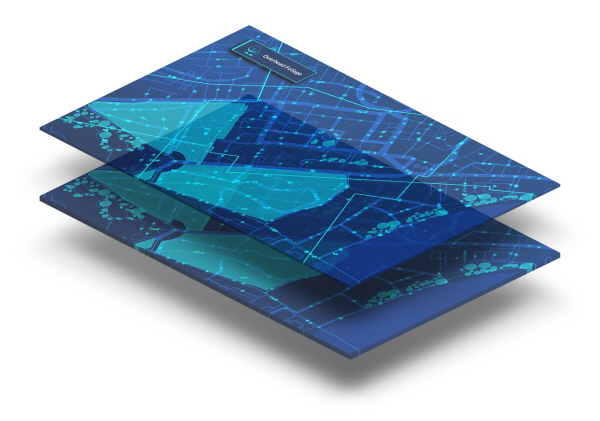
▲ Mobileye data hierarchy <Image = Intel>
The Autonomous Ready project aims to improve road safety by continuously improving roads and analyzing the condition of infrastructure. The City of Barcelona and the Department of Transport are using Mobileye's advanced driver assistance technology to achieve immediate and long-term improvements in urban safety.
We improve vehicle safety by utilizing vehicles that travel at high frequencies, while improving infrastructure through analysis of the most accident-prone areas.
Nearly 400 vehicles in 12 locations are equipped with Mobileye's ADAS system, Mobileye 8 Connect, powered by EyeQ4, and the vehicles drive 45,000 kilometers (28,000 miles) every day, transmitting data captured by their onboard cameras to the cloud.
In the first two months of testing, 240,000 pedestrians and 37,000 cyclists were identified, and vehicles equipped with this feature were able to prevent 668 high-risk collisions by sending safety alerts to drivers. There was.
The city of Barcelona is working with public-private partnerships to expand this project to urban vehicles, offering various benefits for parking, access, loading and unloading.
Barcelona officials also aim for the project to become a model for cities across Spain and around the world by ensuring participating vehicles are prepared for EU regulations mandating advanced driver assistance systems (ADAS) from 2022.
This project aims to reduce traffic accidents in Barcelona by equipping hundreds of thousands of vehicles with Mobileye's collision avoidance radar warning devices and mapping technology to make the city safer.
Here, Barcelona's roads are manually surveyed and analyzed, and the data is transmitted to the cloud to improve urban infrastructure and enhance street safety.
As the vehicle travels its usual route through the streets of Barcelona, its on-board cameras collect anonymous information about roadside infrastructure, including external data such as accident history and weather information.
The aggregated data forms the basis for artificial intelligence technologies that detect potential hazards and uncover hidden issues that pose risks during movement. Sensors are increasingly collecting information to understand behavioral patterns in everyday traffic situations where vehicles, bicycles, and pedestrians coexist, and are used to develop a deeper understanding of a city's risk profile.
As a result, city streets become safer, and infrastructure improvements based on evidence-based data contribute to providing a safe and efficient mobility environment.
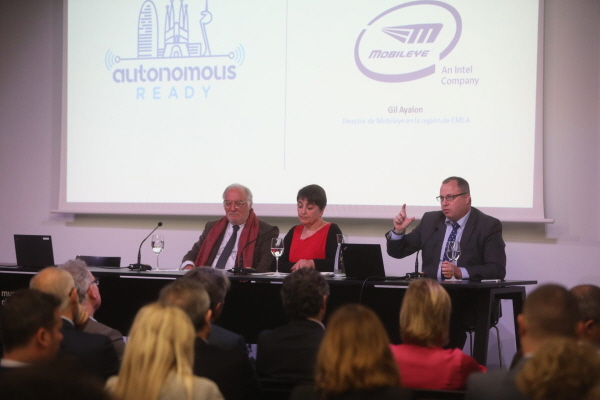
▲ Gil Ayalon, Mobileye Europe, Middle East and Africa Regional Director, attending the Barcelona Autonomous Ready Initiative launch event <Photo = Intel>
“Safety is our top priority, and we continue to invest in the development of technologies that protect the most vulnerable road users and lay the foundation for autonomous vehicles of the future,” said Gil Ayalon, Mobileye’s regional director for EMEA. “This technology is available to any city official who wants to make streets safer, and Spain is leading the way in adopting innovative technologies through its Autonomous Ready initiative, establishing itself as a global leader in road safety and mobility.”
Meanwhile, Intel projects that the number of vehicles equipped with Mobileye will reach 1,000 by 2020 and 5,000 within three years.
Comments
Related news
ON Semiconductor Unveils Scalable Image Sensor for Autonomous Driving
ON Semiconductor has announced an extensible CMOS image sensor product family that can be broadly applied to advanced driver assistance systems (ADAS) and autonomous driving-related applications. This new sensor product family, based on a common platform and functions, enables automotive manufacturers and major suppliers to design powerful imaging devices. The newly introduced sensors from ON Semiconductor offer resolutions ranging from a minimum of 1.2 MP (megapixels) to a maximum of 8.3 MP, delivering industry-leading low-light performance through large pixels of 4.2 μm. Additional features include functional safety up to ASIL-C rating, HDR (High-Dynamic Range), an industry-first cyber security option, and second-generation wafer stacking technology that reduces package size. Currently, multiple technology partners are conducting individual product testing within this platform, and Mobileye and NVIDIA are undergoing compatibility testing with their respective DRIVE AI computing platforms for autonomous vehicles.
2018.01.09by 김지혜 기자
Mobileye commercializes electric vehicle MaaS in Israel.
Intel subsidiary Mobileye, Volkswagen Group, and Champion Motors announced that they will introduce Israel's first autonomous vehicle hailing service in 2019. Mobileye plans to provide the Level 4 AV Kit, a turnkey complete autonomous driving solution consisting of hardware, driving policy, safety software, and map data.
2018.11.01by 이수민 기자
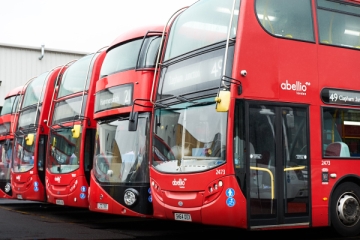
Mobileye Reduces London Bus Collision Rate by 29% with Collision Avoidance Technology
Abelio London, one of London's major bus operators, has initiated a pilot program to validate the safety technology of Mobileye, an Intel subsidiary. The pilot program focuses on reducing collisions between buses and bicycles, motorcycles, pedestrians, and other road users. According to results obtained to date, the Mobileye collision avoidance technology has achieved a 29% reduction in collisions, with injuries from such collisions reduced by 60%.
2018.11.22by 이수민 기자

Technology Standards Forum to Promote Commercialization of Autonomous Vehicles Held
The National Institute of Standards and Technology under the Ministry of Trade, Industry and Energy held a plenary session of the autonomous vehicle standardization forum. At the plenary session, domestic R&D achievements were shared to implement standards-related initiatives of the future vehicle industry development strategy established by the ministry. Additionally, international standards candidate projects that could become global standards were identified and discussed.
2019.11.27by 이수민 기자
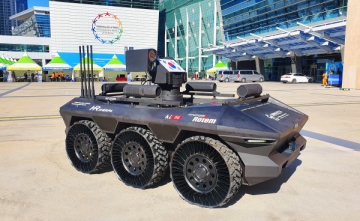
KT and Hyundai Rotem Unveil 5G-Based Autonomous Driving Technology
KT and Hyundai Rotem unveiled the '5G HR-Sherpa,' a 5G-based multipurpose unmanned vehicle, at the Korea-ASEAN Special Summit, receiving recognition for their 5G and autonomous vehicle technology capabilities. To accelerate 5G autonomous driving, the two companies plan to advance their technology by expanding the application of remote and autonomous driving technology based on 5G-V2X.
2019.11.27by 최인영 기자











