



Xilinx Announces Machine Learning Capabilities Targeting the Broadcast Market
 Published2020.02.11 14:29
Xilinx announced on the 11th that it has added machine learning capabilities to its devices targeting the professional audio/video (Pro AV) and broadcast markets. Additionally, a programmable HDMI 2.1 demo implemented on a 7nm Versal device was unveiled.
.png)
Xilinx's adaptive solutions, unveiled at Integrated Systems Europe (ISE) 2020 in Amsterdam, the Netherlands, from February 11-14, are designed to help customers address new usage models and evolving industry standards, reduce costs, and effectively future-proof their investments.
Machine learning capabilities for AI edge processing
Machine learning capabilities offered by Xilinx for pro AV and broadcast platforms include region-of-interest encoding, intelligent digital signage, automatic object tracking, window cropping, and speech recognition.
Customers can leverage these machine learning capabilities on Xilinx devices, including the Zynq UltraScale+ MPSoC platform for AI edge processing. Users can integrate real-time AV processing, AV connectivity interfaces, codecs, IP networking, CPUs, and GPUs into a scalable, adaptable, single-chip solution, reducing space, power, and cost.
Customers in the pro AV market can apply new machine learning capabilities to a variety of applications and workloads. Key examples include:
Region of Interest Encoding - Leveraging the Zynq UltraScale+ MPSoC with integrated machine learning and H.264/H.265 codecs, face and feature detection can be used to enhance video quality in those areas and apply higher compression rates to the background. This reduces overall bitrate and significantly reduces the cost of live streaming.
Intelligent Digital Signage - Machine learning models for gender, age, and gesture detection can be used to display targeted interactive ads on digital signage. This not only measures monetizable behavior but also increases advertisers' return on investment.
Automatic object tracking and window cropping - Use machine learning to output multiple HD windows from a single 4K camera. This is useful for providing switchable live event content in the control room.
Speech recognition - Automatically converts speech to text, making it ideal for taking meeting notes for conferences and collaborations, and automatically processing language translations.
First HDMI 2.1 implementation on a 7nm device
At ISE 2020, Xilinx will demonstrate programmable HDMI 2.1 on its 7nm Versal devices, an Adaptive Compute Acceleration Platform (ACAP). ACAP is a heterogeneous computing device that surpasses the performance of existing CPUs, GPUs, and FPGAs.
HDMI 2.1, which provides data transfer rates of up to 48 Gbps, supports a variety of high-resolution video and high-frame rates, including 8K60 and 4K120.
This enables more vivid visuals in fast-moving video-based applications such as LED walls, large displays, digital signage, and live sports. The Versal ACAP can transmit, receive, and process up to 8K UHD video.
The 7nm Versal ACAP delivers scalable, adaptable, and intelligent engines through a software-programmable infrastructure that tightly couples embedded software with multi-channel AV processing pipelines and AI inference.
Additionally, by integrating real-time video processing and AV connectivity interfaces, codecs, IP networking, CPUs, GPUs, and more into a single-chip solution, space, power, and cost can be reduced.
Comments
Related news
NXP Announces Deep Learning Toolkit for Next-Generation Automotive Development
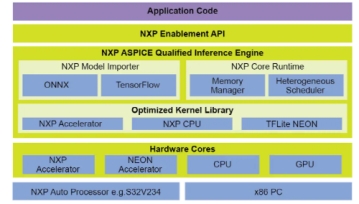
NXP Semiconductors announced the launch of eIQ Auto, a deep learning toolkit for automotive applications, expanding its eIQ machine learning product portfolio. The toolkit aims to enable customers to rapidly transition from development environments to deployment of AI applications that meet stringent automotive standards.
2019.10.10by 명세환 기자
AI Implementation in Mid-Range Devices, Arm Announces 4 ML-Optimized IP Products
As market demand for AI increases, machine learning implementation is expanding not only in high-end devices but also in mid-range devices with limited resources. Arm has announced four new processor IP products to prepare for the AI era. On the 12th, Arm held "Arm Tech Symposia 2019" with the theme "The New Era of Compute" at the Intercontinental Seoul COEX Hotel. In the keynote speech, Jem Davies, Vice President and Head of Arm ML Division, introduced the 'Ethos-N57' and 'Ethos-N37' NPUs optimized for AI applications, the 'Mali-G57' GPU designed based on the Valhall architecture, and the 'Mali-D37' DPU suitable for small displays.
2019.11.12by 이수민 기자
.jpg)
What are the top eight enterprise technology trends for 2020?
Enterprise software specialist VMware announced eight key enterprise technology trends to watch in 2020. By keyword, these include hybrid applications, unified edge solutions, specialized hardware remote support, intrinsic security, compact devices, machine learning, cloud segregation, and shared service platforms.
2019.12.26by 최인영 기자

[e4ds Tech Day 2026 ⑨] Sim Sang-gyu, Autocrypt CTO: "In the Physical AI Era, Automotive Security Must Extend Beyond the Vehicle"
At e4ds Tech Day 2026, Sim Sang-gyu, CTO of Autocrypt, explained automotive cybersecurity strategies in the era of Physical AI and SDV (Software-Defined Vehicle). Automobiles are evolving as part of an ecosystem connected to AI, cloud, chargers, IoT, and robots, and he emphasized that the scope of security must expand beyond the vehicle interior to the entire connected environment. In particular, AI model tampering, adversarial attacks, OTA updates, and EV charger hacking were identified as major threats. He explained that response measures require zero trust, AI model integrity protection, intrusion detection, Security by Design and Default, and full lifecycle security management, and that proactive security system establishment beyond regulatory compliance is critical for securing future mobility competitiveness.
2026.10.12by 배종인 기자
NVIDIA to Invest $1 Billion in U.S. Science Over Next Five Years
NVIDIA has announced plans to invest $1 billion over the next five years to strengthen U.S. scientific and technological competitiveness. The company will enhance cutting-edge artificial intelligence research and development capabilities in key areas including quantum computing, healthcare, and energy security, while expanding support for higher education research institutions and cloud service providers. NVIDIA is participating as a major industry partner in the White House Office of Science and Technology Policy's Genesis Mission, and is promoting supercomputer construction in collaboration with national laboratories including Argonne and Los Alamos.
2026.10.12by 배종인 기자











