



Support for "marketability verification" to increase the success rate of "laboratory startups"
 Published2020.02.24 15:25
98 science and engineering startup teams scheduled to be supported in 2020
New initiatives for domestic education and overseas specialized types
On the 24th, the Ministry of Science and ICT announced that it has established an implementation plan for the 2020 Public Technology-based Market-Linked Startup Exploration Support Project to promote laboratory startups and will select new recipients of support.

Announcement of Selection for New Recipients of Market-Linked Startup Exploration Support Program
According to a report released by CB Insights in November 2019, the biggest reason for startup failure was a 'market without demand'.
In particular, to increase the success rate of technology startups, it is necessary to verify the market demand and suitability of the technology and to go through a process of supplementing and modifying the business model (BM) (pivoting).
To this end, the Ministry of Science and ICT has been promoting a startup exploration education program since 2015 in conjunction with the National Science Foundation (NSF) to support young researchers who wish to start a business based on research results from universities or government-funded research institutes, enabling them to improve their business models based on market research through interviews with potential customers.
Over the four years since 2015, this program supported 161 startup teams, resulting in the establishment of 82 (51%) startups, the creation of 400 jobs (an average of 4.9 per company), and 10.535 billion We succeeded in attracting investment from Won.
Last year, 59 out of 70 startup teams (84.3%) that applied were pivoting their business models or preparing to start a business.
This year, the eligibility criteria were expanded from undergraduate or graduate students in science and engineering to include postdoctoral researchers and researchers at government-funded research institutes, and the number of supported teams was increased from the existing 70 to 98.
Startup incubation centers will be established in the Honam and Southeast regions, which have historically lacked support for startup exploration, to resolve regional disparities. Additionally, new domestic and overseas-specialized startup exploration education programs will be launched to reflect the diverse educational needs of startup teams.
The domestic education type is an entrepreneurship exploration education program that applies the NSF entrepreneurship education methodology and targets startup teams hoping to start a business in Korea. Over the past three years since 2016, a domestic instructor training program has been implemented, training 26 instructors, who are scheduled to participate in this year's domestic education program.
The Overseas Specialized Type is being piloted for the first time this year as a project that supports startup teams hoping to launch or commercialize businesses in the U.S. through startup mentoring programs and market expansion, based on an already established local public technology commercialization network.
The call for proposals runs until the end of March, and selections are made by May. Education and childcare continue until February of the following year after selection. Further details about the project can be found in the project announcements on the websites of the Ministry of Science and ICT and the National Research Foundation of Korea .
Comments
Related news
.jpg)
Ministry of Science and ICT Supports SMEs' Overseas Expansion of 5G Networks
The Ministry of Science and ICT held a roundtable discussion with related small and medium-sized enterprises to vitalize 5G network equipment and components, and shared policies including methods for collecting overseas local information, support for 5G equipment testing and verification, and preferential treatment through 5G trade insurance. The Ministry plans to communicate news of supporting SMEs' overseas expansion through the Korea Network Industry Association.
2020.02.04by 최인영 기자
Ministry of Science and ICT Holds Meeting of ICT Sector Response Team Regarding Novel Coronavirus Infection
Jang Seok-young, Vice Minister of Science and ICT, chaired a meeting of the ICT Response Task Force at the KAIT conference room with ICT industry associations and organizations, as well as key related agencies, to review the current situation regarding COVID-19 and establish a response system. Vice Minister Jang stated that an ICT industry support system will be established to enable rapid responses at the association and organization level when industry difficulties arise due to COVID-19, and that relevant measures will be devised to ensure that government support can be implemented in a timely manner.
2020.02.06by 이수민 기자
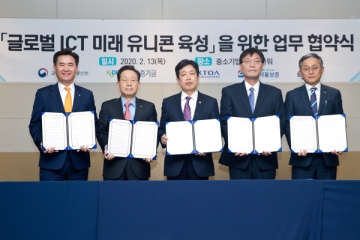
The Ministry of Science and ICT has launched a program to foster future unicorns in the ICT sector.
The Ministry of Science and ICT announced that it has signed a memorandum of understanding with four organizations—Korea Credit Guarantee Fund, Korea Telecommunications Business Association, Seoul Guarantee Insurance, and Born to Global Center—to promote ICT GROWTH, a global ICT future unicorn nurturing program. The ICT GROWTH program aims to create an ecosystem and establish a support system capable of fostering high-growth ICT companies by combining government and private resources. The plan is to select approximately 15 companies annually starting this year, with a total of 50 companies to be selected and supported by 2025.
2020.02.17by 이수민 기자
Nvidia invests $5 billion in Intel
NVIDIA and Intel, leaders in global AI computing technology, are now forging ahead in providing cutting-edge solutions through NVLink-based architecture integration. NVIDIA and Intel have officially announced a strategic partnership and stated that they will jointly develop customized data center and personal computing products to accelerate diverse applications and workloads ranging from hyperscale to enterprise and consumer markets, thereby laying the foundation for the next generation computing era.
2025.09.22by 배종인 기자
.jpg)
Applied Materials Launches Environmental Protection Campaign to Mark World Cleanup Day
Applied Materials Korea (CEO Park Kwang-seon) is carrying out environmental cleanup activities with employees and their families around the Dongtan Sinricheon area on the occasion of World Cleanup Day, evolving into a company that engages with the local community beyond technological innovation.
2025.09.22by 명세환 기자











