


AI Talent Demand Higher in Non-IT Departments
 Published2020.03.19 11:27
AI Talent Utilization Increases in Marketing, Sales, Customer Service, Finance, and R&D Departments
Over the past four years, it has been found that departments seeking talent with AI technical capabilities are more often from other business units rather than the IT field.
According to Talent Neuron data released by Gartner on March 19, AI talent demand in IT departments increased three-fold from 2015 to 2019, but when compared with other business units, this fell short of even half the level, according to the compilation.
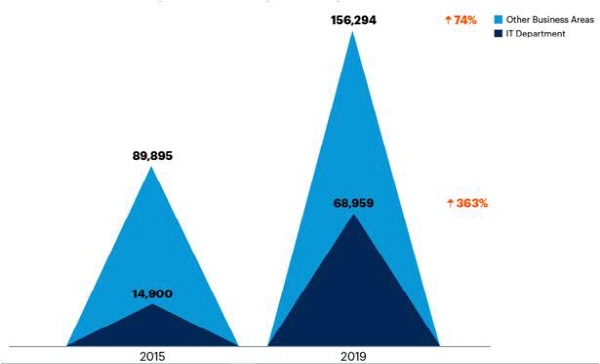
▲ Total AI Job Openings Posted from July 2015 to March 2019 in Top 12 GDP Countries
Departments recruiting AI talent on a large scale include ▲marketing ▲sales ▲customer service ▲finance ▲research and development, and these business units were utilizing AI talent for ▲customer churn modeling ▲customer profitability analysis ▲customer segmentation ▲cross-sell and upsell recommendations ▲demand planning ▲risk management and others.
A significant portion of AI use cases were being utilized in asset-intensive industries supporting projects such as predictive maintenance, workflow and production optimization, quality management, and supply chain optimization.
In these departments, there were many cases where AI talent was directly recruited with clear use cases in mind, which allows data scientists and others to learn complex matters in specific business areas while maintaining close alignment with the deployment and utilization of their work results.
Peter Krenskey, Gartner Research Director, stated, "High demand and fierce labor markets have increased the competitiveness of candidates with AI technical capabilities, but organizations' recruitment techniques and strategies have not kept pace with this," and added, "Respondents participating in Gartner's recently released AI and ML Development Strategy research report cited employee skill levels as the maximum challenge or barrier to AI and machine learning adoption."
He continued, "Given the complexity, novelty, and multidisciplinary nature of AI, along with its potentially tremendous impact, CIOs and HR leaders must consider what capabilities AI specialists should possess from their first day of work and analyze evaluation criteria for candidates that approach hiring requirements." He further stated, "CIOs must think creatively about IT's role and activities in overseeing and supporting various AI initiatives and teams leading those activities."
Meanwhile, additional analysis regarding AI talent trends is scheduled to take place at the Gartner IT Symposium & Expo 2020.
Comments
Related news
Can 256GB of ultra-large data processing in the AI era become a reality with FPGA accelerators?
Recent strength in the mobile market has led to an expansion in investment scale for data center servers. As technology enabling multiple users to simultaneously use various applications without latency gains attention, data transmission and reception of 256GB/s is expected to be realized by 2022. We heard from a current Intel engineer about methods to optimize server performance in preparation for the PCIe Gen6 era.
2020.03.17by 최인영 기자

Preemptive strike on the global market by expanding investment in DNA and Big 3 sectors
In accordance with amendments to the Data Act, the Ministry of Science and Technology Information and Communications is strengthening support for the data collection and utilization ecosystem while pursuing advancement in 5G and AI converged services and future vehicle technologies, as well as securing global competitiveness in the system semiconductor sector. The government will inject 24 trillion won in research and development budget to accelerate innovation infrastructure and growth of three major new industries.
2020.03.12by 최인영 기자

First Implementation of AI Voucher Program Across All Industries
An AI voucher support program will be implemented for the first time this year, targeting small and medium-sized enterprises, venture companies, and startups looking to adopt AI technology, enabling them to utilize AI solutions and services. Support of up to 300 million won per company is planned, with the program structured so that companies seeking to apply AI technology purchase products from companies that provide AI solutions or services.
2020.03.16by 이수민 기자
[e4ds Tech Day 2026 ⑨] Sim Sang-gyu, Autocrypt CTO: "In the Physical AI Era, Automotive Security Must Extend Beyond the Vehicle"
At e4ds Tech Day 2026, Sim Sang-gyu, CTO of Autocrypt, explained automotive cybersecurity strategies in the era of Physical AI and SDV (Software-Defined Vehicle). Automobiles are evolving as part of an ecosystem connected to AI, cloud, chargers, IoT, and robots, and he emphasized that the scope of security must expand beyond the vehicle interior to the entire connected environment. In particular, AI model tampering, adversarial attacks, OTA updates, and EV charger hacking were identified as major threats. He explained that response measures require zero trust, AI model integrity protection, intrusion detection, Security by Design and Default, and full lifecycle security management, and that proactive security system establishment beyond regulatory compliance is critical for securing future mobility competitiveness.
2026.10.12by 배종인 기자
NVIDIA to Invest $1 Billion in U.S. Science Over Next Five Years
NVIDIA has announced plans to invest $1 billion over the next five years to strengthen U.S. scientific and technological competitiveness. The company will enhance cutting-edge artificial intelligence research and development capabilities in key areas including quantum computing, healthcare, and energy security, while expanding support for higher education research institutions and cloud service providers. NVIDIA is participating as a major industry partner in the White House Office of Science and Technology Policy's Genesis Mission, and is promoting supercomputer construction in collaboration with national laboratories including Argonne and Los Alamos.
2026.10.12by 배종인 기자











