



IRS Global Releases Market and Technology Trends Report for Smart Manufacturing Factories
 Published2020.03.20 14:39
To address current manufacturing challenges, IRS Global published a report titled "Manufacturing Innovation in the Fourth Industrial Revolution: Market and Technology Standardization Analysis and Response Strategies for Smart Manufacturing and Smart Factories."
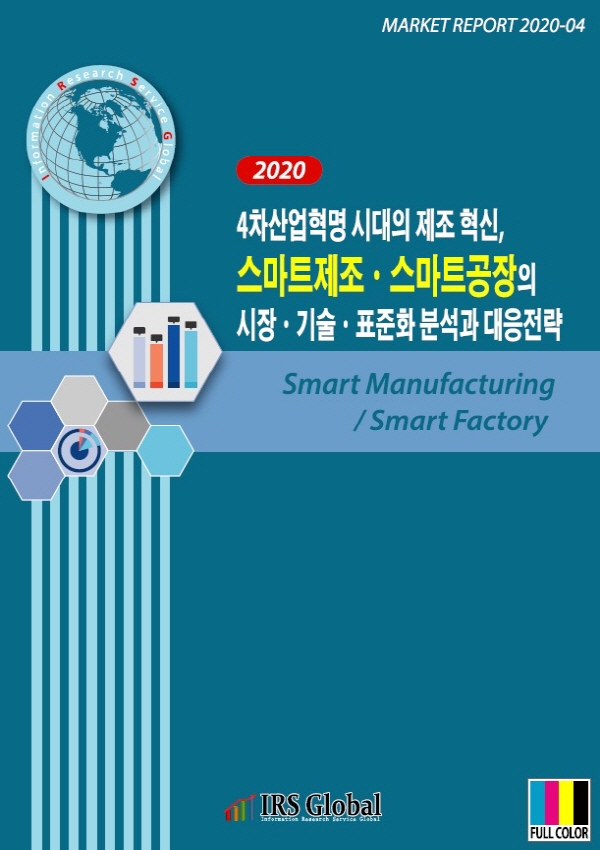
▲ Cover of the report "Market, Technology, and Standardization Analysis and Response Strategies for Smart Manufacturing and Smart Factories" (Image = IRS Global)
Traditional factories have often relied on skilled workers, highly skilled staff, and experienced managers to operate, but relying solely on human intervention has its limitations when it comes to detecting malfunctions, detecting defective products, improving productivity, and optimizing energy consumption.
As devices become increasingly sophisticated, IT technologies supporting factory operations, such as the introduction of factory automation (FA) devices that support automation, the spread of IoT, and the practical application of AI, are continuously evolving.
As product quality and condition, factory equipment operating status, and line information become more accurately linked, various options for energy conservation and productivity improvement become available.
Realizing smart factories To achieve this, technologies such as IoT, AI, big data, manufacturing robots, and CPS are required, and the key is to operate the factory while linking them using cutting-edge technologies.
The United States, with its leading technology, is highly regarded in the areas of production sites, IoT, communications, factory operation systems, business, and platforms, while Germany is considered the best in control systems. While South Korea's communications technology is also highly regarded, its technological prowess in other areas remains weak, at only 72.3% of that of the United States, the world's leading technology leader.
Our government is actively promoting the creation of a smart ecosystem centered on small and medium-sized enterprises (SMEs), with the goal of establishing 30,000 smart factories by 2025.
So far, the level of distribution is mainly SW, and advanced smart manufacturing technologies such as industrial IoT and cyber-physical systems are being attempted mainly by large corporations, and there are not many success stories among small and medium-sized enterprises.
The global smart factory market is projected to reach USD 17 billion in 2020, a 9.3% increase from 2019. By region, Asia-Pacific is projected to account for an overwhelming 44% of the total market, reaching USD 7.5 billion.
The domestic smart factory market is estimated to be the third largest in Asia, following China and Japan, and its growth rate is expected to be the second fastest after China, reaching a market size of $10.2 billion in 2020.
An IRS Global official stated, “We planned and published this report by comprehensively analyzing and organizing not only market trends by field, such as platforms and equipment for smart manufacturing and smart factories, but also various technology development trends, such as 5G, IIoT, AI, CPS, manufacturing robots, and industrial sensors, as well as major domestic and international cases and standardization response strategies.”
Comments
Related news
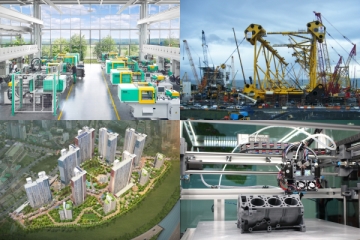
A Look at Five Key Industrial Automation Issues in 2019
2019 was a year of heightened interest in smart factories. In June, the government announced a manufacturing renaissance vision and strategy for leapfrogging into the world's top four manufacturing powers. To achieve this strategy, the government decided to supply 30,000 smart factories to small and medium-sized enterprises by 2022, and to establish 20 smart industrial complexes by 2030. The industry is also focusing on developing and implementing new technologies such as CPS and MEC, while dedicating considerable effort to establishing standards that enhance IoT connectivity, including the OPC-UA protocol and TSN specifications.
2019.12.18by 이수민 기자
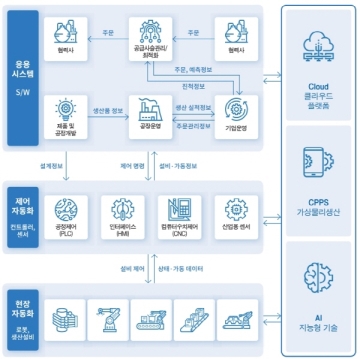
Domestic manufacturing industry emerges as a global IIoT powerhouse with digital twin strategy
Global manufacturing enterprises are focusing on IoT technology as a new growth driver, and attention is being directed toward OPC UA platform utilization strategies that enable real-time CPS data provision beyond data sharing and integration within a single factory. A smart factory market valued at over $7.8 billion is being analyzed from a CPS perspective.
2020.03.03by 최인영 기자

KT Powertel Adds Gas Detection Function to Industrial Safety IoT Solution
KT Powertel has added a hazardous gas leak detection system to its 'Industrial Safety IoT' solution, which detects the leakage of harmful chemical substances. The hazardous gas leak detection system can rapidly detect the leakage of gases with hazardous and explosive properties, such as hydrogen sulfide and carbon monoxide, thereby enabling preemptive prevention of industrial accidents in workplace environments.
2020.03.18by 이수민 기자
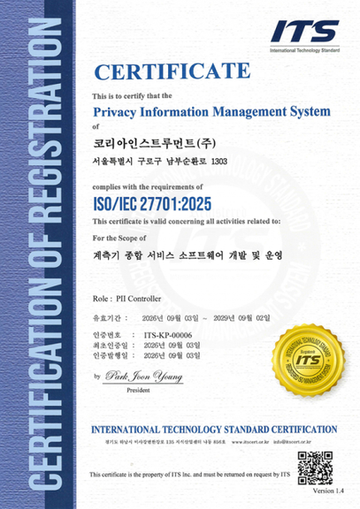
Korea Instrument, KOLAS Accredited Calibration Agency First to Simultaneously Acquire ISO/IEC 27,001·27,701
Korea Instrument has become the first among KOLAS accredited calibration agencies to simultaneously acquire ISO/IEC 27,001 and ISO/IEC 27,701 certifications. Through its proprietary platforms CWIZ Enterprise and CWIZ Partners, the company has embedded information security and personal data protection requirements across all business processes including customer information, equipment data, and calibration reports, with plans to continuously advance its management system through regular audits and security inspections.
2026.10.12by 배종인 기자
TeamViewer One, IT Incident Automation Workflow and Resolution Center Enhanced
TeamViewer has added IT incident automation capabilities and an advanced Resolution Center to its integrated digital workplace management platform 'TeamViewer ONE'. Recurrent service disruptions, configuration errors, and capacity shortages are automatically handled according to preset policies, and device status verification through script deployment can be managed in a unified interface, significantly reducing repetitive tasks for IT teams.
2026.10.12by 배종인 기자











