


Considerations When Implementing Power Solutions for 5G Cells
 Published2020.04.14 09:53
Power supplies with improved packaging technology are required.
Choosing the right power management solution can help prevent crises.
Cellular communications have come a long way since the introduction of analog cellular networks in the early 1980s.
As the cellular market transitions from LTE to 5G, the industry is poised for a massive leap forward in data transmission speeds, low latency, capacity, user density, and reliability.
For example, 5G will deliver 100x faster data speeds, 10x greater network capacity, and sub-ms latency, enabling billions of connected devices to access the Internet of Things (IoT) virtually anywhere, anytime.
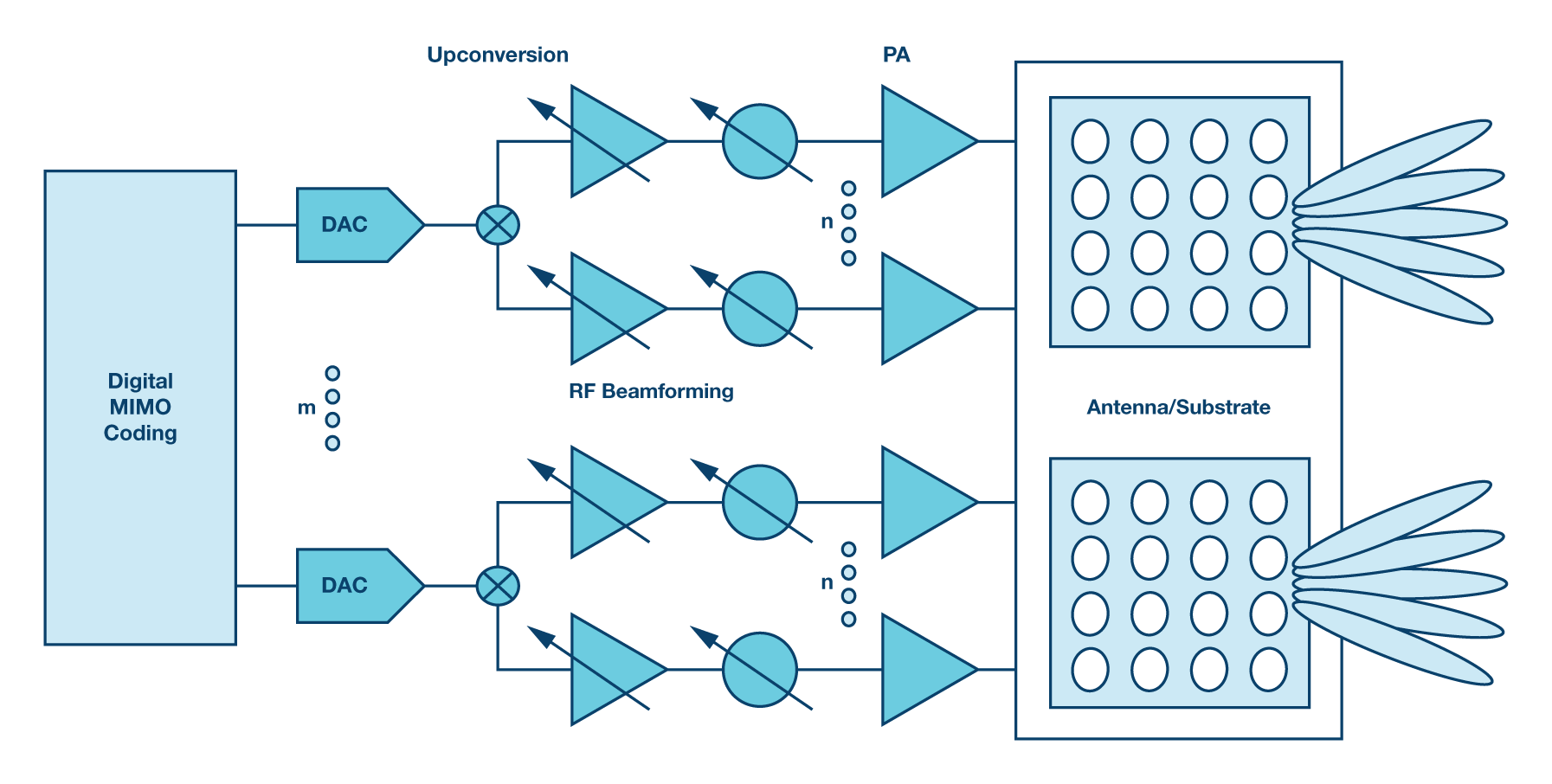
A typical 5G beamforming transmitter consists of a digital MIMO (Multiple Input, Multiple Output), data converter, signal processing components, amplifiers, and antennas.
Power supply for FPGA
To fully realize the benefits of 5G, designers must integrate highly integrated microwave/millimeter wave transceivers, FPGAs, high-speed data converters, and high-power, low-noise power amplifiers (PAs) for smaller 5G cells.
/> This is because high-frequency wireless systems are needed to utilize new spectrum needed to meet the increasing data capacity demands of the future.
Additionally, these 5G cells may include more integrated antennas to enable Massive MIMO technology for reliable connectivity. Ultimately, powering these 5G base station components will require a variety of advanced power supplies.
Modern FPGAs are fabricated using advanced nanometer processes, enabling them to perform calculations at high speeds using low voltages (less than 0.9 V) and high currents in ultra-small packages.
Next-generation FPGAs will require lower core voltages to significantly increase computational speeds, but will also require higher voltages for I/O interfaces and additional rails for DDR memory.
For an FPGA to operate optimally, it requires multiple voltages with tight tolerances and different current ratings. Additionally, to prevent damage, these voltage rails must be sequenced in the correct order.
Meeting these demanding requirements will require power supplies manufactured with advanced circuit topologies and improved packaging technologies combined with the latest semiconductor technologies.
If designers don't use appropriate power management solutions, they risk a wide range of problems, from inefficiencies to thermal issues and other undesirable performance issues.
Noiseless power supply for high-speed data converters
Similarly, high-speed, precision data converters such as analog-to-digital converters (ADCs) and digital-to-analog converters (DACs) require multiple power rails, such as 1.3 V, 2.5 V, and 3.3 V, along with low noise and DC ripple.
High-speed ADCs and DACs are typically placed on compact, space-constrained PCBs. Therefore, when designing a power system for high-speed data converters, the power sensitivity of the ADC and DAC must be a top priority.
Analog Devices' (ADI) µModule® Silent Switcher® regulators address these challenges by combining the advantages of advanced semiconductor and packaging technologies to meet the efficiency, density, and noise performance demands of high-speed data converters.
Take the Silent Switcher LTM8065, for example, which provides a quieter, smaller, and more efficient solution for powering these devices.
Unlike traditional discrete solutions, the LTM8065 significantly reduces component count and power board space without compromising the dynamic performance of the data converter. A single RoHS-compliant BGA package integrates the switching controller, power switches, inductor, and all other supporting components.
Sometimes a linear regulator is used after a switching regulator in the power path to maximize power supply rejection ratio (PSRR) performance.
The ADP7118 is a low dropout (LDO), low-noise linear regulator that can handle a wide input voltage range with high output accuracy, low noise, high PSRR, and stable line and load transient response.
This family includes many more products, so you can use ADI's software tools, such as LTpowerCAD and LTspice®, to select the product that best suits your application.
Power Management for PA and Transceiver
Next-generation wireless systems that integrate integrated transceivers and low-noise, high-power microwave/millimeter-wave PAs with wider bandwidths must be accompanied by digital control and management systems that utilize multiple specialized power technologies.
For example, gallium nitride (GaN)-based low-noise, high-power PAs require voltages of 28 to 50 V, while FPGA-based control and high-speed ADCs/DACs require multiple lower voltages, along with appropriate sequencing, monitoring, and protection features. Advanced DC/DC converters can deliver the high efficiency (>90%), power density, low-noise performance, and control characteristics required by these 5G PAs.
With increasing pressure to deliver next-generation (5G) products that outperform previous generations (LTE), there is no room for compromise. Therefore, only companies with expertise in all aspects of the base station RF chain and a thorough understanding of the power management tools required to power these applications can provide the right power resources for 5G-based PAs and transceivers.
ADI offers a holistic approach to powering the 5G signal chain with its Power by Linear™ product portfolio, ranging from high-efficiency, high-density DC/DC converter modules to power management ICs (PMICs) and ultra-low-noise linear regulators, including power sequencing, monitoring, and protection.
ADI's µModule regulators and Silent Switcher services are power system-in-package (SiP) solutions that deliver precision voltage and power density with the highest efficiency (>95%) in an ultra-small package, along with high reliability and the lowest EMI and noise.
These solutions are specifically designed to power high-performance RF systems with the highest power conversion efficiency and density without introducing noise or interference to the radio signals of interest.
Similarly, to address power sequencing challenges in circuits requiring multiple rails, ADI offers a family of sequencers ranging from two-supply (ADM6819/ADM6820) sequencing to 17-channel (ADM1266) sequencing.
Monitoring device voltage, current, or temperature is essential to ensure that the system operates accurately, efficiently, and safely. For this purpose, ADI also offers products such as the LTC2990.
In conclusion
ADI's Power by Linear product portfolio consists of low-noise LDO regulators, low-EMI, highly integrated multi-rail DC/DC converter µModule devices, Silent Switcher technology, and a variety of power management ICs including power sequencers, monitors, and protection circuits.
It includes everything needed to power 5G base station components, including software design and simulation tools like LTpowerCAD and LTspice. These tools simplify the task of selecting the right power management solution for these devices, providing the optimal power solution for 5G base station components.
This article is a summary of Analog Devices' article titled "Considerations When Selecting a Power Solution for Powering 5G Base Station Components."
Comments
Related news
Launch of IEEE 802.3bt compliant PoE product family supporting 5G small cells
Silicon Labs has unveiled a product lineup that reduces the complexity arising from adding 90W Power over Ethernet (PoE) to Power Sourcing Equipment (PSE) and Powered Devices (PD). The products comply with the IEEE 802.3bt standard, which doubles power delivery compared to standard PoE and expands the capabilities of wireless access points (AP) and Internet of Things (IoT) wireless gateways.
2020.03.17by 최인영 기자

How to determine and detect the effects of 5G waves on the human body?
The radio wave characteristics of 5G are significantly different from those of previous generation networks. Organizations such as ITU and IEC are continuously presenting methods for evaluating the impact of electromagnetic fields generated by 5G equipment on the human body. Developers must be familiar with these methods in order to rapidly bring 5G-related products to market in the future.
2020.03.31by 이수민 기자

LG U+ introduces 5G base station verification automation equipment 'mPTS'
LG Uplus announced that it will introduce base station validation automation equipment (mPTS) jointly developed with Innowireless into its 5G network operations field. The mPTS virtually implements various wireless environmental factors in an internal laboratory to minimize trial-and-error that may occur during mobile communication service operations. Through this, performance testing for commercial LTE and 5G services can be conducted in advance.
2020.04.13by 이수민 기자

Intel Unveils Next-Generation 'Core Ultra Series 3' and vPro Platform for Enterprise PCs
Intel has officially unveiled the "Intel Core Ultra Series 3" for next-generation enterprise PCs and the latest vPro platform, addressing a wide range of demands from enterprise notebooks to high-performance workstations.
2026.03.26by 배종인 기자

ROHM Launches ESD Protection Diode Compatible with High-Speed Interfaces of 10Gbps or Higher
Semiconductor specialist ROHM has developed the 'RESDxVx series' of ESD (electrostatic discharge) protection diodes capable of responding to next-generation high-speed data communication environments exceeding 10Gbps, simultaneously enhancing both signal quality maintenance required in high-speed interfaces and IC protection performance.
2026.03.26by 배종인 기자











