


Concrete service models to grow Korea's drone industry to be developed
 Published2020.04.29 10:58
Investing 48 billion won over 5 years in drone service development
Testbeds provided by 13 demand agencies
A project to develop new drone services by integrating drones with ICT such as 5G, AI, and big data is being promoted.
The Ministry of Science and ICT announced on the 28th that, following the selection evaluation results for the DNA+Drone Technology Development Project (2020–2024, total 48 billion KRW), it has finally selected a consortium led by the Electronics and Telecommunications Research Institute (ETRI) and will proceed with the project.
This project is designed to create a new drone service model by integrating data, 5G, and artificial intelligence technologies into drones, in response to the changes in the drone industry that are rapidly expanding from drone manufacturing to application services.
The selected consortium is expected to include a total of 25 organizations, consisting of three public research institutes including ETRI, three universities including KAIST, and 19 companies including telecommunications companies (KT, LGU+), drone manufacturers, and AI specialized companies (Acrylic, etc.).
The consortium plans to build an open platform that utilizes 5G to analyze mission data acquired in real time through AI learning and inference, and provides application services using autonomous and swarm flight technologies for non-line-of-sight.
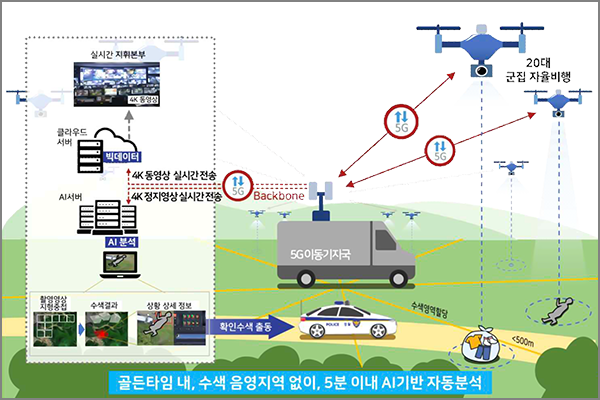
th: 600px; height: 400px;" />
▲ Structure drone service model [Image = Ministry of Science and ICT]
Over the next five years, the ETRI consortium plans to develop and demonstrate four service models: police drones (search for missing persons and patrolling), water resource drones (monitoring localized floods and water pollution, etc.), smart farm drones (AI-based precision pest control and crop management), and structure drones (management of cell towers and high-rise structures).
In the data section, data is secured through linkage with data (satellite, aerial, and spatial) held by the National Geographic Information Institute, and sensor data modeling and standardization are promoted.
In the 5G sector, the application of small cell technology to overcome dead zones, demonstration of drone operation linked with the Korea Aviation Safety Technology Institute (5G drone flight test site) and telecommunications carrier networks, and the establishment of a mission control platform for 5G drone operation will also be carried out in parallel.
In the AI sector, next-generation AI technologies such as customized AI modules for each service model, distributed learning, and edge AI for recognizing and tracking moving objects will be developed based on the Korea Institute of Science and Technology Information (KISTI) supercomputer high-performance accelerator system and applied to drones.
The consortium plans to increase the participation of demand agencies through competitive demonstrations between service models to enable early commercialization of service models, while simultaneously pursuing the pre-disclosure of results (data, AI modules) through challenge competitions and preemptive regulatory improvements through consultations with relevant ministries (Ministry of Science and ICT, Ministry of Land, Infrastructure and Transport, etc.).
Comments
Related news
Establishing a communication protocol between drones, improving the safety of autonomous flight
With the adoption of an international standard project on low-altitude drone-to-drone communication protocols, it is expected to enable information sharing between heterogeneous drones and collision avoidance between drones. The Ministry of Science and ICT and the National Radio Research Agency have implemented a direct and independent communication method applied between drones, thereby complementing the shortcomings of existing LTE communication methods while establishing an environment where multiple drones can fly simultaneously.
2020.03.24by 최인영 기자
Drone stations to charge drone batteries to be built nationwide
Dedicated drone battery charging stations are expected to be established nationwide, and drones will be able to travel anywhere with free battery charging just like electric vehicles. LG Uplus, Japan's KDDI, and Taiwan's CIRC have signed an MOU to expand their smart drone business. Through this collaboration, the three companies will expand their smart drone platform.
2020.04.12by 이수민 기자
Ministry of Land, Infrastructure and Transport Selects 4 Local Governments and 13 Companies for Drone Technology Demonstration
The Ministry of Land, Infrastructure and Transport selected four regions—Jeju Island, Busan, Daejeon, and Goyang—as drone demonstration cities for 2020, and also selected 13 companies participating in regulatory sandbox projects to support early commercialization of drone-related technologies. The Ministry announced that it will prepare safety management measures and begin pilot testing as early as June.
2020.04.22by 이수민 기자
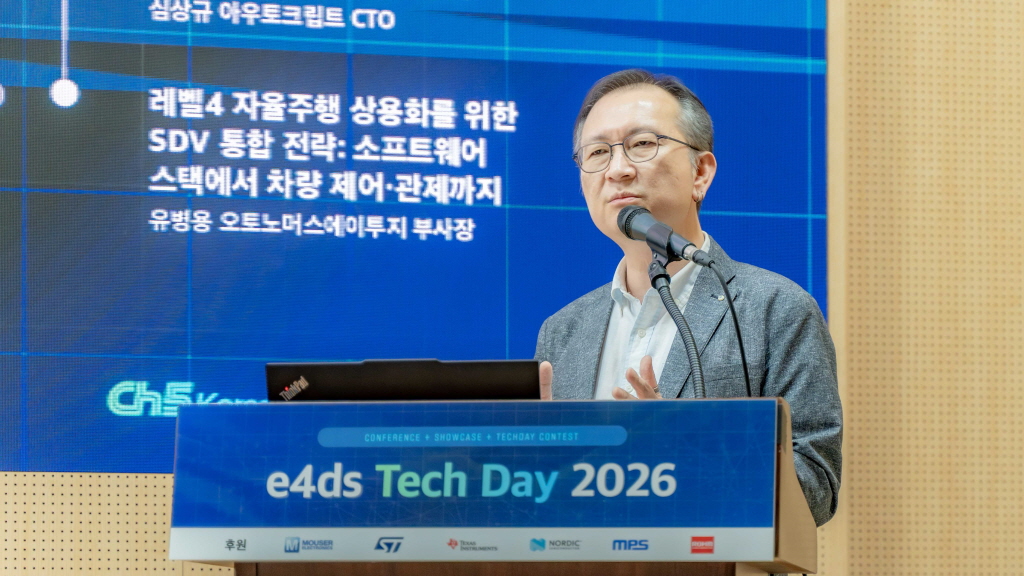
[e4ds Tech Day 2026 ⑨] Sim Sang-gyu, Autocrypt CTO: "In the Physical AI Era, Automotive Security Must Extend Beyond the Vehicle"
At e4ds Tech Day 2026, Sim Sang-gyu, CTO of Autocrypt, explained automotive cybersecurity strategies in the era of Physical AI and SDV (Software-Defined Vehicle). Automobiles are evolving as part of an ecosystem connected to AI, cloud, chargers, IoT, and robots, and he emphasized that the scope of security must expand beyond the vehicle interior to the entire connected environment. In particular, AI model tampering, adversarial attacks, OTA updates, and EV charger hacking were identified as major threats. He explained that response measures require zero trust, AI model integrity protection, intrusion detection, Security by Design and Default, and full lifecycle security management, and that proactive security system establishment beyond regulatory compliance is critical for securing future mobility competitiveness.
2026.10.12by 배종인 기자
NVIDIA to Invest $1 Billion in U.S. Science Over Next Five Years
NVIDIA has announced plans to invest $1 billion over the next five years to strengthen U.S. scientific and technological competitiveness. The company will enhance cutting-edge artificial intelligence research and development capabilities in key areas including quantum computing, healthcare, and energy security, while expanding support for higher education research institutions and cloud service providers. NVIDIA is participating as a major industry partner in the White House Office of Science and Technology Policy's Genesis Mission, and is promoting supercomputer construction in collaboration with national laboratories including Argonne and Los Alamos.
2026.10.12by 배종인 기자











