



Rohm Group's LAPIS Develops Automotive Speech Synthesis LSI, Capable of Updating Voice Data Even After Shipment
 Published2020.05.27 12:35
Onboard lighting and main MCU refresh function
Voice data can be changed and updated even after shipment
Recently, the function of notifying pedestrians and passengers of the vehicle's status or presence has become increasingly important.
ROHM Group LAPIS Semiconductor announced on the 27th that it has developed the "ML2253x series," an automotive voice synthesis LSI suitable for voice output systems of advanced driver assistance systems (ADAS) and vehicle approach warning systems (AVAS).
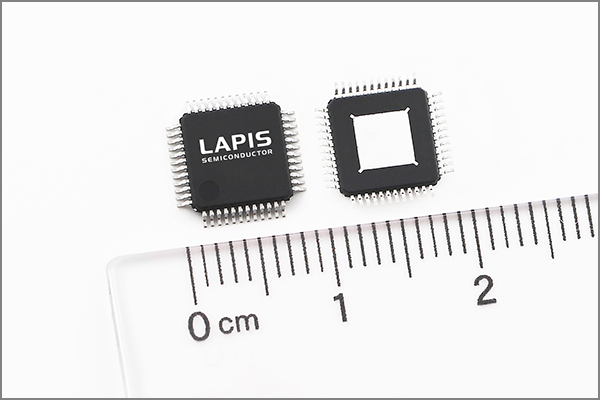
The ML2253x voice synthesis LSI integrates communication interfaces, logic, memory, and amplifiers, enabling the construction of a voice output system that does not rely on an MCU.
Lapis' new automotive voice synthesis LSI features a playback anomaly detection function that outputs an error signal to the MCU and other devices. This capability improves the quality of automotive voice output systems by detecting playback anomalies such as audio interruptions.
Additionally, in addition to the onboard lighting function using the existing ROM writer, the main MCU's update function has been added. Data can be written to the built-in flash memory (ML22Q53x series) or external flash memory (ML22530 series) via the SPI I/F from the main MCU, allowing voice data to be changed and updated even after shipment.
The ML2253x series, which achieves both high sound quality and memory savings by adopting HQ-ADPCM as a compression method, began sample shipments in April at 1,300 yen per unit, excluding tax.
Development kits and reference boards for the ML2253x series, scheduled for mass production starting in July, are currently available from Chip 1 Stop and Corestaff.
Comments
Related news
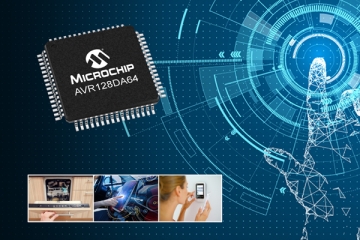
Microchip Launches AVR DA MCU with Embedded PTC for HMI
Microchip has unveiled its next-generation AVR DA functional safety certified MCU family with built-in PTC. The embedded PTC is designed independently of the CPU and employs driven shield+ and boost mode technology, enabling highly responsive capacitive touch designs. Additionally, it supports up to 46 self-capacitance sensors and up to 529 mutual capacitance sensors.
2020.05.06by 이수민 기자
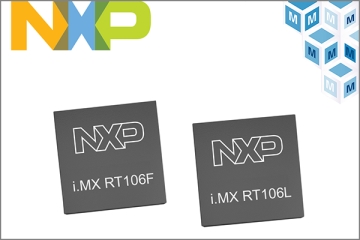
NXP i.MX RT106L·F MCU with Voice and Face Recognition Capabilities
Mouser Electronics supplies NXP Semiconductor's i.MX RT106L and i.MX RT106F crossover MCUs. Developers can utilize the i.MX RT106L and i.MX RT106F MCUs, which are equipped with Arm Cortex-M7 cores operating at up to 600MHz, to integrate remote local command-based voice control functionality into various devices.
2020.05.18by 이수민 기자

"Strengthening the security of battlefield equipment starts with selecting a vehicle MCU"
As technologies such as ADAS, IVI, ECU, V2X, and autonomous driving continue to advance, the proportion of electrical and electronic components in automotive parts is steadily increasing. Electrical and electronic components must guarantee security functions in accordance with international functional safety standards for automobiles to ensure passenger safety. In order for engineers to implement security functions in electrical and electronic components, they must first select an appropriate MCU.
2020.06.04by 이수민 기자
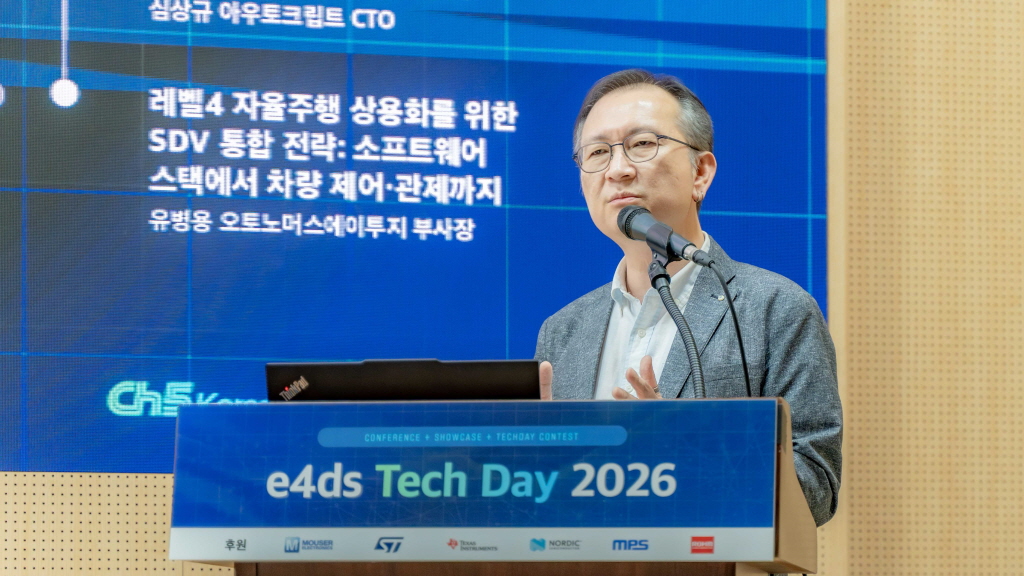
[e4ds Tech Day 2026 ⑨] Sim Sang-gyu, Autocrypt CTO: "In the Physical AI Era, Automotive Security Must Extend Beyond the Vehicle"
At e4ds Tech Day 2026, Sim Sang-gyu, CTO of Autocrypt, explained automotive cybersecurity strategies in the era of Physical AI and SDV (Software-Defined Vehicle). Automobiles are evolving as part of an ecosystem connected to AI, cloud, chargers, IoT, and robots, and he emphasized that the scope of security must expand beyond the vehicle interior to the entire connected environment. In particular, AI model tampering, adversarial attacks, OTA updates, and EV charger hacking were identified as major threats. He explained that response measures require zero trust, AI model integrity protection, intrusion detection, Security by Design and Default, and full lifecycle security management, and that proactive security system establishment beyond regulatory compliance is critical for securing future mobility competitiveness.
2026.10.12by 배종인 기자

Practical HIL Construction Strategy for Automotive and Off-Highway Controller Validation
As vehicle E/E architecture transitions to zonal structures and shifts to software-defined vehicles (SDV), the number of controllers (ECUs) requiring validation and software complexity are surging dramatically. Meanwhile, real vehicle testing cannot provide repeated verification under identical conditions and entails lead time and safety concerns. This white paper explains the principles of HIL (Hardware-in-the-Loop) validation and the structure of the NI platform composed of PXI, SLSC, and VeriStand, and through two actual implementation cases—Camera Record & Replay HIL for In-Cabin Monitoring Controller (ICMU) and Forklift Controller (VCU) HILS—describes how controller-level regression testing becomes possible. Additionally, it explicitly states application boundaries and limitations, such as lack of A2B support.
2026.10.12by 편집부











