



Neuromorphic semiconductors that mimic the human brain are the key to low-power, high-performance AI processing
 Published2020.06.09 18:21
Moore's Law Breaks Down, Slowing Performance Improvements
Neuromorphic semiconductors that mimic the human brain are in the spotlight
AI has cognitive abilities that are equal to or better than those of humans. Today, most companies are exploring ways to use AI in their business.
As companies undergo digital transformation, they are strengthening the AI functions of their existing IT resources. Using AI accelerators is one way to do so.
AI accelerators are hardware that support fast processing of AI algorithms and are designed to efficiently perform specific AI-related tasks that are inefficient with x86-based CPUs.

AI accelerators are being used to apply AI functions to CCTV security, etc.
AI accelerators use processors such as CPUs, GPUs, FPGAs, and ASICs. CPUs are the best in terms of general usability, and ASICs are the best in terms of suitability. The problem is that as Moore's law reaches its limit, we cannot expect dramatic performance improvements or increased power efficiency. The concept that emerged in response is neuromorphic semiconductors.
IBM has been involved in the U.S. Department of Defense's SyNAPSE project since 2008 and created a neuromorphic chip, TrueNorth, in 2014. TrueNorth can classify images at 1,200 to 2,600 frames per second with a power of 25 to 275 mW, which is 1/10,000th of that of existing processors. It is a good example of the low-power performance of neuromorphic semiconductors.
According to the 'Artificial Intelligence Neuromorphic Semiconductor Technology Trends' published by the Electronics and Telecommunications Research Institute (ETRI) on June 1, the human brain operates in a different way from computers. Computing systems that follow the von Neumann architecture are optimized to transmit and modify precise numerical representations of data. On the other hand, the human brain operates on temporal events called action potentials or spikes.
Neurons receive spikes across synapses and convert them into small changes in the cell membrane potential, and neurons integrate these potential changes over time. When many spikes arrive in a short period of time, the neuron finally outputs a spike.
Spikes can be considered messages in a computational sense, but they are very simple and different from the traditional concept of messages in that they do not contain any information other than the time and source at that point in time. Therefore, computing in the brain can be said to be an event-based operation that communicates through very simple messages called spikes, based on computing nodes (neurons) with a very simple structure.
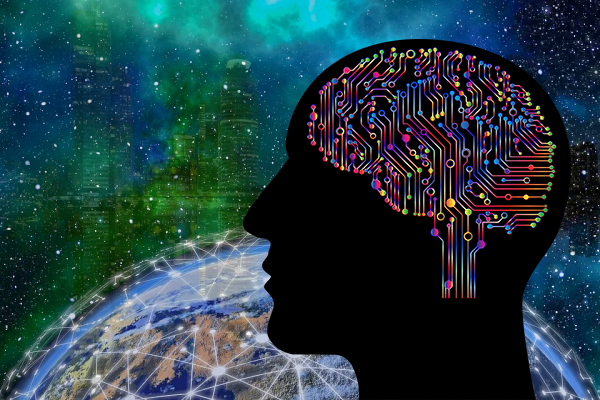
Increase parallelism of operations and reduce energy consumption
It is estimated that there are about 10 11 neurons in the human brain, with about 5,000 to 10,000 synapses per neuron.
The probability that a single neuron can receive a signal from another neuron is about 10 -6 %, indicating a sparse signaling connectivity, which is even smaller when considering that a single dendrite can form multiple synapses.
Instead, the fan-out connectivity of neurons is very large, with an estimated 10 15 connections across the brain. That is, the probability of receiving a signal is very low, but there are many paths for the signal to come in.
Neuromorphic computing platforms based on spiking neural networks (SNNs) aim to efficiently mimic biological spiking neural network mechanisms by distributing information through synaptic computation and information storage via an event-based asynchronous spike operation mechanism across a large number of relatively simple computational units, such as neurons.
The event-based asynchronous operation characteristics of SNNs are known to greatly increase parallelism and significantly reduce hardware energy consumption. Moreover, combining SNN neuromorphic hardware with nano-scale memory devices is expected to achieve even higher energy consumption efficiency goals.
◇ Neuromorphic semiconductors, combining with memory semiconductor technology is important
Most neuromorphic semiconductors developed to date have been implemented using only existing silicon-based CMOS transistor technology. If this is called the first-generation neuromorphic method from the perspective of the implementation device, then the neuromorphic semiconductors implemented as next-generation neuromorphic devices can be called the second-generation method.
In the first generation of neuromorphic semiconductors, synapses were implemented by storing and then reading synaptic weights using existing CMOS memory devices.
In the industry, research is being conducted to implement second-generation neuromorphic semiconductors by utilizing memristor devices that have both the functions of memory and variable registers.
Memristor is a combination of the words memory and resistor. It must be small in size and have gradual switching resistance characteristics for detailed weighting.
Second-generation neuromorphic semiconductors include flash memory, resistive RAM (RRAM), phase-change memory (PRAM), and magnetic RAM (MRAM) depending on the device materials and implementation method, and the memristor method is currently being studied the most.
Second-generation neuromorphic semiconductors have been studied at the unit function block level, but recent developments have focused on testing the feasibility of implementation at the system level.
As the number of cases utilizing AI increases across all industries, interest in CPU, GPU, FPGA, and ASIC-based AI accelerators is naturally increasing. However, the processors used in these accelerators are power-hungry, unlike the human brain, and ironically, their data processing is also inefficient.
If neuromorphic technology-based semiconductors are commercialized, AI will be able to overcome the limitations of existing computing systems and further demonstrate its potential in various industries.
Comments 2
2 Comments:
Related news
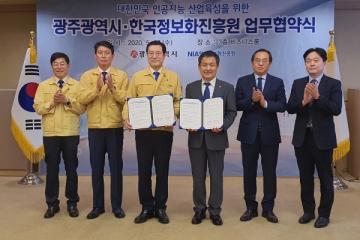
NIA and Gwangju Metropolitan City Sign MOU for Establishment of AI Industry Convergence Complex
The National Information Society Agency (NIA) and Gwangju Metropolitan City have concluded a memorandum of understanding for fostering the AI industry in the Republic of Korea. The main contents of this MOU signing ceremony include mutual cooperation on data utilization of big data platforms (10 units) and centers (100 units) for the implementation of Gwangju's AI industry convergence integrated complex development project, establishment of infrastructure for access to and utilization of public data, and construction and operation of an AI hub and AI data center.
2020.05.28by 강정규 기자
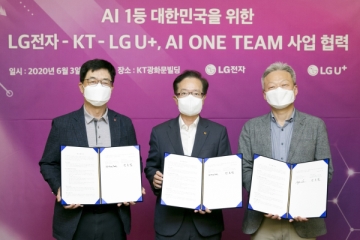
KT Joins AI Alliance, LG Electronics and U+ Join AI One Team
LG Electronics and LG Uplus concluded a business agreement to participate in the AI One Team at KT Gwanghwamun Building in Jongno-gu, Seoul. The AI One Team is an industry-academia-research collaborative body established to enhance the competitiveness of Korea's AI industry, which was launched in February this year by KT, Hyundai Heavy Industries Holdings, KAIST, Hanyang University, and ETRI. Based on this agreement, LG Uplus and LG Electronics will develop core AI-related technologies and discover new business opportunities within the AI One Team.
2020.06.04by 강정규 기자
NanoEdge AI Studio, which integrates machine learning algorithms into low-power MCUs, is optimized for the STM32 development board.
Cartesiam, which develops AI software for embedded systems, has released a new version of 'NanoEdge AI Studio' optimized for ST Microelectronics' STM32 MCU development boards. Designed for companies without machine learning expertise, NanoEdge AI Studio enables systems designers using Arm-based low-power MCUs to directly integrate machine learning algorithms into various applications.
2020.06.04by 이수민 기자

[e4ds Tech Day 2026 ⑨] Sim Sang-gyu, Autocrypt CTO: "In the Physical AI Era, Automotive Security Must Extend Beyond the Vehicle"
At e4ds Tech Day 2026, Sim Sang-gyu, CTO of Autocrypt, explained automotive cybersecurity strategies in the era of Physical AI and SDV (Software-Defined Vehicle). Automobiles are evolving as part of an ecosystem connected to AI, cloud, chargers, IoT, and robots, and he emphasized that the scope of security must expand beyond the vehicle interior to the entire connected environment. In particular, AI model tampering, adversarial attacks, OTA updates, and EV charger hacking were identified as major threats. He explained that response measures require zero trust, AI model integrity protection, intrusion detection, Security by Design and Default, and full lifecycle security management, and that proactive security system establishment beyond regulatory compliance is critical for securing future mobility competitiveness.
2026.10.12by 배종인 기자
NVIDIA to Invest $1 Billion in U.S. Science Over Next Five Years
NVIDIA has announced plans to invest $1 billion over the next five years to strengthen U.S. scientific and technological competitiveness. The company will enhance cutting-edge artificial intelligence research and development capabilities in key areas including quantum computing, healthcare, and energy security, while expanding support for higher education research institutions and cloud service providers. NVIDIA is participating as a major industry partner in the White House Office of Science and Technology Policy's Genesis Mission, and is promoting supercomputer construction in collaboration with national laboratories including Argonne and Los Alamos.
2026.10.12by 배종인 기자












한국전자통신연구원(ETRI) ‘인공지능 뉴로모픽 반도체 기술 동향’ 자료 6월 1일 발행된거 맞나요
인간 뇌에 뉴런 수가 약 1011개 라구요? 너무 적은거 같네요 ㅋ