


Infineon Debuts Technology to Protect IGBTs from Hydrogen Sulfide
 Published2020.07.03 08:41
Infineon's H2S protection technology blocks H2S in modules.
Guaranteed 20 years of operation at ISA 71.04 harsh conditions
Exposure of electronic components to hydrogen sulfide (H2S) reduces their lifespan.
On the 2nd, Infineon announced H2S protection technology that extends the life of IGBT modules operating in harsh environments where H2S reaches critical levels, such as the rubber, petrochemical, paper, mining, and wastewater industries. The company also unveiled the EconoPACK+ module, featuring the TRENCHSTOP IGBT4 chipset, the first product to utilize this technology.
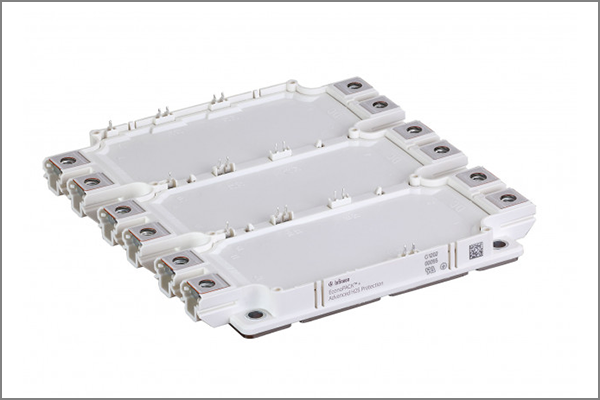
Hydrogen sulfide (H2S) is the most damaging corrosive contaminant to power semiconductors. IGBT modules are often heated to high temperatures during operation, which, combined with applied voltage and H2S contamination, triggers the growth of copper sulfide (Cu2S) crystals. These conductive structures grow in the DCB trenches of the ceramic substrate, potentially causing short circuits in the worst-case scenario. This can lead to premature failure of the IGBT module, significantly shortening the inverter's lifespan.
Infineon's H2S protection technology prevents hydrogen sulfide from entering the module. All electrical, thermal, and mechanical parameters of the module remain unchanged, maintaining the same characteristics as standard modules. Therefore, the life of systems operating under harsh environmental conditions can be extended.
To ensure this, Infineon has designed a proprietary HV-H2S test that certifies the operation of IGBT modules under specific conditions according to the ISA 71.04-2013 standard. This standard defines four severity levels for contamination effects, from "mild" (G1) to "severe" (GX). This test covers a wide range of industrial applications and provides a quantitative approach to assessing the reliability of IGBT modules.
IGBT modules protected with Infineon's H2S technology can expect a service life of 20 years at the upper limit of the "harsh" (G3) severity level (≤ 2000 A/50 ppb) according to ISA 71.04. The EconoPACK+, with its integrated protection features, simply replaces standard modules, eliminating the need for time-consuming design work. Furthermore, inverter system integrators do not need extended protection measures, such as additional room ventilation, temperature and humidity control, or even a sealed cabinet for the inverter.
EconoPACK+ with integrated H2S protection is available in bulk quantities in 300A and 450A versions for 1200V and 300A and 500A versions for 1700V.

Comments
Related news

Launch of 'Software Configurable I/O' for Industry 4.0
ADI has launched the AD74412R and AD74413R, software-configurable I/O products for building control and process automation. By utilizing these two products, remote configuration is possible using reconfigurable module channels without the need for rewiring. Manufacturers can leverage these solutions to pursue new projects more efficiently, implement more flexible automatic control, and reduce costs.
2020.05.29by 이수민 기자
Vicor Unveils 6U VITA-62 Compatible Power Supply
Vicor announced on the 24th the launch of a VITA 62 compatible power supply. The unit utilizes Vicor's high-density, high-efficiency ChiP power modules and is designed for 6U OpenVPX conduction-cooled chassis systems. Customers requiring different output voltages or power levels can request customized power supplies tailored to their specifications.
2020.06.24by 명세환 기자

"High-efficiency inverters should adopt SiC MOSFETs instead of IGBTs"
As power consumption increases, demand for safe and efficient compact inverters is growing. Accordingly, inverter developers are reviewing power devices with low losses and high current density. SiC MOSFETs are more robust than the currently widely used Si-based MOSFETs or IGBTs, allowing them to operate normally in high voltage and temperature environments.
2020.06.29by 이수민 기자

Intel Unveils Next-Generation 'Core Ultra Series 3' and vPro Platform for Enterprise PCs
Intel has officially unveiled the "Intel Core Ultra Series 3" for next-generation enterprise PCs and the latest vPro platform, addressing a wide range of demands from enterprise notebooks to high-performance workstations.
2026.03.26by 배종인 기자
ROHM Launches ESD Protection Diode Compatible with High-Speed Interfaces of 10Gbps or Higher
Semiconductor specialist ROHM has developed the 'RESDxVx series' of ESD (electrostatic discharge) protection diodes capable of responding to next-generation high-speed data communication environments exceeding 10Gbps, simultaneously enhancing both signal quality maintenance required in high-speed interfaces and IC protection performance.
2026.03.26by 배종인 기자











