



A KAIST research team successfully developed a power-less IoT gateway.
 Published2020.07.13 16:52
Modulating Zigbee/BLE signals into Wi-Fi signals
Also confirmed as a potential integrated IoT gateway
A domestic research team has developed an IoT gateway that can generate wireless signals without consuming power, thus reducing installation space constraints.
A joint research team, including Professors Sungmin Kim and Yong Lee of the Department of Electrical and Electronic Engineering at KAIST, and Ph.D. candidate Jinhwan Jeong, and Professor Jihoon Ryu of the Department of Computer Science at the State University of New York, Korea, announced on the 13th that they had succeeded in developing a wireless IoT gateway using backscattering technology.

Professor Lee Yong and PhD candidate Jeong Jin-hwan [Photo = KAIST]
Backscatter technology is a technology that transmits information by reflecting radiated signals existing in the air rather than directly generating wireless signals from the device, and does not consume power to generate wireless signals.
For IoT devices to connect to the Internet, an IoT gateway equipped with multiple wireless transmitters and receivers is required. However, due to the high power consumption generated by various wireless transmitters and receivers, IoT gateways require wired power supplies, and their free installation is inevitably limited.
To address these issues, the research team developed a technology that utilizes backscattering technology to reflect wireless signals conforming to the ZigBee or BLE (Bluetooth Low Energy) communication standards primarily used by IoT devices in an optimal pattern and modulate them into Wi-Fi signals. Using this technology, they created a wireless IoT gateway that connects IoT devices to Wi-Fi devices, providing internet connectivity.
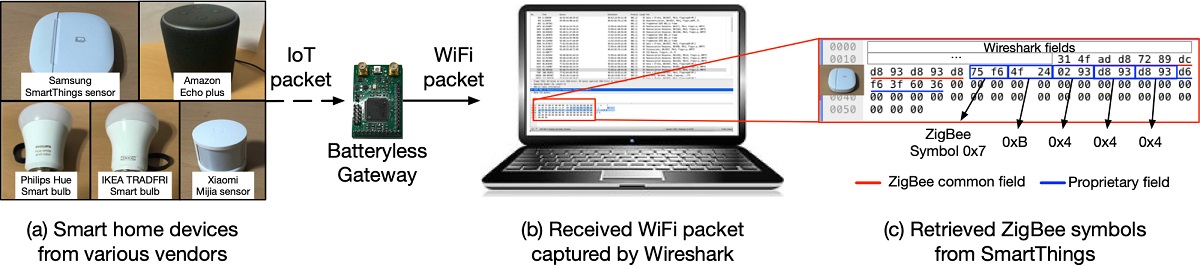
Schematic diagram showing the process of connecting to Wi-Fi [Image = KAIST]
The wireless IoT gateway technology developed by the research team utilizes backscattering technology to harvest energy, enabling zero power consumption and significantly reducing installation and maintenance costs. Furthermore, the inherent nature of backscattering allows for physical modulation of wireless signals by reflecting them into the air, making it universally applicable to all IoT devices using the same communication standard.
The research team confirmed that Zigbee and BLE signals, which are low-power communication standards, were modulated into Wi-Fi signals through a wireless IoT gateway and received on a commercial laptop. In addition, the possibility of an integrated IoT gateway was confirmed by experimentally proving that commercial smart home devices sold by various manufacturers are interconnected to Wi-Fi devices through an IoT gateway.
“By utilizing backscattering technology, we can connect IoT devices to the Internet via Wi-Fi at a very low cost,” said first author Jin-Hwan Jeong, a researcher. “Through this research, we have confirmed that the limitations of existing expensive and power-hungry IoT gateways can be overcome with a wireless IoT gateway.”
Meanwhile, this study was presented under the title 'Gateway over the air: Towards Pervasive Internet Connectivity for Commodity IoT' at 'ACM MobiSys 2020', the most prestigious academic conference in the field of mobile computing held in Toronto, Canada in June, and was conducted with the support of the National Research Foundation of Korea and the National IT Industry Promotion Agency.
Comments
Related news

IoT product security certification process to be simplified and improved.
The Ministry of Science and ICT convened an IoT Security Certification System Improvement Research Group on May 29th and held its first meeting to improve and activate the IoT security certification system. The research group discussed development measures for the IoT security certification system through review of domestic and international trends in systems and standardization, examination of improvements such as the scope of IoT devices, certification targets, and classification types, linkage with domestic and international mutual recognition and standardization, and activation measures including mandatory certification requirements.
2020.06.01by 이수민 기자
ST-Panasonic-Arrow Supplies Multi-Sensor Modules Suitable for IoT
Arrow supplies an edge intelligence multisensor module developed by Panasonic based on ST's BlueTile multisensor development kit. This ultra-compact onboard type sensor combines acceleration, gyroscope, ToF, pressure, and humidity sensors including ST's BlueNRG BLE 5.0 SoC, enabling utilization across various IoT applications.
2020.06.09by 이수민 기자

What IoT Devices Need to Prepare for the Post-Corona Era
The world before COVID-19 will not return. Non-contact and remote-based IoT devices will continue to be necessary as long as humanity exists. To develop effective IoT devices even in the post-COVID era, device connectivity and security, data integration and management, and the construction of scalable infrastructure must be considered.
2020.06.30by 이수민 기자

ESP32 Development Environment Selection and GPS Application Implementation
The ESP32 is a microcontroller that integrates Wi-Fi, Bluetooth, 12-bit ADC, capacitive touch, PWM, DAC, and UART in a single SoC. However, the abundance of features does not by itself solve the designer's problems. The real challenges lie in selecting the appropriate development environment, determining which pins can be used and which must be avoided, and converting raw data from modules into usable information. This document addresses ESP32 peripheral constraints (ADC2 and Wi-Fi coexistence limitation, UART1 occupancy, ADC non-linear regions), the trade-offs between Arduino IDE and ESP-IDF, and the process from connecting NEO-6M/NEO-M8N GPS modules to UART2, parsing NMEA sentences, and visualizing routes in Google Earth, all organized based on documented references.
2026.10.12by 편집부

MIPI CSI-2, DSI-2, C-PHY, D-PHY Test Solution Technical White Paper
The MIPI interface adopts a burst mode that transitions between low-power (LP) and high-speed (HS) states for low-power consumption, and in return, strict timing rules are imposed on state transitions. Additionally, the high-speed section operates as a packet-based protocol with headers, ECC, and CRC, so verification engineers must handle waveforms and protocols simultaneously. Traditional configurations combining general-purpose oscilloscopes and AWGs reveal limitations in setup complexity, measurement uncertainty, and lack of reproducibility when faced with these requirements. This white paper, based on webinar materials, organizes the structure of this problem and describes how the SV5C-DPTXCPTX generator for receiver testing and SV5C-DPRXCPRX analyzer for transmitter testing integrate state transition testing, stressed eye testing, and protocol analysis into a single bench, along with their application boundaries.
2026.10.12by 편집부











