


Bycor Supports Design of "Modular PDN" for 48V Electric Vehicle Battery Packs
 Published2020.10.30 09:44
Achieving miniaturization, lightness, and high performance through PDN utilization
The British Touring Car Championship (BTCC) has been running since 1958, with over 30 highly engineered cars competing for the title.
The BTCC can use electric motors tactically. Delta Motorsports designed a new battery pack and associated electronics for tactical boosting.
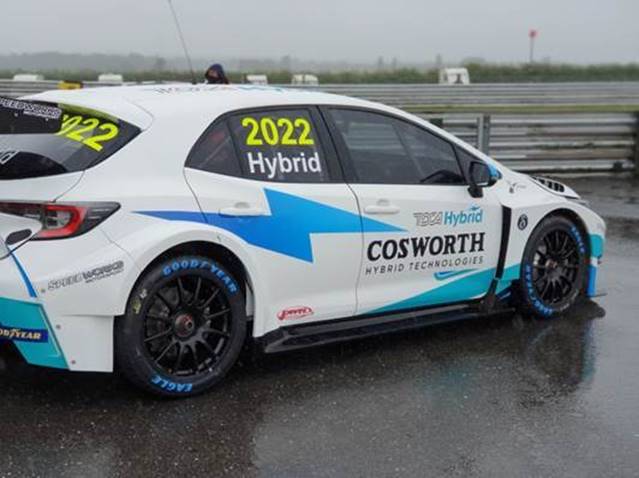
Designing a 'modular PDN' of the required battery pack related electronics
High performance achieved with 48VDC power supply [Photo = Byco]
The new 48V lithium-ion battery pack features innovative intelligent power management, high-power, high-density DC-DC converters, and regulation systems.
The battery pack powers the inverter-motor combination and receives the power generated by this combination, while the high-power, high-density converter solution powers all of the vehicle's electronic circuits and devices. The power density and power management achieved with this architecture enable control of the alternator system, further improving weight, performance, and reliability.
Additionally, the system achieves miniaturization, light weight, and high performance by utilizing a modular power network (PDN).
The PDN integrates a 48VDC power source that feeds four DC-DC converters connected in parallel, which provide regulated 13.8V power at up to 92 amps (approximately 1.2 kilowatts). The four converters share the load with N+1, or aviation-grade redundancy, but three converters can also fully support the load.
The hybrid system's three-phase brushless motor is connected to the battery via a bidirectional inverter. The inverter routes battery power to the motor and regenerates the power back from the motor to the battery.
The motor initially operates the car in pure EV mode (motor only, no ICE) during the speed-limited pit lane, and then switches to mild hybrid mode (ICE in combination) when increased performance is required during the race.
◇ Innovative battery pack intelligence and management
The battery pack includes a battery management system, which controls all cell voltages and ensures the battery maintains maximum charge and discharge voltages while communicating with the motor-inverter controller. It continuously calculates and updates the amount of current the battery can supply or accept based on its state of charge (SoC). Power demand is reduced at low SoCs, while regeneration is limited at high SoCs.
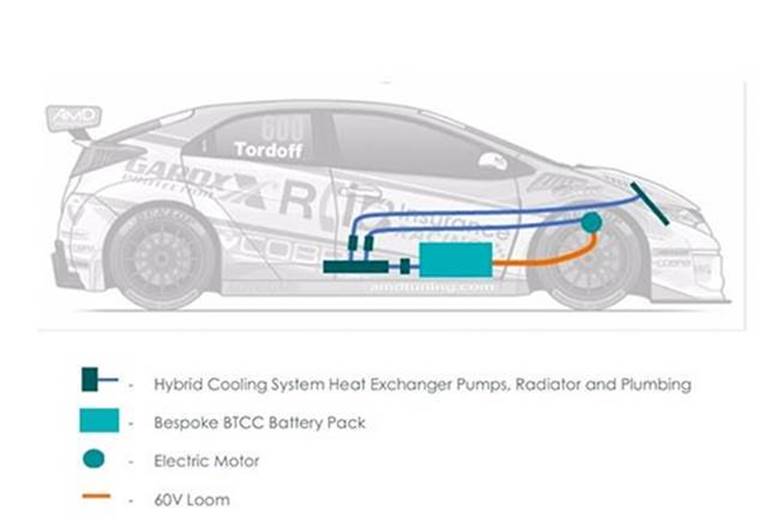
Designed. This network supplies power to four DC-DC converters connected in parallel.
DC-DC converters can supply up to 92 amps (about 1.2 kilowatts of power).
It supplies regulated power of 13.8V. N+1 or aviation grade.
With redundancy, four converters share the load, but three can also
We can fully support you. [Photo = VICOR]
The battery management system supports data logging and diagnostic functions to record the performance of the DC-DC converter. This is not only to detect faults but also to provide feedback on the exact amount of current delivered to each vehicle.
◇ Vicor DC-DC converter power module
The DC-DC converter power system uses four Vicor DCM3623 isolated regulated DC-DC converter ChiP power modules to provide a regulated 13.8V output from the battery pack at current levels up to 92A. The small profile and footprint allow for direct thermal contact mounting with micro-bore cooling plates extending between the battery cells.
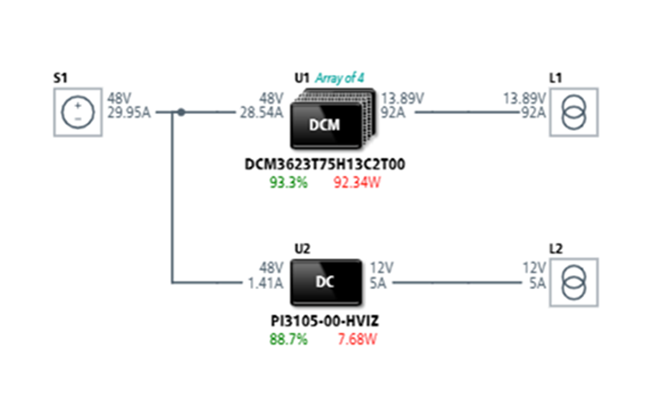
It achieves lightweight and high performance. The PDN consists of four parallel-connected
Integrates a 48 VDC power source that supplies the DC-DC converter.
DC-DC converters can supply up to 92 amps (about 1.2 kilowatts of power).
It supplies 3.8V of regulated power. [Photo = VICOR]
The scalability and ease of paralleling of DCM modules enable a modular power architecture, allowing Delta to customize the DC-DC PDN to the small footprint required without sacrificing power.
Future electric vehicles will inevitably require smaller, lighter, and more efficient power electronics to accommodate their increasing performance demands. As manufacturers move to 48V batteries to handle this increased power, Vicor's modular approach improves power supply efficiency, reducing power loss and weight with smaller, lighter cables and connectors.

Comments
Related news
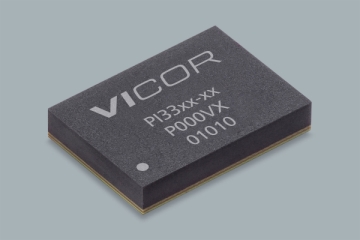
Vicor Unveils Two Buck Regulators with Expanded Operating Temperature Range
Vicor has released two types of ZVS buck regulators. The PI3323 and PI3325 ZVS buck regulators feature an expanded operating temperature range of -55~120°C and can be applied to Mil COTS in a tin-lead 10×14mm SiP BGA package.
2020.06.30by 강정규 기자
Byco Joins GSA, Focusing on Development of Automotive Power Modules
Baico has become a member of the Global Semiconductor Alliance (GSA). The GSA is an alliance dedicated to building an efficient, profitable, and sustainable global ecosystem of semiconductors and advanced technologies encompassing semiconductors, software, solutions, systems, and services. Baico plans to participate in the GSA Automotive Interest Group and focus its efforts on developing compact, lightweight, and integrated power modules required in the emerging vehicle electrification sector.
2020.07.03by 이수민 기자
Vicor Globally Supplys "Modular Power Solutions" via Arrow
Vicor Corporation announced that it is expanding the scope of its distribution agreement with Arrow Electronics from the Europe, Middle East, and Africa region to worldwide coverage. Arrow stated that this contract expansion was made to propose smaller and more efficient solutions to customers seeking to innovate their power delivery networks in response to ever-increasing system power demands.
2020.09.16by 이수민 기자
[e4ds Tech Day 2026 ⑨] Sim Sang-gyu, Autocrypt CTO: "In the Physical AI Era, Automotive Security Must Extend Beyond the Vehicle"
At e4ds Tech Day 2026, Sim Sang-gyu, CTO of Autocrypt, explained automotive cybersecurity strategies in the era of Physical AI and SDV (Software-Defined Vehicle). Automobiles are evolving as part of an ecosystem connected to AI, cloud, chargers, IoT, and robots, and he emphasized that the scope of security must expand beyond the vehicle interior to the entire connected environment. In particular, AI model tampering, adversarial attacks, OTA updates, and EV charger hacking were identified as major threats. He explained that response measures require zero trust, AI model integrity protection, intrusion detection, Security by Design and Default, and full lifecycle security management, and that proactive security system establishment beyond regulatory compliance is critical for securing future mobility competitiveness.
2026.10.12by 배종인 기자

Practical HIL Construction Strategy for Automotive and Off-Highway Controller Validation
As vehicle E/E architecture transitions to zonal structures and shifts to software-defined vehicles (SDV), the number of controllers (ECUs) requiring validation and software complexity are surging dramatically. Meanwhile, real vehicle testing cannot provide repeated verification under identical conditions and entails lead time and safety concerns. This white paper explains the principles of HIL (Hardware-in-the-Loop) validation and the structure of the NI platform composed of PXI, SLSC, and VeriStand, and through two actual implementation cases—Camera Record & Replay HIL for In-Cabin Monitoring Controller (ICMU) and Forklift Controller (VCU) HILS—describes how controller-level regression testing becomes possible. Additionally, it explicitly states application boundaries and limitations, such as lack of A2B support.
2026.10.12by 편집부











