


Xilinx Provides Deep Learning Models for AI Medical Device Development
 Published2020.11.17 13:35
Launch of Classification Deep Learning Model and Healthcare AI Evaluation Board
Building training models for medical edge devices is possible.
In the medical field, demand for AI-based solutions that rapidly collect and analyze patient data is increasing. The COVID-19 pandemic, which has raised concerns about accumulated fatigue among medical staff, is accelerating this trend. Demand for telemedicine is also growing, requiring devices capable of AI processing at the edge.
On the 17th, Xilinx held an online press conference and unveiled, in collaboration with Spline.ai, a 'medical X-ray classification deep learning model' that is fully functional on Amazon Web Services (AWS) and the FPGA-based 'Xilinx Zynq® UltraScale+™ Healthcare AI Starter Kit.'
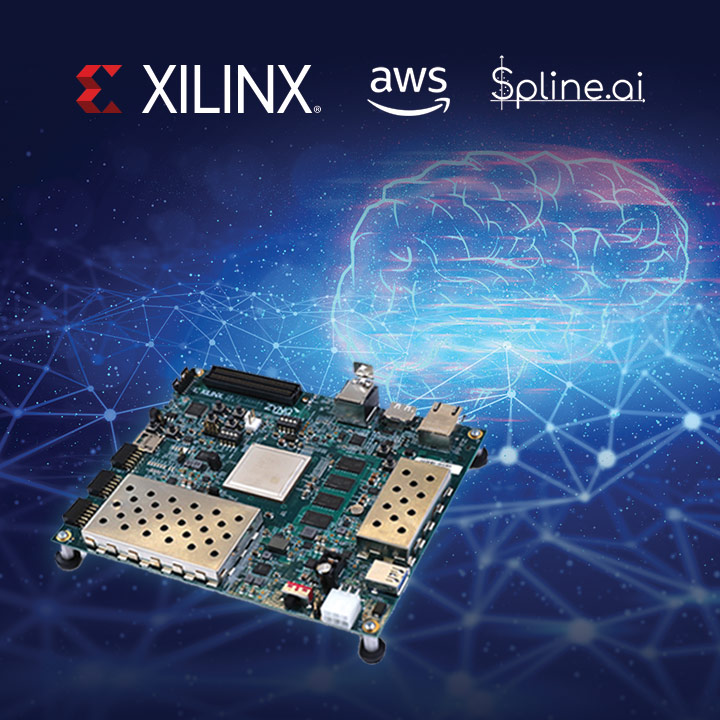
Developing Deep Learning Models and AI Starter Kits [Image = Xilinx]
The deep learning model is built on the Zynq UltraScale+ MPSoC-based 'ZCU104 Evaluation Board' and utilizes Xilinx's Deep Learning Processor Unit (DPU), a powerful soft IP tensor accelerator that runs various neural networks such as disease classification and detection.
The Healthcare AI Starter Kit uses an open-source model that runs on the Python programming platform of the Zynq UltraScale+ MPSoC, allowing developers to tailor it to suit their diverse application needs.
Medical diagnostic and clinical equipment manufacturers and healthcare service providers can leverage the open source design and cloud expansion options above to deliver a wide range of clinical and radiology applications on mobile, portable, or point-of-care edge devices.Inning models can be developed and built quickly.
The deep learning model recently announced by Xilinx is trained with 'Amazon SageMaker' and deployed from the cloud to the edge using 'AWS IoT Greengrass', enabling remote updates of machine learning models, geographically distributed deployment of inference, and expansion across remote networks and wide areas.
“Xilinx and Spline.ai have developed a solution using Amazon SageMaker that enables accurate clinical diagnosis even with low-cost medical devices,” said Dirk Didascalou, Vice President of IoT at AWS. “Furthermore, by integrating AWS IoT Greengrass, they have further expanded the reach of telemedicine by enabling clinicians to easily upload X-ray images to the cloud without using physical medical devices.”
Currently, this solution is being used in detection systems for pneumonia, COVID-19, and other diseases due to its high accuracy and low inference latency. Xilinx and spline.ai trained a deep learning model using over 30,000 labeled pneumonia images and 500 COVID-19 images. This data is being used in public research at health and medical research institutions such as the National Institutes of Health (NIH), Stanford University, and MIT, as well as in hospitals and clinics around the world.
“FPGAs are suitable for low-power AI computation compared to general-purpose CPUs and GPUs, and it is easy to enhance security both in software and hardware,” said Subh Bhattacharya, leader of healthcare science and medical devices at Xilinx, who moderated the meeting. “Xilinx supports the development of adaptive, intelligent healthcare IoT solutions by providing semiconductors such as the Zynq UltraScale+ MPSoC as well as the AI inference development platform, Vitis.”
Comments
Related news

SW-led 'digital treatment' to take its first step in 2020
The Software as a Medical Device (SaMD) market continues to show growth as software such as big data, cloud computing, and artificial intelligence are increasingly applied to healthcare. There is a spreading trend of utilizing ICT technology in medical image analysis, post-traumatic stress treatment, and robotic surgery. The healthcare industry represents the sector with the highest CAGR within the overall artificial intelligence market. Korea, having a 5G network infrastructure, possesses significant growth potential in the digital healthcare market.
2020.01.15by 최인영 기자

Achieving real-time hardware security requires an FPGA-based solution.
As the proliferation of connected devices accelerates, developers now need to demonstrate that their hardware platforms are protected against cyber threats and IP theft. In response, Lattice Semiconductor has launched the "Sentry Solution Stack," a NIST-compliant real-time dynamic PFR software solution, and "SupplyGuard," a supply chain protection service that enables FPGA provenance tracking.
2020.08.13by 이수민 기자

KT and Health Hub Launch AI-Based "Digital Healthcare" Business
KT is partnering with Healthhub to launch cloud and AI-based digital healthcare services. The two companies will pursue digital healthcare business by combining KT's ICT platform capabilities such as cloud, artificial intelligence, and 5G with Healthhub's telemedicine interpretation and medical AI solution capabilities. Specifically, they plan to provide medical imaging platforms safely and quickly through KT Cloud, jointly develop medical imaging services combined with AI, and pursue joint business development both domestically and internationally.
2020.10.21by 김동우 기자

[e4ds Tech Day 2026 ⑨] Sim Sang-gyu, Autocrypt CTO: "In the Physical AI Era, Automotive Security Must Extend Beyond the Vehicle"
At e4ds Tech Day 2026, Sim Sang-gyu, CTO of Autocrypt, explained automotive cybersecurity strategies in the era of Physical AI and SDV (Software-Defined Vehicle). Automobiles are evolving as part of an ecosystem connected to AI, cloud, chargers, IoT, and robots, and he emphasized that the scope of security must expand beyond the vehicle interior to the entire connected environment. In particular, AI model tampering, adversarial attacks, OTA updates, and EV charger hacking were identified as major threats. He explained that response measures require zero trust, AI model integrity protection, intrusion detection, Security by Design and Default, and full lifecycle security management, and that proactive security system establishment beyond regulatory compliance is critical for securing future mobility competitiveness.
2026.10.12by 배종인 기자

NVIDIA to Invest $1 Billion in U.S. Science Over Next Five Years
NVIDIA has announced plans to invest $1 billion over the next five years to strengthen U.S. scientific and technological competitiveness. The company will enhance cutting-edge artificial intelligence research and development capabilities in key areas including quantum computing, healthcare, and energy security, while expanding support for higher education research institutions and cloud service providers. NVIDIA is participating as a major industry partner in the White House Office of Science and Technology Policy's Genesis Mission, and is promoting supercomputer construction in collaboration with national laboratories including Argonne and Los Alamos.
2026.10.12by 배종인 기자











