



Launch of "Carbic," a research center developing advanced vehicle inspection standards.
 Published2020.11.18 15:05
Establishment and opening of the Advanced Automotive Inspection Research Center, "Cavik."
Development of safety inspection technology for advanced vehicles during their operational stages.
The Ministry of Land, Infrastructure and Transport and the Korea Transportation Safety Authority announced on the 18th that they will officially launch the Korea Advanced Vehicle Inspection R&D Center (KAVIK) to ensure the operational safety of advanced vehicles such as autonomous vehicles and electric vehicles (EVs).
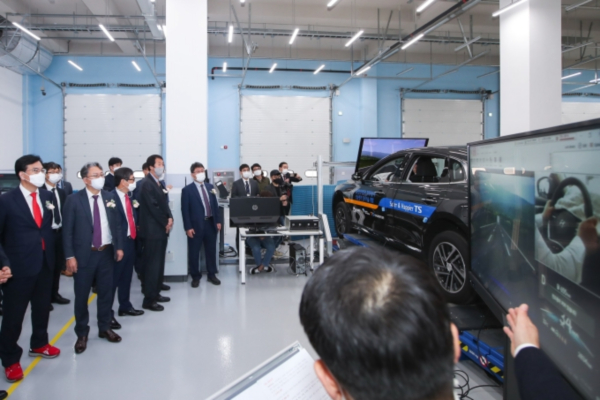
▲ Kabic announced its full-scale launch [Photo = Ministry of Land, Infrastructure and Transport]
Five years ago, the number of EVs was only around 6,000, but today, the number has skyrocketed to 120,000. With the increasing number of vehicles equipped with advanced safety features such as lane departure warning systems, automatic emergency braking systems, and adaptive cruise control, which enable autonomous lane changes and overtaking, the role of vehicle inspections in ensuring the safety of cutting-edge vehicles, including electric, hydrogen, and autonomous vehicles, has become increasingly crucial.
Since 2017, the Ministry of Land, Infrastructure and Transport and the Korea Transportation Safety Authority have invested approximately 23 billion won to promote the construction of the Cavic in Gimcheon Innovation City, Gyeongbuk. Kabic will be operated by the Korea Transportation Safety Authority, and a new operating organization has been established within the authority.
Going forward, Kabic will conduct R&D on advanced safety device inspection technology (2021-22) and hydrogen bus inspection technology (2021-23).
Furthermore, in response to future changes in the transportation environment, we will develop and disseminate inspection technologies to ensure the safety of advanced vehicles during operation, ensuring efficient implementation of vehicle inspection and safety policies. Through the development and training of specialized training programs for advanced automotive professionals, we will also contribute to enhancing the expertise of automotive industry workers and creating new jobs in new industries.
Earlier this year, South Korea became the first country in the world to adopt Level 3 autonomous vehicle safety standards, enabling the launch and sale of autonomous vehicles equipped with autonomous vehicle maintenance functions starting in July. Last year, South Korea was appointed the Asian Chair of the Comité International de l'Inspection Technique Automobile (CITA), a UN advisory body, and is planning joint research abroad. This, coupled with the country's appointment as the Asian Chair of CITA, a UN advisory body, suggests that Kavik's role in leading the global automotive inspection industry is expected to grow even further.
Yoon Jin-hwan, Director General of Automobile Management at the Ministry of Land, Infrastructure and Transport, said, “In line with the expansion of advanced vehicles such as electric, hydrogen, and autonomous vehicles, we will accelerate the development and distribution of inspection technology to create a safe driving environment,” and “We will strive to ensure that Carbic can play a key role in the international standardization of inspection systems and standards.”

Comments
Related news
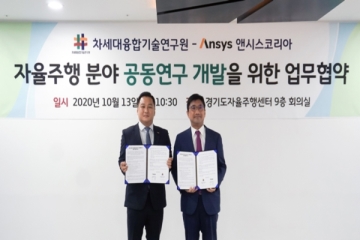
Ansys and the Korea Institute of Convergence Technology Sign MOU on Autonomous Driving
Ansys Korea and the Advanced Institute for Convergent Technology (AICT) have signed a memorandum of understanding (MOU) at the Gyeonggi-do Autonomous Driving Center. The agreement was concluded to jointly conduct research in the autonomous driving field, develop toolchains for validating autonomous driving technology standards, and provide a development environment compliant with global standards to relevant small and medium-sized venture companies. Under this agreement, the two organizations will establish a mutually organic cooperation system to jointly develop and support joint research in the autonomous driving field and autonomous driving technology verification classification and development processes for small and medium-sized venture companies. Additionally, they will provide environments and technologies for integrated development of autonomous driving embedded software, and exchange technologies regarding toolchain development for autonomous driving technology standard validation, autonomous vehicle operation scenario validation, and autonomous driving sensor simulation.
2020.10.15by 명세환 기자
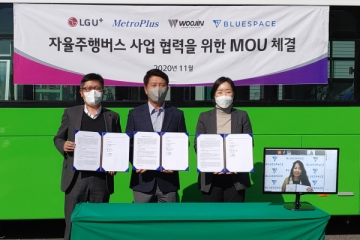
LGU+ partners with domestic and international companies to unveil autonomous buses.
LG Uplus is joining hands with domestic and international specialists including Blue Space, Woojin Industrial Systems, and Metro Plus to launch an autonomous bus business in earnest. The four companies signed a memorandum of understanding (MOU) for business cooperation at Woojin Industrial Systems' plant in Ochang, North Chungcheong Province, and agreed to develop detailed measures including the formation and operation of a working-level consultation group.
2020.11.11by 명세환 기자
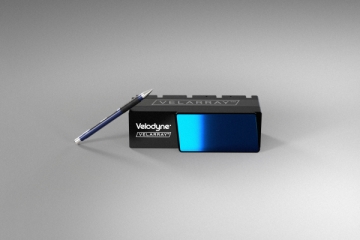
Velodyne Unveils Affordable Solid-State Lidar
Lidar, which detects areas that cameras and radars cannot sense, is useful not only for implementing autonomous driving but also for preventing traffic accidents. However, its high price has been a barrier to adoption. Velodyne Lidar has unveiled the VelaRay H800, a solid-state lidar sensor, at an affordable price of less than 500 dollars.
2020.11.18by 명세환 기자

[e4ds Tech Day 2026 ⑨] Sim Sang-gyu, Autocrypt CTO: "In the Physical AI Era, Automotive Security Must Extend Beyond the Vehicle"
At e4ds Tech Day 2026, Sim Sang-gyu, CTO of Autocrypt, explained automotive cybersecurity strategies in the era of Physical AI and SDV (Software-Defined Vehicle). Automobiles are evolving as part of an ecosystem connected to AI, cloud, chargers, IoT, and robots, and he emphasized that the scope of security must expand beyond the vehicle interior to the entire connected environment. In particular, AI model tampering, adversarial attacks, OTA updates, and EV charger hacking were identified as major threats. He explained that response measures require zero trust, AI model integrity protection, intrusion detection, Security by Design and Default, and full lifecycle security management, and that proactive security system establishment beyond regulatory compliance is critical for securing future mobility competitiveness.
2026.10.12by 배종인 기자

Practical HIL Construction Strategy for Automotive and Off-Highway Controller Validation
As vehicle E/E architecture transitions to zonal structures and shifts to software-defined vehicles (SDV), the number of controllers (ECUs) requiring validation and software complexity are surging dramatically. Meanwhile, real vehicle testing cannot provide repeated verification under identical conditions and entails lead time and safety concerns. This white paper explains the principles of HIL (Hardware-in-the-Loop) validation and the structure of the NI platform composed of PXI, SLSC, and VeriStand, and through two actual implementation cases—Camera Record & Replay HIL for In-Cabin Monitoring Controller (ICMU) and Forklift Controller (VCU) HILS—describes how controller-level regression testing becomes possible. Additionally, it explicitly states application boundaries and limitations, such as lack of A2B support.
2026.10.12by 편집부











