



Maxim Unveils 'Parasitic Power Operation' Automotive 1-Wire Certified Device
 Published2021.01.14 15:15
DS28E40 Automotive 1-Wire Certification Device Launched
Small PCB space and code base, resulting in high reliability
As vehicle functions become increasingly sophisticated, safety and security risks are also rising. Vehicle manufacturers use authentication devices to verify that OEM-certified components are properly installed for safe vehicle operation and to mitigate the risk of malware attacks. However, most security MCUs require a relatively large footprint, and software development teams are also needed to generate code for testing and debugging.
Maxim Integrated Korea launched the 'DS28E40', a DeepCover® automotive 1-wire security authentication device that operates on parasitic power to enhance the safety, security, and data integrity of systems installed in vehicles and reduce design complexity, on the 14th.
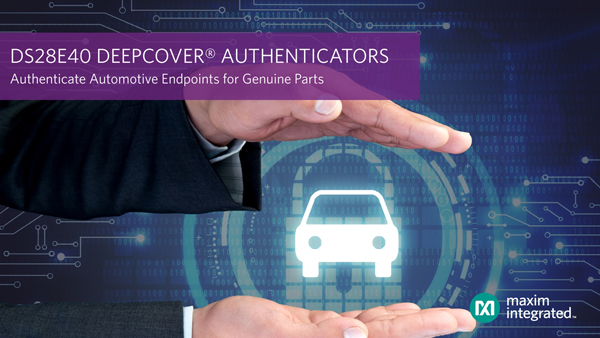
DS28E40 Launch [Image=Maxim]
For MCU-based solutions, the larger the codebase, the greater the risk of bugs that negatively impact performance or the infiltration of malware. Furthermore, I2 C/SPI interface automotive security solutions require as many as 5 to 6 interface pins, including dedicated power and reset lines; the more pins there are, the higher the cost and the more reliability issues arise.
The DS28E40 meets the AEC-Q100 standard Grade 1 performance criteria and replaces MCU-based methods. It reduces system design complexity while meeting security demands by providing manufacturers with the desired algorithms and command sets. It includes public/private key asymmetric ECDSA (ECC-P256 curve) as well as other key authentication algorithms, allowing for the elimination of the need for proprietary device-level code development.
The 1-wire interface combines power and communication onto a single pin, requiring only two connection pins, including a ground pin, compared to the six pins previously required. Fewer connection pins allow for a smaller cable harness size to connect the ECU to a remote endpoint, thereby reducing costs and ensuring reliability. It is housed in a 4mm × 3mm TDFN package with an operating temperature range of –40 to +125°C.
The DS28E40 supports the embedded symmetric key security hash algorithm (SHA-256). It provides hardware-based security stronger than software-based methods by offering secure storage of ECDSA and SHA-256 keys, as well as one-time programmable (OTP) non-volatile memory for storing digital certificates and production data.

Comments
Related news

Telechips Adopts Arm IP Supporting 'Functional Safety' for Automotive APs
Telechips has adopted an Arm Cortex-A76 CPU supporting automotive digital cockpit, an Arm Mali-G78AE GPU providing functional safety by supporting up to four fully independent partitions, and an Arm Ethos-N78 NPU dedicated to machine learning in its next-generation automotive AP, Dolphin 5.
2020.12.15by 명세환 기자
ROHM Launches 'BR24H-5AC' EEPROM withstanding 125℃ environment
To ensure the safety of industrial and automotive equipment and manage production history, there is growing demand for recording and preserving system operation history in non-volatile memory within the system. In response, Rohm has developed the BR24H-5AC series, an I2C BUS EEPROM that supports operation at 125°C and enables stable data writing and retention even in harsh environments.
2020.12.29by 이수민 기자

TI Announces Highly Accurate Voltage Monitoring/Balancing IC for EVs
For automobile manufacturers, filtering system-level noise to accurately measure battery cell voltage and temperature and reliably transmit this information to the MCU is a very important design challenge. Texas Instruments has released the BQ79616-Q1, an automotive battery monitoring and balancing IC that enables accurate voltage measurement even in high-voltage systems of up to 800V.
2021.01.07by 명세환 기자
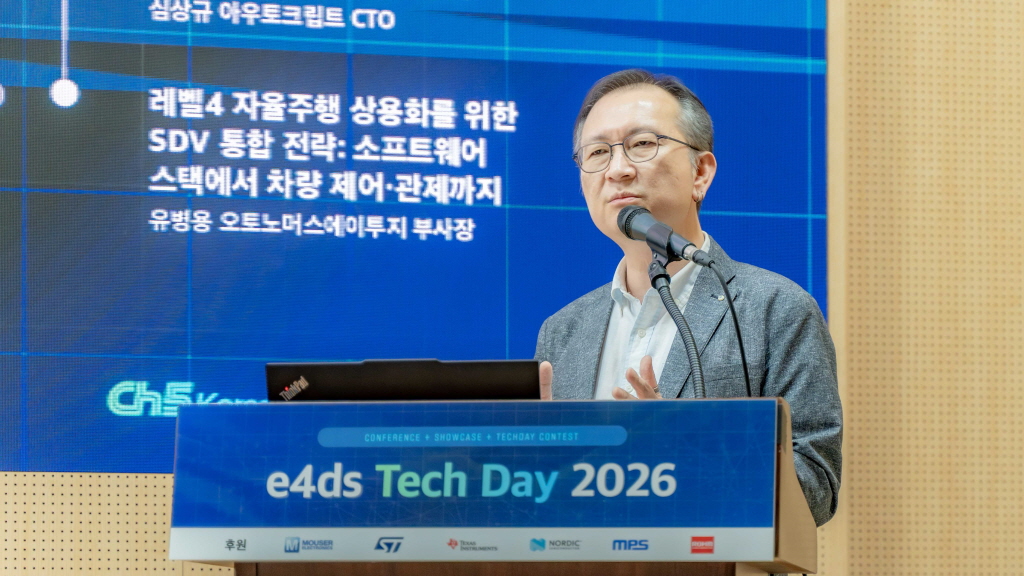
[e4ds Tech Day 2026 ⑨] Sim Sang-gyu, Autocrypt CTO: "In the Physical AI Era, Automotive Security Must Extend Beyond the Vehicle"
At e4ds Tech Day 2026, Sim Sang-gyu, CTO of Autocrypt, explained automotive cybersecurity strategies in the era of Physical AI and SDV (Software-Defined Vehicle). Automobiles are evolving as part of an ecosystem connected to AI, cloud, chargers, IoT, and robots, and he emphasized that the scope of security must expand beyond the vehicle interior to the entire connected environment. In particular, AI model tampering, adversarial attacks, OTA updates, and EV charger hacking were identified as major threats. He explained that response measures require zero trust, AI model integrity protection, intrusion detection, Security by Design and Default, and full lifecycle security management, and that proactive security system establishment beyond regulatory compliance is critical for securing future mobility competitiveness.
2026.10.12by 배종인 기자

Practical HIL Construction Strategy for Automotive and Off-Highway Controller Validation
As vehicle E/E architecture transitions to zonal structures and shifts to software-defined vehicles (SDV), the number of controllers (ECUs) requiring validation and software complexity are surging dramatically. Meanwhile, real vehicle testing cannot provide repeated verification under identical conditions and entails lead time and safety concerns. This white paper explains the principles of HIL (Hardware-in-the-Loop) validation and the structure of the NI platform composed of PXI, SLSC, and VeriStand, and through two actual implementation cases—Camera Record & Replay HIL for In-Cabin Monitoring Controller (ICMU) and Forklift Controller (VCU) HILS—describes how controller-level regression testing becomes possible. Additionally, it explicitly states application boundaries and limitations, such as lack of A2B support.
2026.10.12by 편집부











