


A consultative body has been launched to aim for commercialization of UAM services by 2025.
 Published2021.01.29 09:25
Anchor for global competition through cooperation among Korean UAM players
Targeting commercial UAM services by 2025
Urban Air Mobility (UAM) is an air transportation service utilizing electric vertical takeoff and landing (eVTOL) small aircraft. It can reach destinations that would normally take an hour by car in about 20 minutes, and it can be connected to various ground transportation modes, attracting attention as a transformative urban lifestyle service.
On the 28th, SK Telecom signed an MOU for UAM commercialization with Korea Airports Corporation, Hanwha Systems, and the Korea Transport Institute at Gimpo Airport in Seoul.
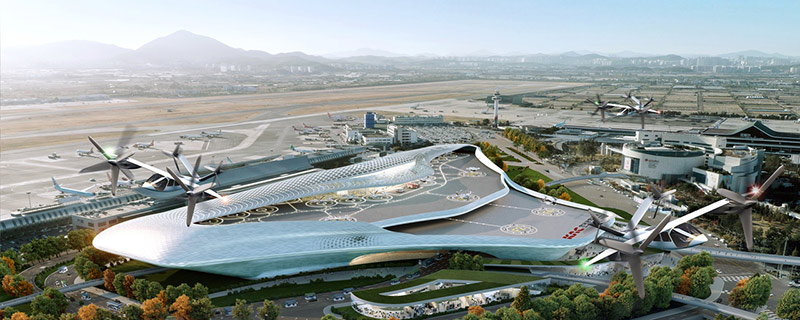
According to the Ministry of Land, Infrastructure and Transport, the UAM industry is expected to form a global market worth 731 trillion won by 2040. In response, the government established "UAM Team Korea," a government-wide consultative body, in June of last year and set a target of launching UAM commercial services by 2025.
Additionally, we are supporting private sector-led flight demonstration projects. The plan is to also establish operating standards that are suitable for domestic conditions, such as communication environment and safety measures.
The four companies plan to continue collaborating on research and development across all areas, including UAM infrastructure, aircraft, operation services, navigation, platforms, demand, and acceptance. In the long term, they aim to reduce the social costs associated with traffic congestion in major cities, including the Seoul metropolitan area, and promote the establishment of eco-friendly transportation modes that do not emit greenhouse gases.
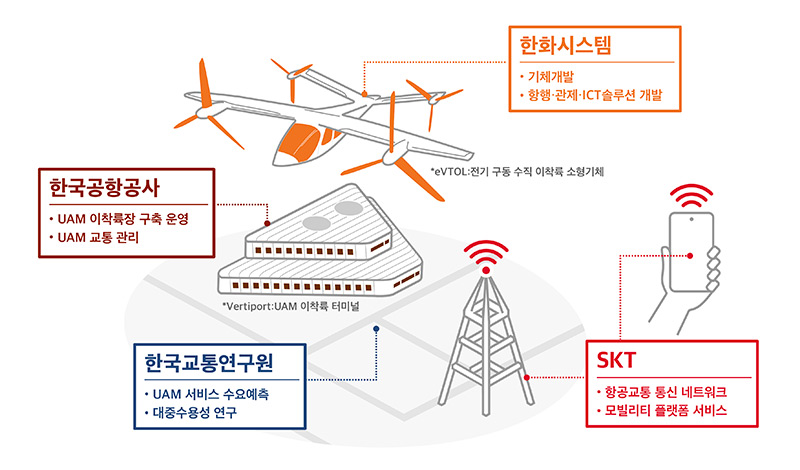
SKT is demonstrating and building an air traffic communication network model. To safely control UAM, a stable communication system connecting the aircraft and the ground is essential. SKT is building a network that provides an optimal communication environment not only on the ground but also in the air.
In addition, a mobility platform for UAM will be developed to provide integrated services related to boarding reservations and transfers with ground transportation, thereby laying the foundation for efficient use of UAM, buses, trains, and personal mobility from departure to arrival.
Korea Airports Corporation will be responsible for the construction and operation of UAM vertiports and UAM traffic management, while Hanwha Systems will be responsible for UAM airframe development, navigation, control, and ICT solution development. The Korea Transport Institute will conduct research on UAM service demand forecasting and public acceptance.

Comments
Related news
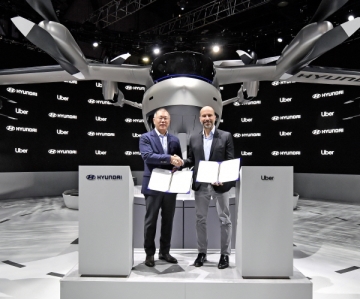
Hyundai Motor and Uber Present New Direction for Human Mobility by Realizing Urban Air Mobility
Hyundai Motor unveiled an urban air mobility concept based on personal air vehicles with Uber at CES 2020. Completed through Uber's air taxi development process, it features electric propulsion and vertical takeoff and landing capability that enables flight without a runway. Hyundai will pursue PAV development while Uber will focus on providing urban air mobility services.
2020.01.08by 최인영 기자
.jpg)
"Drone taxis are taking off." The Ministry of Land, Infrastructure and Transport and the Seoul Metropolitan Government demonstrate 'UAM' in the city center.
Urban air mobility has recently drawn attention as an alternative to solve ground traffic congestion in major metropolitan areas. Leading countries worldwide are accelerating the development of electric-powered vertical takeoff and landing aircraft. The Ministry of Land, Infrastructure and Transport and Seoul City jointly held demonstration events for drone delivery and taxi services in Yeouido. The Ministry of Land, Infrastructure and Transport announced that it will smoothly implement the K-UAM roadmap through industry-academic-research-government collaboration, with the aim of commercialization in 2025 based on this demonstration.
2020.11.12by 명세환 기자
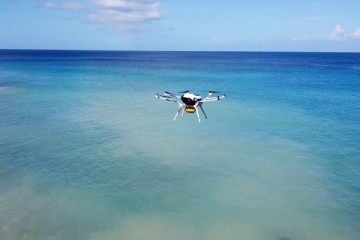
Extending drone flight range depends on optimizing hydrogen fuel cell power delivery network (PDN).
Hydrogen fuel cell technology is enhancing the utility of drones. Doosan Mobility Innovation (DMI) has completed demonstration of the DS30 drone equipped with the DP30 power pack, a hydrogen fuel cell, and is now expanding its lineup. To manufacture drones capable of flights exceeding two hours, DMI adopted Vicor's modular regulators, achieving miniaturization, weight reduction, and efficiency optimization of the power system.
2021.01.12by 이수민 기자
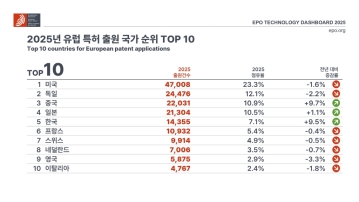
European Patent Applications Surpass 200,000 for the First Time… South Korea Maintains 5th Place, Led by Batteries and Telecommunications
According to the European Patent Office (EPO)'s 'Technology Dashboard 2025', European patent applications last year reached 201,974, surpassing 200,000 for the first time. Korean companies and inventors filed 14,355 applications, representing a 9.5% increase from the previous year and maintaining 5th place by country. Battery, digital communication, and semiconductor technologies led the growth, with Samsung ranking as the top EPO applicant for the second consecutive year and LG reaching 3rd place. The presence of major domestic cities such as Seoul, Suwon, and Yongin was also confirmed. It was also revealed that Korea's European patent strategy is expanding beyond individual technologies to span the entire industry.
2026.03.24by 명세환 기자

SK Telecom First Applies AI-Based Network Operations at Gwanghwamun K-Pop Concert
SK Telecom announced that it applied an AI-based network operation system for the first time at a large-scale K-pop concert held in the Gwanghwamun area of Seoul on March 21st, managing communication quality throughout the event. Mobile data usage during the three hours before and after the concert reached 12.15TB, approximately doubling compared to the same time slot the previous weekend. SK Telecom monitored traffic using the AI system 'A-One' in five-minute and 50-meter units to respond to potential overload situations, while also operating temporary communication facilities and on-site personnel in parallel. This case is interpreted as confirmation of the practical applicability of AI-based autonomous network operation in an environment where demand from dense events and foreign users increases simultaneously.
2026.03.23by 명세환 기자











