


5 Winds of Change to Blow Through the Automotive Industry in 2021
 Published2021.02.19 15:35
Autonomous driving expected to be applied first to commercial vehicles rather than passenger cars
New car features can be downloaded like an app
The automotive industry this year is expected to continue adopting new technologies and approaches to lay the foundation for autonomous driving businesses. Willard Tu, Senior Director of Xilinx’s Automotive Business Unit, predicted five changes that will sweep through the automotive industry this year.

It appears likely to enter the autonomous driving business [Graphic = Xilinx]
The five changes are the expansion of AI technology into areas beyond ADAS, autonomous commercial vehicles paving the way for autonomous passenger cars, suburban areas growing alongside electric vehicle infrastructure, the emerging battery recycling business, and the beginning of privately owned vehicles becoming adaptive platforms.
Diffusion of AI technology into areas beyond ADAS
Advanced Driver Assistance Systems (ADAS) utilize AI technology and other means to assist drivers in safe driving. AI technology is expected to enhance driver convenience in areas beyond driving. Director Two cited self-restoration, beginner mode, and valet parking as examples.
Automobiles are now expected to be equipped with self-healing capabilities based on self-diagnosis using AI technology—in other words, predictive maintenance functions. Furthermore, just as AI solutions that generate driving habit feedback to improve fuel efficiency have emerged, the appearance of AI solutions that analyze the surrounding environment using cameras, radar, and lidar to provide real-time coaching to novice drivers so they can avoid accidents is also anticipated.
Perfect, comprehensive AI systems like Jarvis from the movie 'Iron Man,' HAL 9000 from '2001: Space Odyssey,' and KITT from the drama 'Knight Rider' are still premature. However, automakers are already pushing forward with plans to develop valet parking functions.
These systems ensure passenger safety, provide information and convenience, and increase productivity. Voice and gesture-based UIs will intuitively understand commands. Augmented reality (AR) supports navigation, provides points of interest, or warns of safety issues, while virtual reality (VR) projections can show what is behind blind spots.
To implement this, Director Two predicted that there would be development and improvements such as AI-based voice/motion combination technology, high-performance hardware, OTA update capabilities, and a camera system supporting VR overlays. These technologies are also expected to be used to predict 'Driving Mood,' such as whether the driver is driving leisurely or needs to reach their destination quickly.
Autonomous commercial vehicles paving the way for autonomous passenger cars
Commercial vehicle manufacturers are already developing and applying autonomous driving technology. As a result, it is expected that we will see even more examples of autonomous driving in this field.
Director Tu said, “In the future, we will see new technologies such as trucks traveling long distances on special roads filled with sensors connected to 5G networks, and drone mode functions that allow the driver to remotely intervene in truck operations in emergencies.”
suburban areas growing with electric vehicle infrastructure
In countries like Germany, Japan, and China, train stations serve as leisure hubs. Electric vehicles require a large number of charging stations. If a large number of charging stations are established at hubs like train stations, leisure services can be provided to drivers resting while their vehicles are fully charged, which will lead to the development of suburban areas.
Emerging Battery Recycling Business
Last year, IHS Markit predicted that global automobile demand would increase to 11.2 million units in 2025 and 31.1 million units in 2030, accounting for about 32% of total new car sales. And batteries account for 40% of the price of an electric vehicle on average.
With battery usage projected to increase compared to current levels, the development of technologies for processing or recycling expired batteries is expected to accelerate in order to prevent environmental problems caused by mass battery disposal in the future.
Start of Adaptive Platformization for Privately Owned Vehicles
Numerous automobile manufacturers have long attempted to utilize personal-owned vehicles (POVs) as a platform for a stable revenue stream. Some manufacturers attempted to collect monthly reception fees by equipping their cars with satellite radio reception capabilities.
If automotive manufacturers deploy upgradeable High Performance Central Computing (HPCC) nodes within vehicles, they gain the ability to sell 'features' similar to the proliferation of smartphone app stores. This signifies a transformation from existing low-cost, distributed ECU-centric vehicles into flexible, adaptive platforms capable of supporting functions that have not yet been designed.
In addition, brand loyalty can be increased by providing a service that allows users to transfer features downloaded to their current vehicle to a newly purchased car, much like a smartphone.

Comments
Related news
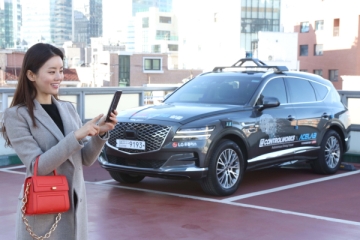
U+ Demonstrates 5G Unmanned Valet Parking Service: "Commercialization Not Yet"
Autonomous driving technology that enhances accuracy through communication with surrounding objects has been developed. LG Uplus, AceLab, and ControlWorks held an online press briefing on the 17th and publicly demonstrated 5G mobile communication-based autonomous parking technology. Autonomous parking is a concept of autonomous valet parking where a vehicle independently finds nearby parking lots and parks in an available space. This demonstration comes approximately one year after LG Uplus showcased vehicle unmanned remote call technology in October of last year.
2020.12.17by 이수민 기자
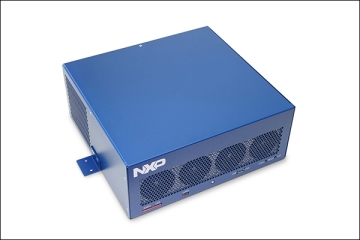
NXP Announces BlueBox 3.0, a Automotive Computing Development Platform
NXP Semiconductors has announced BlueBox 3.0, a new expanded version of its automotive high-performance compute (AHPC) development platform. BlueBox 3.0 is a platform for software application development and validation before semiconductors are commercialized. This version provides flexible implementation methods for evolving automotive architectures, including customized vehicles, autonomous driving at safety level 2+, and connected cars.
2021.01.14by 명세환 기자

Creating a Level 4 Autonomous Driving Ecosystem, to be Completed by 2027
The implementation of Level 4 fully autonomous driving, where vehicles independently assess situations and require no driver intervention even in emergencies, demands changes not only to vehicles and components but also to infrastructure. Four government agencies—the Ministry of Land, Infrastructure and Transport, the Ministry of Trade, Industry and Energy, the Ministry of Science and ICT, and the National Police Agency—announced 53 new projects for the 2021 'Autonomous Driving Technology Development Innovation Project' with an investment of 85.04 billion won. The project will receive a total investment of 1.0974 trillion won from this year through 2027.
2021.01.16by 명세환 기자
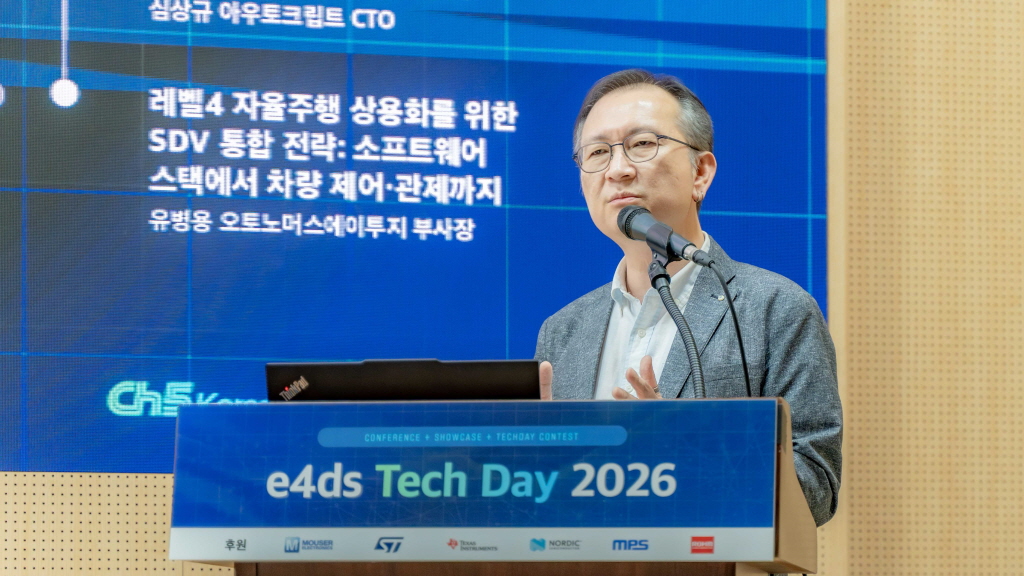
[e4ds Tech Day 2026 ⑨] Sim Sang-gyu, Autocrypt CTO: "In the Physical AI Era, Automotive Security Must Extend Beyond the Vehicle"
At e4ds Tech Day 2026, Sim Sang-gyu, CTO of Autocrypt, explained automotive cybersecurity strategies in the era of Physical AI and SDV (Software-Defined Vehicle). Automobiles are evolving as part of an ecosystem connected to AI, cloud, chargers, IoT, and robots, and he emphasized that the scope of security must expand beyond the vehicle interior to the entire connected environment. In particular, AI model tampering, adversarial attacks, OTA updates, and EV charger hacking were identified as major threats. He explained that response measures require zero trust, AI model integrity protection, intrusion detection, Security by Design and Default, and full lifecycle security management, and that proactive security system establishment beyond regulatory compliance is critical for securing future mobility competitiveness.
2026.10.12by 배종인 기자

Practical HIL Construction Strategy for Automotive and Off-Highway Controller Validation
As vehicle E/E architecture transitions to zonal structures and shifts to software-defined vehicles (SDV), the number of controllers (ECUs) requiring validation and software complexity are surging dramatically. Meanwhile, real vehicle testing cannot provide repeated verification under identical conditions and entails lead time and safety concerns. This white paper explains the principles of HIL (Hardware-in-the-Loop) validation and the structure of the NI platform composed of PXI, SLSC, and VeriStand, and through two actual implementation cases—Camera Record & Replay HIL for In-Cabin Monitoring Controller (ICMU) and Forklift Controller (VCU) HILS—describes how controller-level regression testing becomes possible. Additionally, it explicitly states application boundaries and limitations, such as lack of A2B support.
2026.10.12by 편집부











