


"Expanding semiconductor manufacturing facilities requires tax credits."
 Published2021.04.09 15:35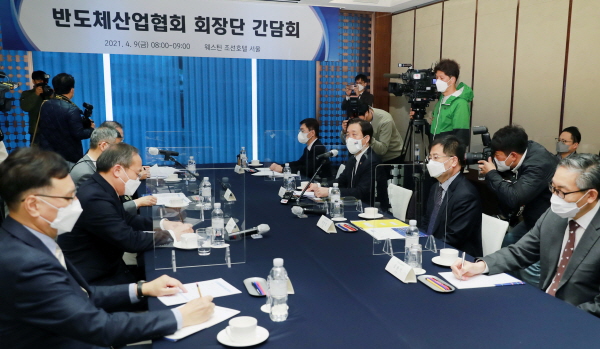
Suggestions for expanded incentive support and proactive response to international situations
The semiconductor industry has requested government support, including tax incentives, to expand semiconductor supply and respond to the global semiconductor market.
The Ministry of Trade, Industry and Energy (Minister Sung Yun-mo) held a 'Semiconductor Association Chairman's Meeting' on the 9th, chaired by Minister Sung Yun-mo, to review issues related to the semiconductor global supply chain and discuss response measures.
At this meeting, the government and industry shared recent key trends, including the global semiconductor supply shortage and major countries' semiconductor industry development policies, and intensively discussed future response measures, including expanding domestic investment and government support measures.
At this event, Samsung Electronics President Lee Jung-bae, who began his term as chairman of the Semiconductor Association in March of this year, said, “The semiconductor industry is an essential element for the development of future industries such as artificial intelligence, autonomous vehicles, and bio, and is a core industry that leads the national economy.” He also requested, “In order for the semiconductor industry to continue to develop, it is necessary to establish a comprehensive support system at the government level for training semiconductor personnel, and to strengthen government policy support such as tax deductions for the expansion of domestic semiconductor manufacturing facilities.”
Additionally, the Semiconductor Association's executive committee delivered an 'Industry Suggestion for the Development of the Semiconductor Industry' at this event and requested that it be reflected in future policies.
The proposal includes: △ Expanding incentive support for the expansion of domestic semiconductor manufacturing facilities; △ Developing excellent human resources to lead the semiconductor super gap.It includes support for stabilizing the domestic semiconductor supply chain, fostering and supplying resourses, and providing government support for proactive responses to the rapidly changing international situation surrounding the semiconductor industry.
The Ministry of Trade, Industry and Energy and the industry recently agreed that Korea, as a semiconductor production base, a core component of the global IT industry, contributes to the revitalization of the global economy by providing a stable supply of semiconductors, including 71% of DRAM, 45% of NAND, and 40% of advanced foundries, in response to the global semiconductor shortage.
They also exchanged opinions on key current semiconductor-related issues, including stabilizing the global supply chain, expanding private investment, nurturing human resources, addressing the shortage of automotive semiconductors, and developing new markets such as next-generation power semiconductors and AI semiconductors.
Minister of Trade, Industry and Energy Sung Yun-mo said, “The semiconductor industry has recently faced competition not only between companies but also between countries, so it is time for the government and the private sector to join forces to overcome the current crisis.” He added, “As a global semiconductor production base, our country must contribute to the global economy by providing sufficient and stable supply.”
He also called for "active expansion of private sector investment to build a stable supply chain, including expanding memory and foundry production capacity, and mentioned the need for solidarity and cooperation to revitalize the industrial ecosystem."

Comments
Related news
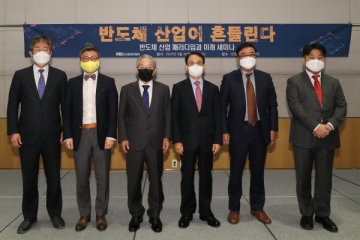
Chairman Jin Dae-je: "National preparation for semiconductor hegemony is essential."
Supply will remain tight relative to semiconductor demand for a considerable period, and opinions have been presented that national-level countermeasures need to be established in preparation for semiconductor hegemony competition. The Federation of Korean Industries (hereinafter referred to as FKI) held a seminar on the 30th at the FKI Hall Conference Center with the theme of "The Semiconductor Industry is Shaken: Semiconductor Industry Paradigm and Future."
2021.03.30by 배종인 기자
.jpg)
Government to spur next-generation power semiconductor development
The government is accelerating full-scale development of three next-generation semiconductor materials—silicon carbide (SiC), gallium nitride (GaN), and gallium oxide (Ga2O3)—which offer superior power efficiency and durability compared to silicon, while strengthening an integrated value chain that connects semiconductor devices, modules, and systems.
2021.04.01by 배종인 기자
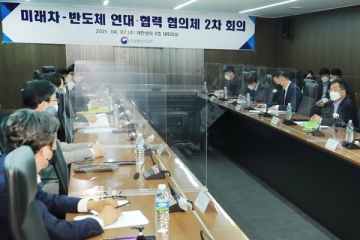
Emergency commercialization of 10 automotive semiconductors
The government and private sector are embarking on emergency commercialization of automotive semiconductor components and modules, identifying approximately 10 items seeking performance evaluation and providing initial budget support of 40 billion won.
2021.04.08by 배종인 기자
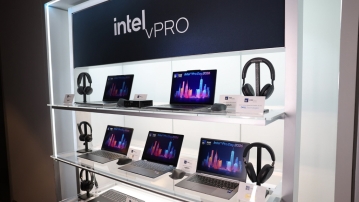
Intel Unveils Next-Generation 'Core Ultra Series 3' and vPro Platform for Enterprise PCs
Intel has officially unveiled the "Intel Core Ultra Series 3" for next-generation enterprise PCs and the latest vPro platform, addressing a wide range of demands from enterprise notebooks to high-performance workstations.
2026.03.26by 배종인 기자
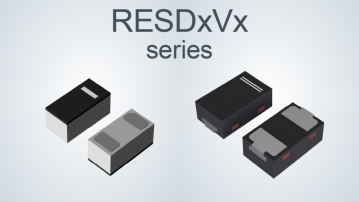
ROHM Launches ESD Protection Diode Compatible with High-Speed Interfaces of 10Gbps or Higher
Semiconductor specialist ROHM has developed the 'RESDxVx series' of ESD (electrostatic discharge) protection diodes capable of responding to next-generation high-speed data communication environments exceeding 10Gbps, simultaneously enhancing both signal quality maintenance required in high-speed interfaces and IC protection performance.
2026.03.26by 배종인 기자











