


Microchip Distributes Free Software to 'Accelerate Development' of USB PD Systems
 Published2021.04.15 11:29
Release of open source PD software supporting code integration
On the 15th, Microchip released the 'Power Delivery Software Framework (PSF),' which supports IP modification and ownership of USB-C Power Delivery (PD) systems.
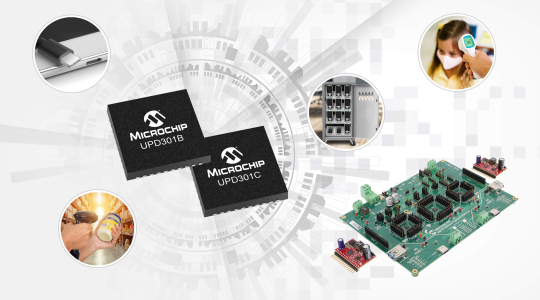
PSF Solution Revealed [Graphic by Microchip]
Developers can combine proprietary code with the Microchip PD stack to gain flexibility for developing differentiated products and select standalone PD solutions for various Microchip SmartHub, MCU, and USB systems.
PSF provides an open-source codebase and a comprehensive programming environment for power supply. Developers can easily program MCUs without relying on vendors and immediately modify PD code as the system evolves. By directly managing the entire process from product development to production, it enables shorter time-to-market and reduced BOM costs.
Developers can leverage both software and hardware frameworks to host PD functions, including the new 'UPD301B and UPD301C' standalone PD controllers, within Microchip's expanded family of controller options. The open approach of the PD architecture allows USB-C and PD ports to be easily added to a wide range of embedded applications, and unused pins or CPU memory can be reallocated to other system functions.
Various Microchip SAMs, PIC® MCUs, and Digital Signal Controllers (DSCs) are also supported. The PSF solution enables developers to run PDs on existing Microchip MCU infrastructure by adding 'UPD350' PD transceivers or integrating PDs into more complex product families via proprietary system code.
The free downloadable PSF solution is supported by the Microchip MPLAB® X IDE development environment. PSF evaluation boards featuring the 'SAMD20' MCU and UPD350 PD PHY are also currently available. The UPD301C is priced at $1.50 per unit in 10,000-unit quantities.
Comments
Related news
Efficient USB-PD power design starts with component selection
Devices powered by rechargeable batteries are being actively sold in the market. To support increasingly enhanced device performance, the power density and efficiency of charging must be improved. USB-PD is a convenient and fast charging technology that minimizes chargers and cables while increasing charging speed. To utilize this, various topologies and power technologies must be available.
2021.01.06by 이수민 기자
.jpg)
ST Unveils MasterGaN2, Boosting Power Density in USB-PD Products
ST Microelectronics has launched the 'MasterGaN2' device, an integrated GaN solution optimized for soft-switching and active rectifier converter topologies. The two 650V normally-off GaN transistors feature on-resistances of 150mΩ and 225mΩ, and when combined with a gate driver, can be used as easily as conventional Si devices.
2021.01.29by 강정규 기자

Microchip Unveils Automotive IVI Ethernet AVB Controller
Microchip has launched the LAN9360, a single-chip Ethernet controller that embeds hardware-based audio endpoint solution protocols for Ethernet AVB. The new controller connects audio between Ethernet AVB and local audio interfaces such as I2S, TDM, and PDM. It also supports audio transmission over Ethernet AVB, including gPTP, timestamping, transmission protocols, and content protection using HDCP. It additionally supports secure boot over Ethernet and secure remote updates.
2021.02.16by 강정규 기자

Intel Unveils Next-Generation 'Core Ultra Series 3' and vPro Platform for Enterprise PCs
Intel has officially unveiled the "Intel Core Ultra Series 3" for next-generation enterprise PCs and the latest vPro platform, addressing a wide range of demands from enterprise notebooks to high-performance workstations.
2026.03.26by 배종인 기자

ROHM Launches ESD Protection Diode Compatible with High-Speed Interfaces of 10Gbps or Higher
Semiconductor specialist ROHM has developed the 'RESDxVx series' of ESD (electrostatic discharge) protection diodes capable of responding to next-generation high-speed data communication environments exceeding 10Gbps, simultaneously enhancing both signal quality maintenance required in high-speed interfaces and IC protection performance.
2026.03.26by 배종인 기자











