


UNIST Discovers Material to Lower Electric Vehicle Prices
 Published2021.05.10 08:42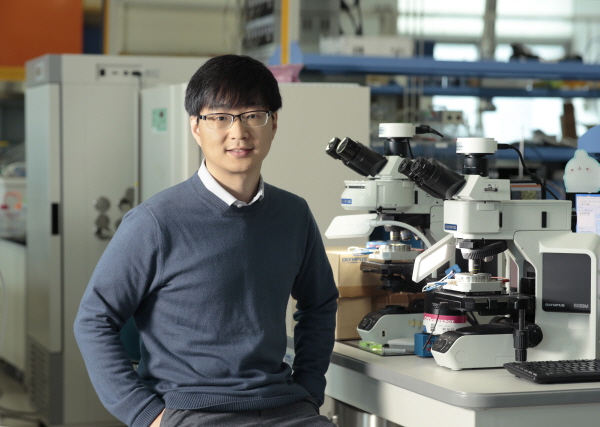
▲Professor Seo Dong-hwa
The design principles of 'disordered rock salt materials', which are attracting attention as next-generation electric vehicle battery materials, have been newly presented, providing momentum to the development of materials that will lower the price of electric vehicles.
An international joint research team led by Professor Dong-Hwa Seo of the Department of Energy and Chemical Engineering at UNIST (President Yong-Hoon Lee) has discovered for the first time that the principle of ‘lithium excess composition,’ which was considered a design principle for high-performance disordered rock salt electrodes, does not apply to certain disordered rock salt materials.
It was known that lithium-excess composition, which designs the lithium ratio to be 35% or more higher than that of expensive transition metals, increases electrode performance but at the same time reduces the lifespan of the battery, but the research team discovered a material that overturns this principle.
The results of this study, in which Professor Jinhyeok Lee of the Department of Materials Science and Engineering at McGill University in Canada and Professor Ju Li of MIT in the United States participated, were published on May 6 in Advanced Energy Materials, an international academic journal in the field of energy materials.
cobalt, cathode materials containing large amounts of expensive rare metals such as nickel account for more than 20% of the cost of electric vehicle battery (lithium-ion battery) cells. For this reason, they have a structure similar to the atomic arrangement of disordered rock-salt salt crystals (rock salt, NaCl), which contain large amounts of inexpensive and abundant manganese and iron. The cations, transition metals and lithium, are arranged randomly (disorderedly), giving them the name disordered rock-salt material.
This material is attracting attention as a new cathode material. Compared to commercially available materials, its capacity is 30-50% greater, making it suitable not only for electric vehicles but also as a large-capacity battery material for storing power generated by renewable energy sources.
On the other hand, the short lifespan of disordered rock salt cathodes has been a stumbling block to their commercialization. Previous research has shown that to maximize high-capacity performance, these cathodes must be designed with a higher lithium content than conventional cathodes. However, high lithium content in the material can lead to unstable oxygen leaking out of the electrode, which reduces battery life.
According to the joint research team's research, certain metal-based disordered rock salt materials, such as manganese and vanadium, can maintain the performance of high-capacity electrodes even with reduced lithium content, and the lifespan is more than twice that of existing ones. On the other hand, in the case of nickel or cobalt metal-based disordered rock salt materials, the higher the lithium content, the better the electrode performance, as per the existing theory.
The research team discovered this fact, which runs counter to existing theories, through experiments using two types of manganese-based disordered rock salt materials with different lithium contents and quantum mechanical modeling techniques based on density functional theory.
Professor Jinhyeok Lee, the first author and co-corresponding author, explained, “A new disordered rock salt material that can maintain high performance while reducing lithium content has been discovered, opening the way to replacing expensive battery cathode materials with cheaper disordered rock salt materials.”
Professor Seo Dong-hwa said, “With the increase in renewable energy generation as well as electric vehicles, there is a growing interest in inexpensive, high-capacity battery materials,” adding, “If disordered rock salt materials are commercialized, they will be able to meet this demand.”
This research was conducted with the support of the National Research Foundation of Korea's Basic Science and Engineering Research Project and the Overseas Excellent Research Institute Attraction Project, and with the support of the supercomputer of the Korea Institute of Science and Technology Information.
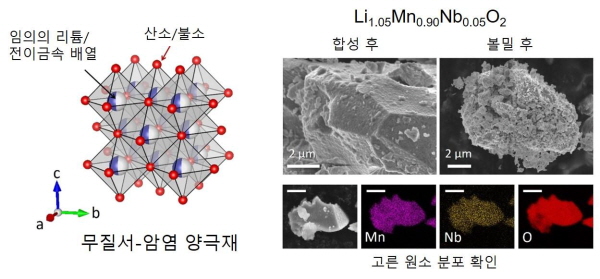
▲The structure of the disordered rock salt cathode material and a microscope image of the cathode material particles.

Comments
Related news
UNIST Develops Next-Generation Semiconductor Material Synthesis Technology to Replace Silicon
The commercialization of next-generation semiconductor materials to replace silicon is expected to accelerate. A research team led by Professor Park Hye-seong at UNIST and a team led by Professor Kang Ju-hun at Sungkyunkwan University have developed a technology for synthesizing transition metal chalcogenide compounds with superior atomic arrangement regularity. By utilizing this technology, two-dimensional semiconductor materials can be grown uniformly, thinly, and widely at the atomic level. The research team has also demonstrated feasibility by fabricating actual semiconductor devices.
2021.03.08by 이수민 기자
Ultra-fine device manufacturing process, atomic layer deposition, lowers costs.
Semiconductor chips contain up to billions of transistors and diodes. These microscopic devices exist in the form of patterns drawn within multiple layers of materials. A research team led by Professor Nam-goong Sun from the Department of Physics at UNIST has developed a technology to manufacture semiconductor patterns using only atomic layer deposition (ALD), a process that coats materials in thin layers repeatedly.
2021.03.24by 이수민 기자

UNIST succeeds in ammonia hydrogen production technology
A research team led by Professor Kim Gun-tae from the Department of Energy and Chemical Engineering at UNIST (President Lee Yong-hun) has developed an efficient technology for converting liquid ammonia into hydrogen and presented a new analytical technique that can identify optimal process conditions. The technology is drawing attention as a key technology to accelerate the green hydrogen era.
2021.05.07by 배종인 기자

[e4ds Tech Day 2026 ⑨] Sim Sang-gyu, Autocrypt CTO: "In the Physical AI Era, Automotive Security Must Extend Beyond the Vehicle"
At e4ds Tech Day 2026, Sim Sang-gyu, CTO of Autocrypt, explained automotive cybersecurity strategies in the era of Physical AI and SDV (Software-Defined Vehicle). Automobiles are evolving as part of an ecosystem connected to AI, cloud, chargers, IoT, and robots, and he emphasized that the scope of security must expand beyond the vehicle interior to the entire connected environment. In particular, AI model tampering, adversarial attacks, OTA updates, and EV charger hacking were identified as major threats. He explained that response measures require zero trust, AI model integrity protection, intrusion detection, Security by Design and Default, and full lifecycle security management, and that proactive security system establishment beyond regulatory compliance is critical for securing future mobility competitiveness.
2026.10.12by 배종인 기자

Practical HIL Construction Strategy for Automotive and Off-Highway Controller Validation
As vehicle E/E architecture transitions to zonal structures and shifts to software-defined vehicles (SDV), the number of controllers (ECUs) requiring validation and software complexity are surging dramatically. Meanwhile, real vehicle testing cannot provide repeated verification under identical conditions and entails lead time and safety concerns. This white paper explains the principles of HIL (Hardware-in-the-Loop) validation and the structure of the NI platform composed of PXI, SLSC, and VeriStand, and through two actual implementation cases—Camera Record & Replay HIL for In-Cabin Monitoring Controller (ICMU) and Forklift Controller (VCU) HILS—describes how controller-level regression testing becomes possible. Additionally, it explicitly states application boundaries and limitations, such as lack of A2B support.
2026.10.12by 편집부











