



Seoul City completes 5G C-ITS demonstration project, aims for commercialization by the end of this month.
 Published2021.06.09 15:05
1,700 public transportation vehicles to be equipped with 5G ADAS and HD maps to be created.
A private transportation information platform will be established by 2022.
SK Telecom announced on the 8th that it plans to complete the demonstration project for the next-generation intelligent transportation system, 'C-ITS (Cooperative-Intelligent Transport Systems),' which connects all vehicles, pedestrians, and transportation infrastructure in Seoul via 5G, by the end of this month and begin commercialization.
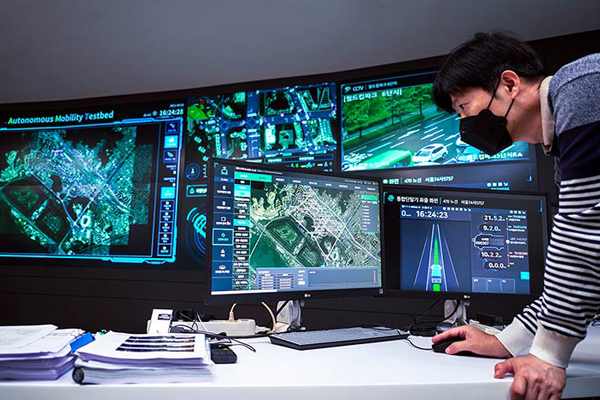
SKT employees inspecting C-ITS [Photo = SKT]
Since early 2019, SK Telecom has been working with the Seoul Metropolitan Government on a C-ITS demonstration project. These efforts include: installing 5G sensors and IoT on major city roads; equipping city buses and taxis with 5G Advanced Driver Assistance Systems (ADAS); and establishing an autonomous driving testbed. The Seoul Metropolitan Government will showcase the results of the C-ITS demonstration project at the Sangam S-Plex Center in Seoul until the 12th. The newly constructed autonomous driving testbed will host hands-on experiences with connected buses and autonomous vehicles.
1,735 5G sensors provide an average of 67 million traffic safety information items per day.
Through the completion of this Seoul City C-ITS demonstration project, SKT has introduced the world's first 5G-based V2X technology. SKT installed 1,735 5G sensors on 151 kilometers of major roads and traffic lights, centered around central bus lanes in Seoul, to monitor traffic conditions in real time. SKT announced that the information acquired through IoT sensors is being sent as an average of 43 million notifications per day regarding pedestrian signals and pedestrian access, 5.8 million notifications regarding potholes, and 520,000 notifications regarding bus stop congestion, helping drivers drive safely.
Additionally, a variety of traffic-related information, including location-based traffic information, dangerous sections, jaywalking pedestrians, tunnel accident information, and passing lane detection, was provided to participating public transportation drivers, averaging an average of 67 million items per day. Notably, services were also implemented, including information on the color of traffic lights at intersections ahead and the remaining seconds of a green light.
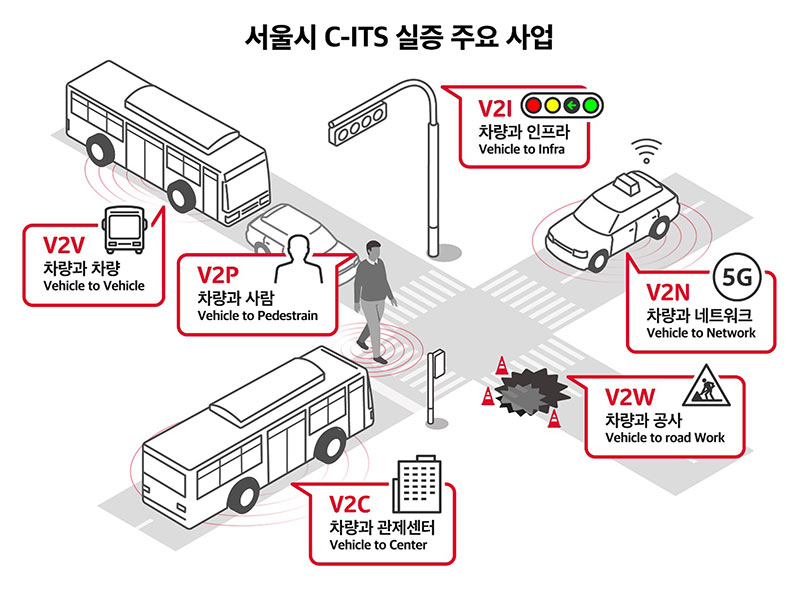
In addition to roads and traffic lights, the Seoul Metropolitan Government and SK Telecom are currently installing 5G ADAS and dedicated terminals in 1,600 city buses and 100 taxis for a V2X demonstration project between vehicles and transportation infrastructure. The 5G ADAS uses vision technology to monitor 124 types of road traffic information in real time, including signs, road markings, construction information, and potholes. It then performs real-time AI analysis in the cloud, reflecting the information on an HD map with a margin of error of within 10 cm.
SKT is also accelerating the creation of a related ecosystem by establishing autonomous cooperative driving test beds in Seoul and Sangam DMC and opening them free of charge to industry, academia, and research institutes. In particular, autonomous driving and connected buses will be available for the general public to experience not only at the performance report meeting but also at the '2021 Seoul Smart Mobility Expo' event held from the 10th to the 12th.
The Seoul Metropolitan Government and SKT are building a platform to provide information acquired through C-ITS to private navigation providers via 5G, enabling these providers to provide this information in real time to their service users. The platform is scheduled for completion by 2022.
Comments
Related news
Seminar and briefing session held to promote R&D for autonomous driving SMEs.
The Ministry of Land, Infrastructure and Transport and the Autonomous Cooperative Driving Industry Development Council held a seminar and business meeting to support small and medium-sized enterprises in the autonomous driving sector at The K Hotel Seoul. The first part of the seminar shared information on various government support programs for autonomous cooperative driving, and the second part of the business meeting provided competitive small and medium-sized enterprises with new investment attraction opportunities.
2021.06.03by 이수민 기자
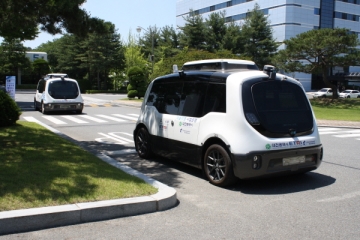
ETRI to Operate Driverless Autonomous Bus
The Electronics and Telecommunications Research Institute (ETRI) has developed unmanned autonomous driving technology applying Korea's highest-level artificial intelligence (AI) technology and is providing a pilot shuttle bus service circulating throughout the research institute.
2021.06.09by 강정규 기자
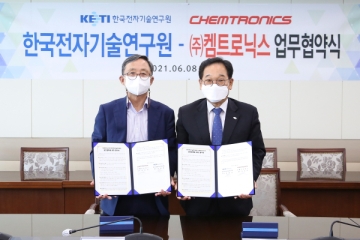
KETI-Chemtronics to Develop V2X and Wireless Charging Technologies
KETI and Kemtronics have concluded a memorandum of understanding for the development of core material technologies in V2X technology and wireless charging fields. Based on their respective proprietary technologies and infrastructure, both parties plan to establish a demonstration environment for autonomous driving and develop autonomous cooperative driving technology. Additionally, they intend to explore new business models in the mobile wireless charging material technology sector.
2021.06.09by 이수민 기자

[e4ds Tech Day 2026 ⑨] Sim Sang-gyu, Autocrypt CTO: "In the Physical AI Era, Automotive Security Must Extend Beyond the Vehicle"
At e4ds Tech Day 2026, Sim Sang-gyu, CTO of Autocrypt, explained automotive cybersecurity strategies in the era of Physical AI and SDV (Software-Defined Vehicle). Automobiles are evolving as part of an ecosystem connected to AI, cloud, chargers, IoT, and robots, and he emphasized that the scope of security must expand beyond the vehicle interior to the entire connected environment. In particular, AI model tampering, adversarial attacks, OTA updates, and EV charger hacking were identified as major threats. He explained that response measures require zero trust, AI model integrity protection, intrusion detection, Security by Design and Default, and full lifecycle security management, and that proactive security system establishment beyond regulatory compliance is critical for securing future mobility competitiveness.
2026.10.12by 배종인 기자

Practical HIL Construction Strategy for Automotive and Off-Highway Controller Validation
As vehicle E/E architecture transitions to zonal structures and shifts to software-defined vehicles (SDV), the number of controllers (ECUs) requiring validation and software complexity are surging dramatically. Meanwhile, real vehicle testing cannot provide repeated verification under identical conditions and entails lead time and safety concerns. This white paper explains the principles of HIL (Hardware-in-the-Loop) validation and the structure of the NI platform composed of PXI, SLSC, and VeriStand, and through two actual implementation cases—Camera Record & Replay HIL for In-Cabin Monitoring Controller (ICMU) and Forklift Controller (VCU) HILS—describes how controller-level regression testing becomes possible. Additionally, it explicitly states application boundaries and limitations, such as lack of A2B support.
2026.10.12by 편집부











