



Samsung Electronics successfully demonstrates 6G THz wireless communication, putting 6G development on the horizon.
 Published2021.06.16 14:23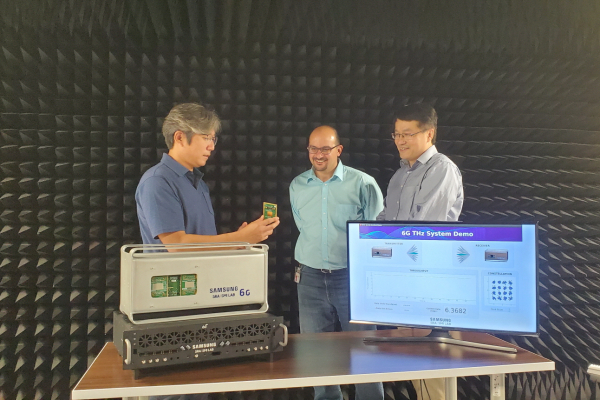
▲Samsung Electronics researchers are demonstrating a 140 GHz communication system at the Samsung Research America (SRA) laboratory.
Samsung Electronics has successfully demonstrated 6G communication in the terahertz band, which is expected to be used as a key frequency band for 6G, raising expectations for commercialization.
Samsung Electronics announced on the 16th that it successfully demonstrated a communication system in the 6G terahertz (THz) band with the University of California, Santa Barbara (UCSB).
Through this, Samsung Electronics and UCSB verified the possibility of utilizing terahertz bands for 6G mobile communications.
The terahertz band refers to the frequency band between 100 GHz and 10 THz, and in general, as the frequency band increases, a wider communication bandwidth can be used, making it suitable for the ultra-high-speed communication required for 6G.
The terahertz band is considered a candidate frequency band for 6G communications, which aims to achieve 1 Tbps (a speed of transmitting 1 trillion bits per second), which is up to 50 times faster than 5G (data transmission speed: up to 20 Gbps).
On the other hand, the higher the frequency band, the greater the path loss due to the propagation characteristics and the shorter the propagation distance, which is a problem in communication. Advanced beamforming technology is required to integrate numerous antennas within the system and transmit and receive radio waves in a specific direction.
Additionally, there are technical challenges such as manufacturing more detailed RFIC (radio frequency integrated circuit) circuits for ultra-high-speed communication.
At the recent IEEE (Institute of Electrical and Electronics Engineers) International Conference on Telecommunications (ICC 2021) Terahertz Communication Workshop, Samsung Electronics' Samsung Research, Samsung Research America (SRA), and researchers at UCSB jointly announced that they had secured and demonstrated a data transmission speed of 6.2 Gbps (gigabits per second) at a distance of 15 meters between a transmitter and receiver using the 140 GHz terahertz band.
Existing terahertz band demonstrations have used only measuring equipment and antennas acting as RFICs or modems to transmit data.
On the other hand, this time, the Samsung Electronics and UCSB researchers succeeded in demonstrating real-time transmission by integrating RFIC, antenna, and baseband modem, thereby making meaningful progress in overcoming technological challenges such as high path loss and low power efficiency in the terahertz band that must be resolved for 6G commercialization.
In particular, a successful demonstration was achieved by configuring a transmitter and receiver module with 128 antenna elements arranged and driven by a CMOS (Complementary Metal Oxide Semiconductor) process-based RFIC, which is widely used in LTE and 5G, and a modem that supports real-time high-performance beamforming.
“Samsung Electronics has been leading the technological innovation and standardization of 5G and 6G,” said Choi Sung-hyun, executive vice president and head of the Next Generation Communications Research Center at Samsung Research. “As we shared in our 6G white paper last year, we expect the terahertz band to be utilized as a key frequency band for 6G, and this demonstration is an important milestone that shows the feasibility of commercializing it.”
br /> Professor Mark Rodwell of UCSB emphasized the importance of cooperation, saying, “UCSB has knowledge of ultra-high frequency bands, especially terahertz frequencies above 100 GHz, and Samsung has expertise in wireless systems and communication networks.”
When 6G is commercialized, new services such as immersive XR (eXtended Reality) and holograms will be supported on mobile devices due to the groundbreaking improvement in communication performance, and the scope of application of mobile communication technology is expected to expand to include satellite communications and urban air mobility.
Meanwhile, Samsung Electronics established the Next-Generation Communications Research Center under Samsung Research in 2019 and is conducting research on strengthening 5G competitiveness and 6G advanced technologies.
Samsung Electronics plans to proactively lead the global standardization and technology development ecosystem by actively conducting research on 6G technology, including publishing the "6G White Paper" last year, based on the technological prowess it has accumulated, including the world's first commercialization of 5G.

Comments
Related news
LG Electronics, Keysight, and KAIST to Collaborate on 6G Mobile Communication Technology Development
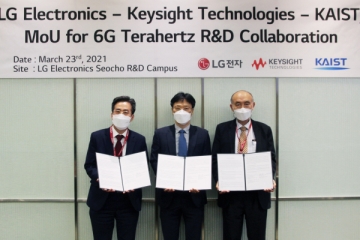
6G technology is considered a means to enable Ambient Internet of Everything (AIoE) with maximum data transmission of 1Tbps per second. LG Electronics, Keysight Technologies, and Korea Advanced Institute of Science and Technology (KAIST) have signed an MOU for technology development and verification system establishment to secure market dominance in 6G technology, with standardization expected in 2025 and commercialization anticipated in 2029.
2021.03.23by 이수민 기자
Samsung Electronics' Kim Yun-sun, Master, 3GPP 6G Standardization Work Team
Kim Yun-seon, Master at Samsung Electronics' Next Generation Communication Research Center, was elected as chair at the 105th 3GPP RAN1 international conference. The RAN1 working group is a subdivision that promotes standardization of wireless access physical layer technology. Since 2017, Master Kim Yun-seon has served as vice chair in RAN1, chairing meetings in 5G core technology areas such as MIMO, eMTC, NR power control, IAB, and DSS, thereby leading 5G standardization efforts.
2021.05.13by 이수민 기자

Ministry of Science and ICT-European Commission Discuss 6G Standardization and R&D Cooperation
The Ministry of Science and ICT held an online "Korea-EU Post-5G Joint Workshop" with the European Commission on next-generation network innovation and standardization cooperation. The event was organized to discuss standardization cooperation measures and other initiatives aimed at accelerating the development and deployment of 6G mobile communication network technologies following 5G mobile communications.
2021.06.03by 이수민 기자
European Patent Applications Surpass 200,000 for the First Time… South Korea Maintains 5th Place, Led by Batteries and Telecommunications
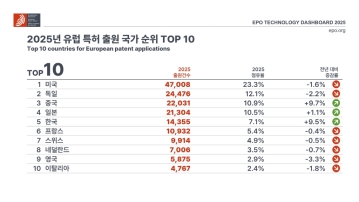
According to the European Patent Office (EPO)'s 'Technology Dashboard 2025', European patent applications last year reached 201,974, surpassing 200,000 for the first time. Korean companies and inventors filed 14,355 applications, representing a 9.5% increase from the previous year and maintaining 5th place by country. Battery, digital communication, and semiconductor technologies led the growth, with Samsung ranking as the top EPO applicant for the second consecutive year and LG reaching 3rd place. The presence of major domestic cities such as Seoul, Suwon, and Yongin was also confirmed. It was also revealed that Korea's European patent strategy is expanding beyond individual technologies to span the entire industry.
2026.03.24by 명세환 기자

SK Telecom First Applies AI-Based Network Operations at Gwanghwamun K-Pop Concert
SK Telecom announced that it applied an AI-based network operation system for the first time at a large-scale K-pop concert held in the Gwanghwamun area of Seoul on March 21st, managing communication quality throughout the event. Mobile data usage during the three hours before and after the concert reached 12.15TB, approximately doubling compared to the same time slot the previous weekend. SK Telecom monitored traffic using the AI system 'A-One' in five-minute and 50-meter units to respond to potential overload situations, while also operating temporary communication facilities and on-site personnel in parallel. This case is interpreted as confirmation of the practical applicability of AI-based autonomous network operation in an environment where demand from dense events and foreign users increases simultaneously.
2026.03.23by 명세환 기자











