


“Urgent Need for AI and Big Data Standardization”
 Published2021.06.16 16:35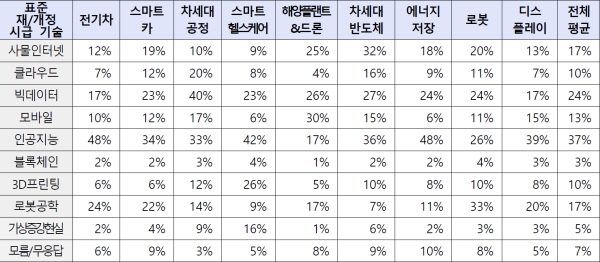
▲ Technologies Urgent for Standard Revision (Source: Korean Agency for Technology and Standards)
Our companies identified 'artificial intelligence (AI)' and 'big data' as fields where standardization is urgently needed to lead the era of the Fourth Industrial Revolution. Large corporations and mid-sized companies cited 'lack of expertise' as the biggest reason for difficulties in standardization activities, while small and medium-sized enterprises cited 'financial burden'.
The Korean Agency for Technology and Standards (KATS) under the Ministry of Trade, Industry and Energy (Director Lee Sang-hoon) announced on the 16th the results of the 'Industrial Standardization Status Survey' conducted on 1,000 manufacturing companies in new industrial sectors and 1,000 citizens to establish standard policies for the era of the Fourth Industrial Revolution.
The detailed survey results showed that companies ranked artificial intelligence (AI) as the top priority (37%) for technology fields requiring urgent standardization to lead the era of the Fourth Industrial Revolution, followed by big data (24%), the Internet of Things (17%), robotics (17%), and mobile (13%).
When asked about areas requiring standardization, respondents answered in the order of product testing and evaluation standards (40%), product specification standards (37%), and technology convergence standards (29%).
However, analysis showed that the technologies and areas deemed urgent vary by industry, indicating a need to establish differentiated standardization strategies for each sector.
In response to the question asking about the standards primarily utilized by industry, respondents cited German standards (DIN) for electric vehicles, British standards (BS) for offshore plants and drones, and American standards (ANSI) for next-generation processes, indicating that national standards of technology-leading countries are being actively utilized to enter overseas markets.
Our companies are actively engaging in international standardization activities to incorporate their technologies into international standards and secure a leading position in the global market. Regarding the reasons for the difficulties encountered in standardization activities, large and medium-sized enterprises cited a lack of expertise among internal personnel, while small and medium-sized enterprises (SMEs) cited the financial burden of overseas standardization as the biggest reason.
It was found that government support is needed, as all companies cited the difficulty of collecting information as a common challenge.
In the survey Most of the respondents were aware of the Korean Industrial Standards (KS), and 99% of respondents showed a level of trust above average in response to the question of whether they trusted the Korean Industrial Standards (KS).
However, looking at the details, awareness among those in their 20s and 30s was lower than among those in their 50s and 60s, and they also responded relatively low in the trust survey, so it was analyzed that efforts to improve perceptions of the younger generation are needed.
Based on the results of this survey, the Korean Agency for Technology and Standards plans to incorporate them into industry-specific and technology-specific standardization strategies to secure a leading position in the technology market of the Fourth Industrial Revolution, continuously expand the budget to support companies' international standardization activities, and actively promote master's and doctoral degree programs to foster professional personnel in standards.
Lee Sang-hoon, Administrator of the Korean Agency for Technology and Standards, stated, “To strengthen the global competitiveness of our companies in the era of the Fourth Industrial Revolution, we will actively promote the standardization of key technologies such as artificial intelligence (AI) and big data, while simultaneously implementing customized support policies tailored to specific industries and company sizes.”

Comments
Related news

Ministry of Trade, Industry and Energy dispatches delegation to AI international standardization meeting to secure leadership
The National Institute of Standards and Technology under the Ministry of Industry, Trade and Resource announced that it has dispatched a delegation composed of 15 experts from industry, academia, and research institutions to the Third AI International Standardization Conference held in Dublin, moving to secure global standard leadership. The Korean delegation proposed the establishment of a new study group for preparing an AI data ecosystem applicable to various industrial fields, which is a core topic of AI technology, and concurrently conducted activities to secure support from major participating countries including the United States, Japan, and China. The newly established study group aims to support the conversion of raw general data into high-quality data in standard formats that can be directly applied to AI technology, and is expected to provide significant benefits to industries requiring AI standards such as smart manufacturing, IoT home appliances, and autonomous driving.
2019.04.12by 이수민 기자
.jpg)
How was a solution developed to determine the possibility of dementia through data-driven AI brain wave analysis?
iMedicin developed iSyncBrain in 2019, which analyzes brain waves to identify the possibility of mild cognitive impairment, a precursor stage to dementia. The need for a method to diagnose dementia by measuring brain waves has been raised for several years, but an appropriate solution could not be developed due to insufficient brain wave data from healthy individuals. The Korea National Institute of Standards and Technology accumulated brain wave data from approximately 1,300 healthy individuals from 2011, and in 2018, iMedicin received this data through a data transaction, successfully developing iSyncBrain by incorporating AI.
2020.02.14by 이수민 기자
Ministry of Science and ICT and Ministry of Trade, Industry and Energy Seek Joint Response Strategy for AI International Standardization
The National Radio Research and Ordinary Laboratory of the Ministry of Science and ICT and the National Institute of Standards and Technology of the Ministry of Trade, Industry and Energy jointly held the 2nd Artificial Intelligence Industry Standardization Workshop with simultaneous online and offline attendance by domestic AI sector experts from academia, industry, research institutes and government. Experts who participated in the workshop emphasized the importance of standards for advancing domestic AI technology and securing industrial competitiveness.
2020.11.19by 이수민 기자
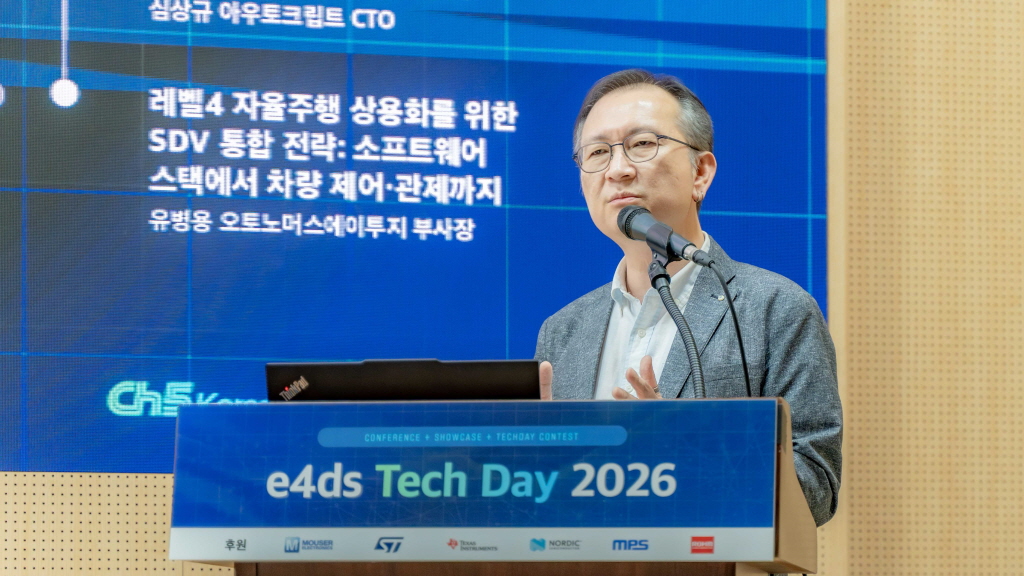
[e4ds Tech Day 2026 ⑨] Sim Sang-gyu, Autocrypt CTO: "In the Physical AI Era, Automotive Security Must Extend Beyond the Vehicle"
At e4ds Tech Day 2026, Sim Sang-gyu, CTO of Autocrypt, explained automotive cybersecurity strategies in the era of Physical AI and SDV (Software-Defined Vehicle). Automobiles are evolving as part of an ecosystem connected to AI, cloud, chargers, IoT, and robots, and he emphasized that the scope of security must expand beyond the vehicle interior to the entire connected environment. In particular, AI model tampering, adversarial attacks, OTA updates, and EV charger hacking were identified as major threats. He explained that response measures require zero trust, AI model integrity protection, intrusion detection, Security by Design and Default, and full lifecycle security management, and that proactive security system establishment beyond regulatory compliance is critical for securing future mobility competitiveness.
2026.10.12by 배종인 기자
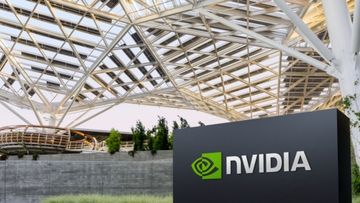
NVIDIA to Invest $1 Billion in U.S. Science Over Next Five Years
NVIDIA has announced plans to invest $1 billion over the next five years to strengthen U.S. scientific and technological competitiveness. The company will enhance cutting-edge artificial intelligence research and development capabilities in key areas including quantum computing, healthcare, and energy security, while expanding support for higher education research institutions and cloud service providers. NVIDIA is participating as a major industry partner in the White House Office of Science and Technology Policy's Genesis Mission, and is promoting supercomputer construction in collaboration with national laboratories including Argonne and Los Alamos.
2026.10.12by 배종인 기자











