



The Ministry of Trade, Industry and Energy has launched a program to train AI-integrated manufacturing personnel in eight fields.
 Published2021.06.24 09:21
8 fields: future cars, digital healthcare, semiconductors, and
8 sectors including IoT home appliances, machinery, textiles, displays, and shipbuilding
Competition for global market dominance in new industries is intensifying, and the need for digital transformation in key domestic industries, such as manufacturing, is growing.
On the 23rd, the Ministry of Trade, Industry and Energy confirmed eight areas of support for the project to 'Strengthen the Innovation Capacity of AI-Fusion Industrial Field Technical Personnel' to integrate AI technology into manufacturing sites: △Future Vehicles, △Digital Healthcare, △Semiconductors, △IoT Home Appliances, △Machinery, △Textiles, △Displays, and △Shipbuilding.
This project was planned as a sub-task of the "Korean New Deal" policy announced in June 2020 to foster innovative leaders through AI-integrated training for manufacturing workers. Starting with training 1,280 people in eight industrial fields this year, a total of 12,750 people will be trained by 2025.
The eight support areas were selected through an evaluation by industry, academia, and research experts from among 21 industrial fields received by the Ministry of Trade, Industry and Energy and the Korea Institute for Advancement of Technology (KIAT) in March and April of this year.
Because the convergence and synergy of industry-specific expertise and AI-related technologies is crucial, the project implementation organization was selected as a consortium that includes industry-specific associations and organizations that best understand the current state of the industry and educational needs, as well as private educational institutions with expertise in AI education.
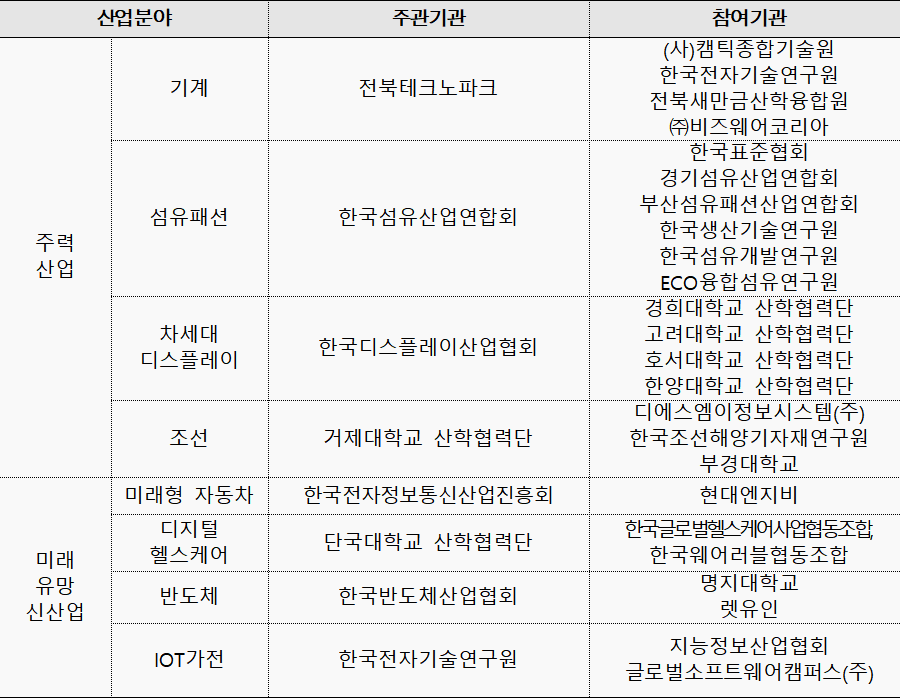
The future automobile sector, one of the Big 3 new industries, will cultivate AI convergence personnel focusing on five areas requiring AI integration (autonomous driving, connectivity, eco-friendly electrification, vehicle reliability assessment, and automobile R&D verification) through cooperation with Hyundai Motor Company's training center, 'ENGV.'
In the case of the shipbuilding industry, which is experiencing a resurgence, including recently achieving the top spot in orders, the industry-academia cooperation group at Geoje University will support education in areas with high demand for AI convergence education, such as smart welding technology, welding quality inspection, and production management, to promote industrial innovation and strengthen competitiveness.
The Ministry of Trade, Industry and Energy and KIAT plan to continuously expand the scope of support by creating diverse innovation cases, such as industrial value chain advancement, focusing on eight fields and disseminating successful cases.
Hwang Su-seong, director general of the Ministry of Trade, Industry and Energy, said, “If we fail to respond to the trend of digital transformation, we will be eliminated,” adding, “We will strengthen our manufacturing capabilities, which are our strengths.” “We will focus on training AI technology professionals so that our industry can proactively respond to changes and enhance its competitiveness,” he said.
Comments
Related news
.jpg)
Xilinx Announces Low-Power ACAP to Enable Edge AI
Xilinx has launched the "Versal AI Edge" series, which delivers 4x better AI performance per watt compared to GPUs and 10x higher computing density than the previous generation adaptive SoC. The new series enables intelligent capabilities across a wide range of applications, including autonomous collaborative mobile robots, factory predictive maintenance systems, healthcare, and multipurpose payloads for aerospace and defense markets that require the highest levels of functional safety.
2021.06.11by 이수민 기자
.jpg)
KETI and Czechoslovak Polytechnic University Establish Foundation for International Joint R&D Cooperation
The Korea Electronics Technology Institute (KETI) has signed a memorandum of understanding with the Czech Technical University in Prague covering the exchange of personnel and information in the fields of AI and autonomous driving technology, as well as the promotion of international joint technology development. The agreement was signed in the presence of Minister Moon Seung-wook of the Ministry of Trade, Industry and Energy during his visit to the Czech Republic and Czech Minister of Industry and Trade Karel Havlíček. On the same day, the ministers of industry and trade of both countries also signed a memorandum of understanding to strengthen cooperation in the nuclear power and advanced industry sectors.
2021.06.21by 이수민 기자
Maxim Launches Class D/G Amplifiers for AI Bluetooth Speakers
AI-enabled smart speakers are emerging as core components of smart homes, with usage increasing rapidly. As speaker sizes continue to shrink, thermal management has become a critical challenge. In response, Maxim Integrated has launched the MAX98396 Class D/G speaker amplifier, which delivers industry-leading low noise, lowest standby power consumption, and highest thermal efficiency.
2021.06.23by 강정규 기자
Camera for Both Humans and Machines: ST BrightSense 5MP Dual Shutter Image Sensor
Video consumed by humans and imagery analyzed by machines impose different requirements on the sensor in terms of shutter method and wavelength band. Until now, sensors had to be separated or supplemented with companion chips and high-performance processors, and this cost and complexity became a bottleneck in vision system design. The ST BrightSense next-generation 5MP image sensor (VD5943, VD1943, VB5943, VB1943) with 2.25 µm pixels supports both global and rolling shutters, and through on-chip staggered HDR (up to 100 dB), on-chip RGB-IR separation and 5MP NIR smart upscaling, and frame-by-frame context switching, absorbs both requirements internally at the sensor level. This white paper describes the rationale, choices, trade-offs, and results of each design decision based on presentation slides and technical Q&A, and specifies application boundaries. The product is scheduled for mass production in February 2026, and evaluation and sampling are currently available.
2026.10.13by 편집부

AI-based Universal Robots Automation Solution
In manufacturing environments where declining labor populations overlap with frequent production item changes, existing programming-based robot automation requires reconfiguration from weeks to several months each time product models change. This white paper takes this flexibility gap as its starting point and synthesizes, based on webinar presentation materials and technical Q&A, what collaborative robots gain and forfeit compared to industrial robots, why process automation is transitioning from rule-based to learning-based (4th generation) approaches, and how Universal Robots' hardware, software, and partner ecosystem implement this. Additionally, it clarifies the application boundaries and limitations, including that AI Accelerator is still at the development kit stage.
2026.10.13by 편집부











