


Korean-style Smart Cities Expand into 11 Global Countries, "Building Networks"
 Published2021.06.24 12:18
11 projects from 11 countries worldwide finally selected
Expectations for the spread of Korean-style smart city standards and technologies
On the 23rd, the Ministry of Land, Infrastructure and Transport, the Korea Overseas Infrastructure & Urban Development Corporation (KOIDEC), and the Korea Institute of Land, Infrastructure and Transport Technology (KILT) selected a total of 11 projects through the open call for the 'K-City Network Global Cooperation Program,' which aims to disseminate domestic smart city experiences overseas. The selected projects include 4 urban development-type projects, 4 solution-type planning-type projects, and 3 solution-type overseas demonstration projects. By region, 3 projects each were selected for the New Southern Policy and Northern Policy, 2 for Europe, and 1 each for North America, South America, and Africa.
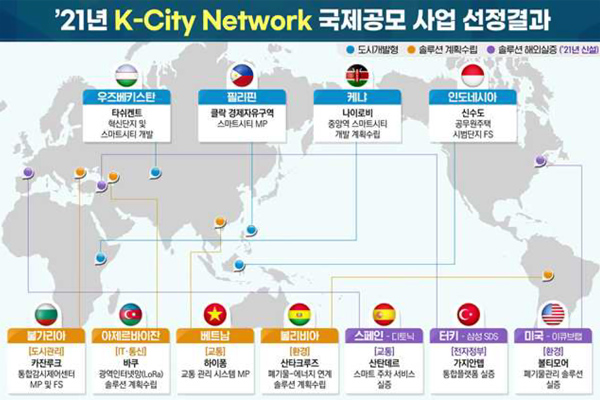
To create a foundation for Korean companies to secure overseas demonstration track records and conduct cross-demonstrations with advanced nations, the Ministry of Land, Infrastructure and Transport established the Solution Overseas Demonstration Project this year and selected countries such as the United States and Europe where demonstration infrastructure has been secured. The project supports the establishment of Master Plans (MP) or Feasibility Studies (F/S), invitation training, and overseas demonstrations by companies, with funding of 400 to 600 million won for the Urban Development type, 200 to 300 million won for the Solution type Planning type, and 400 to 600 million won for the Solution type Overseas Demonstration type.
◇ Urban Development Planning
57 applications for urban development planning projects were submitted from 24 countries, and 4 projects from 4 countries were selected. First, ➊ the Master Plan for the Smart City in the Clark Economic Free Zone in the Philippines is a project to develop the Air Force housing site within the economic free zone in Clark, located 2 hours (80 km) north of Manila, into a smart city. This is the first smart city development cooperation project between Korea and the Philippines, and the project has a high probability of success given that the project site is state-owned land.
➋ The feasibility study for the pilot housing complex for civil servants in Indonesia's new capital is a project applied for by the Indonesian Ministry of Public Works and Housing in conjunction with the New Capital Smart City Master Plan selected last year. It is a project that local Korean officials evaluated as the most urgent among the New Capital projects.
➌ The Master Plan for the Development of the Innovation District and Smart City in Tashkent, Uzbekistan is a project to develop two districts near Tashkent into a new smart city by incorporating them into the capital. Due to the population growth in Tashkent, the Uzbek government is actively promoting smart city development. In 2019, following President Moon Jae-in's visit to Uzbekistan, bilateral relations were elevated to a 'Special Strategic Partnership,' and smart cities were discussed as a cooperation agenda.
❹ The establishment of the smart city development plan for Nairobi Central Station in Kenya is a project applied for by the Kenyan Ministry of Transport and Urban Construction, and aims to develop Nairobi Central Station and its surrounding area into a smart city to establish the standard for smart cities in East Africa.
With the support of the World Bank, a Korean company previously executed the Nairobi Central Station Area Master Plan, which serves as the overarching plan for this project. By leveraging local experience and networks, this is expected to be a valuable opportunity to showcase Korea's expertise in station area urban development and smart city technology.
◇ Solution Planning Business
40 applications were submitted from 16 countries, and 4 projects from 4 countries were selected, including transportation (①), environment (②), IT and telecommunications (③), and urban management (④). First, regarding ① the Vietnam Hai Phong Traffic Management System Master Plan project, a master plan to establish a smart traffic monitoring system is scheduled to be formulated to resolve the traffic congestion problems in Hai Phong City.
② The project to establish a waste-energy linkage solution plan in Santa Cruz, Bolivia, was requested by the local government of Santa Cruz, Bolivia, and supports the planning of smart waste treatment and energy conversion solutions to address the waste problems of Santa Cruz Province. As the first export of a Korean-style new city to Latin America, cooperation has been underway since 2015.
③ The Azerbaijan Baku LoRa network solution planning project is a project applied for by Azlon Telecom, a public institution under the government of Azerbaijan, for which the smart city infrastructure construction project is the government's top priority. It supports the establishment of a master plan to build a smart city platform and a LoRa network to integrate various recently introduced smart services.
④ The project for the master plan and feasibility study of the Kazanluk Integrated Surveillance and Control Center in Bulgaria plans to establish a master plan to upgrade Kazanluk’s current surveillance system, which merely displays video information, into an integrated surveillance and control center utilizing a smart video surveillance system. Although Kazanluk has a small population, it is geographically located in central Bulgaria, making it a transportation hub and a tourist city; through this project, enhanced regional stability and improved transportation systems are expected.
◇ Overseas Solution Demonstration Project
Our company submitted 14 applications for 12 countries, and 3 projects were selected in 3 countries, including IT/telecommunications (➊), environment (➋), and transportation (➌). This project was selected following a presentation evaluation by our company, and overseas partner organizations participated in the evaluation process via real-time video.
➊ Samsung SDS’s demonstration project for the Gaziantep Smart City Integrated Platform in Turkey is a follow-up to the establishment of the Gaziantep Data Integration Platform Master Plan, which was selected as a K-City Network project last year. Samsung SDS, which carried out the project last year, is promoting the project by forming a consortium with small and medium-sized enterprises and establishing a collaborative system with the Gaziantep city government.
➋ Ecube Lab’s waste management solution demonstration project in Baltimore, USA, is demonstrating a solution that collects waste data to promote recycling and provides a matching platform for waste generators and collectors in cooperation with the City of Baltimore’s Department of Public Services. As 25% of the world’s waste is generated in the United States, there is anticipation for the potential to expand the business to nearby cities following this project.
Santander, Spain, is a representative pilot area among European cities where smart city projects are being actively pursued. ➌ Ditonic’s smart parking service demonstration in Santander, Spain, is a project to demonstrate a smart parking service based on a smart city data hub in cooperation with the local government and the University of Cantabria, which is conducting demonstration projects.
The Smart City Data Hub is a technology that was utilized in the COVID-19 epidemiological investigation support system, and this project is expected to secure a channel for overseas expansion.
The Ministry of Land, Infrastructure and Transport plans to finalize the support budget for each project within this month and select project implementers next month. By having foreign government officials directly participate in the selection process, a foundation for G2G cooperation will be established from the project preparation stage. Eight planning-type projects will commence in August following the selection of project implementers. Three overseas demonstration projects are planned to commence in July after the project costs are adjusted.
Choi Im-rak, Director General of Urban Policy at the Ministry of Land, Infrastructure and Transport, stated, “This year, we have launched cooperative projects with developed nations such as the United States and Spain, as well as developing countries,” and expressed his expectation that “the K-City Network will spread Korean-style smart cities globally and enhance the competitiveness of our companies.”
Comments
Related news

Launching Mid-to-Long-Term Policy Council with Goal of Building 5G Industrial Ecosystem
The Ministry of Science and ICT held a launching meeting for the 5G+ Industrial Ecosystem Policy Council to foster a 5G+ convergence ecosystem. The policy council was organized in accordance with the 2021 5G+ Promotion Plan to lead the 5G+ industrial ecosystem globally. In addition to the industrial ecosystem policy council launched today, the policy council to strengthen public-private collaboration related to 5G comprises a total of seven entities, including five 5G services (smart factory, immersive content, digital healthcare, autonomous vehicles, and smart city) and 5G networks.
2021.03.25by 강정규 기자

The Ministry of Land, Infrastructure and Transport will launch the "2021 Smart City Certification Competition" in June.
The Ministry of Land, Infrastructure and Transport is launching the '2021 Smart City Certification Contest' to implement government-level smart city certification. The smart city certification system is designed to assess the level of domestic smart cities using smart city performance indicators and grant certification and ratings to enable comparison between cities. The system is utilized for smart city performance evaluation, discovery and promotion of outstanding smart cities, and related applications.
2021.05.06by 이수민 기자

ST Announces World's First G3-PLC Hybrid Certified Chipset
The G3-PLC hybrid specification enables smart grid, smart city, and industrial/IoT devices to automatically and dynamically select appropriate wireless channels and power line channels according to network conditions. STMicroelectronics announced that its 'ST8500 and S2-LP chipset' was the first to obtain G3-PLC hybrid certification, which defines connectivity across power line and wireless media.
2021.06.17by 이수민 기자

Korea Instrument, KOLAS Accredited Calibration Agency First to Simultaneously Acquire ISO/IEC 27,001·27,701
Korea Instrument has become the first among KOLAS accredited calibration agencies to simultaneously acquire ISO/IEC 27,001 and ISO/IEC 27,701 certifications. Through its proprietary platforms CWIZ Enterprise and CWIZ Partners, the company has embedded information security and personal data protection requirements across all business processes including customer information, equipment data, and calibration reports, with plans to continuously advance its management system through regular audits and security inspections.
2026.10.12by 배종인 기자
TeamViewer One, IT Incident Automation Workflow and Resolution Center Enhanced
TeamViewer has added IT incident automation capabilities and an advanced Resolution Center to its integrated digital workplace management platform 'TeamViewer ONE'. Recurrent service disruptions, configuration errors, and capacity shortages are automatically handled according to preset policies, and device status verification through script deployment can be managed in a unified interface, significantly reducing repetitive tasks for IT teams.
2026.10.12by 배종인 기자











