


The US semiconductor supply chain is in trouble. Where should we start?
 Published2021.06.28 16:50
The technology is there, but the business opportunities are lower than in China.
Maintaining the keynote addressing China and strengthening cooperation with allies
The US semiconductor industry accounts for half of global semiconductor sales, but its manufacturing capacity accounts for only 12%. The US has reaffirmed the importance of supply chain stability as it has faced supply shortages due to pandemic-induced demand surges and natural disaster-induced shutdowns.

We produced a report on the semiconductor supply chain. [Photo = Gage Skidmore]
On the 8th, the U.S. Department of Commerce, at the direction of the White House, released a strategic report on building a resilient, U.S.-centric supply chain. The report analyzed five essential semiconductor sectors: design, manufacturing, post-processing, materials, and equipment.
While American companies dominate the design market, they rely heavily on sales to China. Semiconductor manufacturing and post-processing also rely heavily on Asia. Additionally, while most special liquids and gases for semiconductors are produced in the United States, most materials are dependent on overseas sources.
The semiconductor equipment sector, excluding the exposure sector, holds a world-class share, but due to weak manufacturing capacity in the United States, it relies on sales outside the United States.
A market that refuses to buy semiconductors poses a threat to US security.
The Department of Commerce viewed the current situation as a potential threat to the U.S. semiconductor industry.
First, he pointed out that the semiconductor supply chain is largely dominated by a small number of suppliers. For example, EUV equipment, a key component of advanced semiconductor processes, is supplied solely by ASML in the Netherlands, and approximately 80% of the world's foundries are concentrated in Taiwan.
The report also raised the risk of counterfeit semiconductors produced outside the United States. Counterfeit semiconductors are more vulnerable to external attacks, such as hacking, and could result in annual financial losses of $100 billion and threats to national defense systems, the report noted.
Furthermore, the United States still has significant demand for semiconductors produced using legacy processes. Defense systems have been in operation for decades, and demand for legacy components to maintain these systems is high. This also applies to the consumer sector, making it difficult to transition to advanced processes.
The concentration of semiconductor manufacturing facilities and demand in Asia, particularly China, poses a threat to the United States. Taiwan is the world's largest semiconductor producer, and China is the world's largest semiconductor demander. Therefore, the cross-strait conflict is expected to significantly disrupt the US semiconductor supply chain.
Structurally, the United States faces greater challenges in building semiconductor infrastructure than China. China has more companies that require semiconductors than the United States. This high demand has led to significant development in upstream and downstream industries, from semiconductor materials to electronics manufacturing. Fab construction costs are similar in the U.S. and China, but foundries believe it is more profitable to build fabs in China than in the U.S.
Human resources are also a problem. The US relies heavily on immigrants, with 40% of its semiconductor workforce coming from abroad. While China is strengthening its efforts to attract foreign talent, the US is facing difficulties recruiting due to immigration restrictions implemented during the Trump administration, the report analyzed.
The Department of Commerce also found that China's aggressive semiconductor policies are exacerbating the challenges facing the United States. The report cited China's semiconductor strategies, including acquiring overseas semiconductor technology through IP theft and forcing IP transfers through joint ventures between Chinese and foreign companies, and emphasized that IP protection is paramount to maintaining a competitive edge in the semiconductor industry.
The Department of Commerce also pointed out that the enormous cost of building advanced processes hinders private investment decisions. Manufacturing advanced semiconductors at nodes below 5nm requires massive capital expenditures and years of time, making private investment inevitably difficult given profitability considerations. The Department of Commerce cited GlobalFoundries' decision in 2018 to discontinue its 7nm process as an example. The Department argued that while technically feasible, it was unable to continue due to financial constraints.
◇ Incentives for semiconductor-related businesses in the U.S. should be strengthened.
The Department of Commerce has called for the U.S. government and industry to work together to increase transparency in the semiconductor supply chain. To achieve this, the department asserted the need to strengthen partnerships with industry and strengthen cooperation with allies to ensure fair semiconductor distribution, increased production, and increased investment. He added that in the medium term, the U.S. government should support semiconductor companies in establishing effective supply chain management and security measures.
It also recommended that the U.S. Congress provide at least $50 billion in funding for the CHIPS Act, part of this year's National Defense Authorization Act (NDAA). The reasons for this are that △there is a need to provide incentives for the construction, expansion, or modernization of semiconductor facilities, fabs, and equipment supporting semiconductor manufacturing, ATP, and packaging, and △there is a need to support advanced and mature processes for logic semiconductors, analog and discrete mature processes that are important to core industries and national defense, and memory semiconductor processes.
He also emphasized the need to support semiconductor-related R&D programs of allies, the U.S. National Science and Technology Council (NSTC), the National Institute of Standards and Technology (NIST), and the Department of Defense, and to establish a fund to develop and build security semiconductors and a security semiconductor supply chain.
In order to strengthen the semiconductor manufacturing ecosystem in the United States, he argued that investment should be made in industries that use semiconductors, such as green energy, broadband networks, and electric vehicles, to create demand for semiconductors, and that incentives should be approved for key semiconductor upstream and downstream industries, such as materials, parts, and equipment. He also said that support should be focused on manufacturing domestically produced chips related to U.S. security.
The report also said that legislation is urgently needed to protect American small and medium-sized businesses from coercive mergers and acquisitions by foreign capital and to invest in nurturing STEM talent.
◇ Maximizing China's Rise with the Quad + Taiwan and South Korea
The Commerce Department should encourage foundries and materials suppliers from allied countries to invest in the United States, and relevant agencies should promote policy harmonization and R&D partnerships to address unfair trade practices and industrial policies, the advisory said.
The allies mentioned in the report include the Quad (Japan, India, and Australia), South Korea, which recently pledged to promote mutual complementarity and investment in the semiconductor sector through a summit, and Taiwan, which is currently discussing concluding the Trade and Investment Framework Agreement (TIFA), a preliminary step to a free trade agreement (FTA).
The Department of Commerce said the Biden administration is working to address current semiconductor supply chain vulnerabilities by investing in key semiconductor equipment and technologies.He argued that export controls should continue to be enforced.
◇ Development is more important than regulation, and demand is as important as technology.
Last September, Huawei spun off its Honor sub-brand into an independent entity after US sanctions disrupted its semiconductor supply and excluded 5G models from its flagship smartphones scheduled for release this year. This demonstrates the effectiveness of US sanctions, but Huawei's smartphone market vacancy has been filled by other Chinese companies like Xiaomi, and despite the rise of Ericsson in the 5G communications equipment market, the company still maintains its dominant position.
Japan's restrictions on semiconductor material exports to South Korea, initiated for political reasons, ended up blocking Japanese companies' access to key customers like Samsung Electronics and SK Hynix, ultimately leading to a futile effort. Economic sanctions between countries impact not only the two countries but also their neighbors. However, because the sanctioning parties and companies will resort to any means necessary to survive, they are difficult to implement, making them difficult to achieve desired results.
Therefore, the United States is likely to pursue policies aimed at strengthening its domestic semiconductor industry and attracting facilities from friendly allies. The report highlighted the importance of semiconductor demand sources, a market even the United States lacks. South Korea boasts world-class semiconductor companies such as Samsung Electronics and SK Hynix, offering significant potential in the semiconductor upstream and downstream industries.
On the other hand, demand is significantly weaker. This is due to the small number of companies manufacturing electronic products. While fostering the system semiconductor industry is important, it seems time for us, like the US, to focus on securing demand sources outside of China or expanding domestic demand.
Comments
Related news
“2021 semiconductor growth rate raised to 24%”
IC Insights anticipates that the global IC market will grow 24% in 2021 due to semiconductor supply shortages and price increases, and that the global IC market is expected to exceed $500 billion for the first time this year.
2021.06.18by 배종인 기자
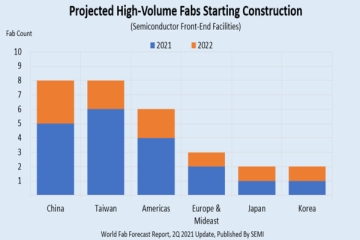
Why the Semiconductor Equipment Market Will Boom in the First Half of 2022
By the end of this year, 19 new fabs will begin construction, and an additional 10 fabs are scheduled to break ground in 2022. Since semiconductor equipment installation typically takes about two years after construction begins, most of the fabs that start construction this year are not expected to begin introducing semiconductor equipment until 2023. However, some fabs are anticipated to have semiconductor equipment installed as early as the first half of 2022.
2021.06.23by 이수민 기자
Power semiconductor market to reach 40 trillion won by 2030
By 2030, the global power semiconductor market is projected to expand to over 40 trillion won, and the market for oxide power semiconductors such as SiC, GaN, and Ga2O3 is expected to grow significantly.
2021.06.25by 배종인 기자

Intel Unveils Next-Generation 'Core Ultra Series 3' and vPro Platform for Enterprise PCs
Intel has officially unveiled the "Intel Core Ultra Series 3" for next-generation enterprise PCs and the latest vPro platform, addressing a wide range of demands from enterprise notebooks to high-performance workstations.
2026.03.26by 배종인 기자
ROHM Launches ESD Protection Diode Compatible with High-Speed Interfaces of 10Gbps or Higher
Semiconductor specialist ROHM has developed the 'RESDxVx series' of ESD (electrostatic discharge) protection diodes capable of responding to next-generation high-speed data communication environments exceeding 10Gbps, simultaneously enhancing both signal quality maintenance required in high-speed interfaces and IC protection performance.
2026.03.26by 배종인 기자











