



Lattice Unveils General-Purpose FPGA to Boost Edge System Bandwidth
 Published2021.06.30 12:17
High availability with external LPDDR4 DRAM support
Supports up to 8 10.3Gbps SERDES lanes
Modern edge devices require low power consumption for thermal management, high system bandwidth for high-speed inter-chip communication, small form factors and components for dense design, powerful memory resources, and excellent reliability for critical applications.
Accordingly, Lattice Semiconductor held an online press conference on the 30th and unveiled the 'CertusPro™-NX' general-purpose FPGA, the fourth product family of the 'Nexus™' platform.
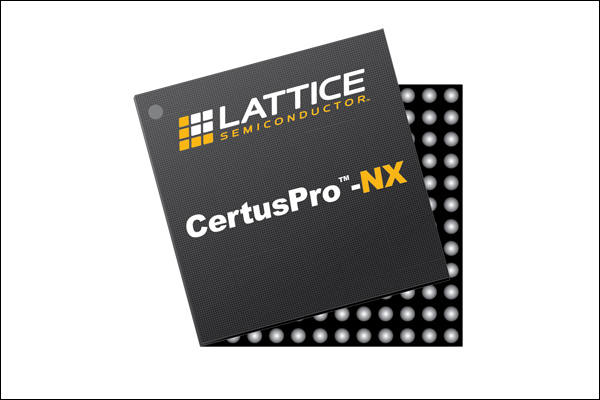
Lee Ki-hoon, General Manager at Lattice Semiconductor Korea, emphasized, “The Sertus Pro-NX has the smallest form factor and high bandwidth and power efficiency compared to comparable FPGA devices on the market,” adding, “It is the only product in its class that supports LPDDR4 external memory.”
The new FPGA is designed to accelerate the development of communications, computing, industrial, automotive, and consumer applications. Manager Lee stated that the Mean Time Between Failures (MTBF) is also longer compared to competing products.
◇ Achieves low power, high bandwidth, and high logic density with a small form factor product
The CERTUS PRO-NX device consumes up to four times less power than comparable FPGA products thanks to Lattice's proprietary FPGA fabric architecture and low-power FD-SOI manufacturing process. It also supports up to eight programmable SERDES lanes with speeds up to 10.3 Gbps. Additionally, it enables the implementation of widely used communication and display interfaces such as 10 Gb Ethernet, PCI Express, SLVS-EC, CXP, and DisplayPort.
It provides up to 65% more on-chip memory than similar FPGAs to meet the data coprocessing requirements of edge AI and machine learning applications. The LPDDR4 DRAM supported by the SirtusPro-NX device is preferred in the industry due to its long-term availability. It supports up to 100k logic cells and has the highest logic density among Nexus-based FPGAs.
In mission-critical environments such as automotive, industrial, and telecommunications, applications must provide high availability to enable predictable performance and securely protect users. The CertusPro-NX device is up to 100 times more robust against soft errors than comparable FPGAs. In comparison, its design area is 81 mm², which is up to 6.5 times smaller. Small form factor characteristics are a key design consideration for developers of SFP modules for industrial cameras or communication systems.
◇ Radiant 3.0 software supporting new devices also unveiled
Sertus Pro-NX, currently being supplied as a sample to partners, is compatible with 'Lattice Radiant® 3.0' design software. The SERDES analysis tool in the new Radiant version has been enhanced to accommodate the SERDES bandwidth supported by new devices, and the ability to trace signals throughout the design flow has also been improved. Designers can trace signals from HDL sources to RTL and technical views, and back.
Radiant users can perform timing constraints and analysis by selecting their preferred engine between the Lattice Synthesis Engine (LSE) and the Synplify Pro® synthesis engine. In particular, version 3.0 separates timing analysis from other tasks, allowing for independent execution.
Designers can evaluate virtual scenarios and rerun timing analysis without rerunning mapping, placement, and routing. This accelerates the iterative design process. Compared to the previous release, version 3.0 reduced runtime by 15% and increased design performance by 7%.
Comments
Related news

Fast Ethernet Implementation with FPGA Hard IP
With the increasing demand for large-capacity data transmission, requirements for expanding Ethernet bandwidth are also growing. Replacing Ethernet controllers with FPGAs is one of the methods for implementing high-speed Ethernet. To support this, Intel provides FPGA-related PHY and MAC hard IP, Intel Quartus Prime Ethernet toolkit, and other resources.
2021.04.30by 이수민 기자

Xilinx Begins Full-Scale Mass Production of 7nm ACAP Versal Portfolio
Xilinx has shipped production volumes of Versal AI Core and Versal Prime series products. Additionally, Versal Premium has been shipped to multiple leading customers through an early access program. Versal is an Adaptive Computing Acceleration Platform (ACAP) that delivers powerful heterogeneous acceleration performance beyond FPGA capabilities to all applications.
2021.05.01by 이수민 기자

Lattice Announces Stack to Accelerate Development of Industrial Automation Systems
The global industrial automation market is projected to reach approximately 367 trillion won by 2027. Lattice Semiconductor held an online press briefing to introduce the 'Lattice Automate' stack to the Korean market and announced the expansion of its low-power FPGA-based solution stack portfolio. The stack supports automation of future smart factories, logistics warehouses, and commercial buildings through intelligent industrial systems.
2021.05.12by 이수민 기자

Intel Unveils Next-Generation 'Core Ultra Series 3' and vPro Platform for Enterprise PCs
Intel has officially unveiled the "Intel Core Ultra Series 3" for next-generation enterprise PCs and the latest vPro platform, addressing a wide range of demands from enterprise notebooks to high-performance workstations.
2026.03.26by 배종인 기자

ROHM Launches ESD Protection Diode Compatible with High-Speed Interfaces of 10Gbps or Higher
Semiconductor specialist ROHM has developed the 'RESDxVx series' of ESD (electrostatic discharge) protection diodes capable of responding to next-generation high-speed data communication environments exceeding 10Gbps, simultaneously enhancing both signal quality maintenance required in high-speed interfaces and IC protection performance.
2026.03.26by 배종인 기자











