


CASE trends require flexibility and diversification of 'EV platforms'
 Published2021.07.12 10:35
Modular EV platform helps produce various vehicle models
Developing a dedicated platform makes it easy to add EV features.
Driven by the CASE (Connected, Autonomous, Shared, Electric) trend in the automotive industry, OEMs are redesigning existing platforms to accommodate electric vehicle (EV) components such as batteries and motors. However, transitioning from a car-centric to a service-centric approach requires the development of new digital platforms such as software, back-haul connectivity, and cloud.
.jpg)
Frost & Sullivan’s report, ‘Future Skateboard and Platform Architecture Strategies of EV Companies ,’ anticipated the flexibility and diversification of modular EV platforms that produce various types and forms of vehicles based on a single program.
Sim Jin-han, Managing Director of Frost & Sullivan Korea, stated, “Recently, the automotive industry has been employing sales strategies to build user-centric downstream revenue streams,” adding, “In the movement to transform the existing pyramid-shaped value chain into a horizontal one, an increasing number of mobility companies are sourcing chassis and platforms from other companies and integrating their own technologies.”
Developing a scalable dedicated platform requires a high initial investment, but this can be offset by economies of scale because it offers significant flexibility once developed. In addition, the time, cost, and effort required to manufacture various BEVs (Battery Electric Vehicles) on an EV platform are significantly less compared to other platforms.
In addition, the report analyzed that many EVs will require X-by-wire systems to secure spacious interiors, fail-operational functions to prevent partial failures from leading to complete failures, and scalable modular end-to-end software platforms that enable the easy addition of new features.

Comments
Related news
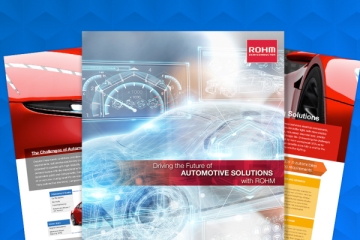
Mouser-ROHM Publishes E-book on EV Power Solutions
Mouser Electronics and Rohm Semiconductor have jointly released a new eBook focused on core technologies for next-generation automotive solutions. "Leading the Future of Automotive Solutions with Rohm" provides technical insights into applications surrounding vehicle electrification, including power management, lighting, and motor control.
2021.05.25by 강정규 기자
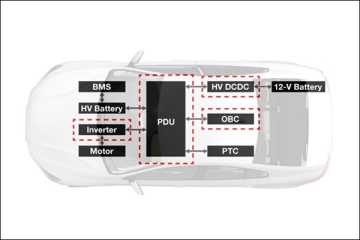
Improving Electric Vehicle Efficiency Depends on Powertrain System Integration
Automotive applications that perform more functions with fewer components reduce vehicle weight and cost while improving reliability. Integrating powertrain final device components increases power density and reliability while reducing cost. Additionally, standardization and modularization become possible, simplifying design and assembly.
2021.06.24by 이수민 기자
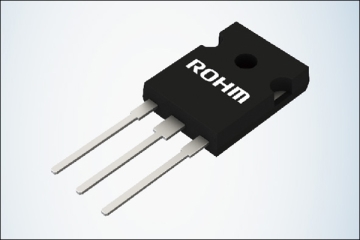
ROHM Develops 'Automotive Grade' IGBT with Built-in 650V SiC SBD
As requirements for power semiconductors mounted in inverters and converters become more diverse, technological innovation is being promoted in both ultra-low-loss SiC power products such as SiC MOSFET and SiC SBD, as well as conventional Si power products such as IGBT and SJ-MOSFET. In response, Rohm has developed the RGWxx65C series, a 650V SiC SBD-integrated IGBT, for automotive and industrial equipment handling high power applications such as EV OBC, DC/DC converters, and solar power conditioners.
2021.07.09by 이수민 기자

[e4ds Tech Day 2026 ⑨] Sim Sang-gyu, Autocrypt CTO: "In the Physical AI Era, Automotive Security Must Extend Beyond the Vehicle"
At e4ds Tech Day 2026, Sim Sang-gyu, CTO of Autocrypt, explained automotive cybersecurity strategies in the era of Physical AI and SDV (Software-Defined Vehicle). Automobiles are evolving as part of an ecosystem connected to AI, cloud, chargers, IoT, and robots, and he emphasized that the scope of security must expand beyond the vehicle interior to the entire connected environment. In particular, AI model tampering, adversarial attacks, OTA updates, and EV charger hacking were identified as major threats. He explained that response measures require zero trust, AI model integrity protection, intrusion detection, Security by Design and Default, and full lifecycle security management, and that proactive security system establishment beyond regulatory compliance is critical for securing future mobility competitiveness.
2026.10.12by 배종인 기자

Practical HIL Construction Strategy for Automotive and Off-Highway Controller Validation
As vehicle E/E architecture transitions to zonal structures and shifts to software-defined vehicles (SDV), the number of controllers (ECUs) requiring validation and software complexity are surging dramatically. Meanwhile, real vehicle testing cannot provide repeated verification under identical conditions and entails lead time and safety concerns. This white paper explains the principles of HIL (Hardware-in-the-Loop) validation and the structure of the NI platform composed of PXI, SLSC, and VeriStand, and through two actual implementation cases—Camera Record & Replay HIL for In-Cabin Monitoring Controller (ICMU) and Forklift Controller (VCU) HILS—describes how controller-level regression testing becomes possible. Additionally, it explicitly states application boundaries and limitations, such as lack of A2B support.
2026.10.12by 편집부











