



Vicor Provides High-Efficiency Power Conversion Solutions for Wave Power Generators
 Published2021.07.27 17:23
Providing compact, high-efficiency, high-density power solutions
Efficient energy transfer, high-bandwidth remote communication support
Vicor announced on the 27th that it has supplied power conversion solutions to the Autonomous Offshore Power System (AOPS) of Columbia Power Technologies (C-Power), a company specializing in marine energy systems. The C-Power AOPS captures wave energy and converts it into electricity for various applications such as offshore oil and gas exploration and production, marine carbon sequestration, oceanographic research, aquaculture, and homeland defense.
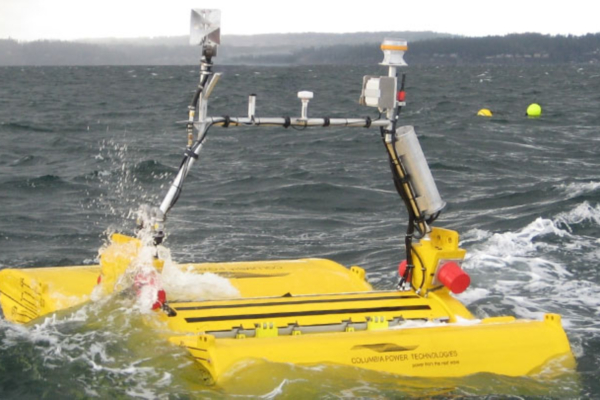
It is a company specializing in AOPS that converts into power. [Photo = C-Power]
Unlike other companies pursuing large-scale megawatt systems, SeaPower is focusing on kilowatt-class remote power systems for maritime data communications through the Defense Advanced Research Projects Agency (DARPA)’s Wave Energy Buoy System (WEBS) project. SeaPower’s AOPS is an autonomous and eco-friendly marine power source that can double the communication conduit length compared to other solutions.
The latest Sea Power AOPS platform, 'SeaRay', captures 10 to 1 megawatt of energy from waves. To achieve its goals within a narrow power range, SeaPower designed the Sea-Ray AOPS using Vicor's power conversion technology, which has a high power-to-weight ratio. This design features a small footprint, enhancing mobility and commercial viability while lowering distribution costs.
Joe Prudell, Senior Electrical Engineer at SeaPower R&D, stated, “To convert power pulses from waves into a semi-stable DC bus, a wide range of DC-DC solutions capable of controlling and regulating them are required,” adding, “We were able to accomplish this at various power levels using Vicor’s power modules and gained significant advantages.”
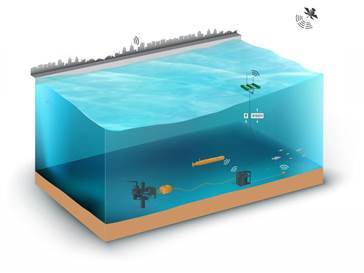
Enables the transmission of information to the cloud [Figure=Vico]
Sea Ray transmits events occurring at sea to the cloud in real time through autonomous remote data communication. While existing marine data collection systems had limited scope and frequency, Sea Ray supports real-time data delivery using cellular networks and satellites. This enables the collection and provision of more data more frequently.
The Vicor power system design team provided a power conversion solution and an energy storage device charger system with an input range of 30:1 to harmonize ocean wave energy characteristics with the demanding power conversion requirements of Sea Ray. These devices received external control signals from the Sea Power system and met power conversion requirements in real time.
SeaRay's scalable power design utilizes PRM™ regulator modules equipped with Vicor's BCM® fixed-ratio bus converters and multi-stage discrete converters to efficiently convert unpredictable wave energy caused by turbulence, providing controlled power. Through this, SeaPower has increased the conversion efficiency of the SeaRay design from 85% to 94%.
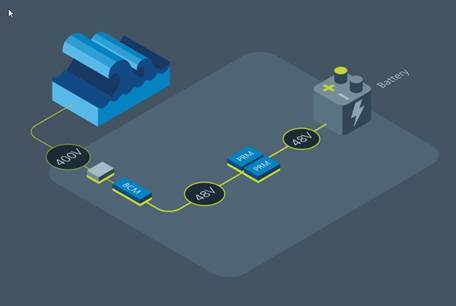
Converts wave energy into electricity [Figure=C-Power]
Vicor's DC-DC converters enable SeaRay to generate constant currents of various power levels while converting wave power pulses into various DC buses, providing essential control functions for SeaPower. Additionally, the power conversion topology used in Vicor modules minimizes built-in electromagnetic interference and noise from SeaRay that can reduce sensor measurement accuracy.
Comments
Related news
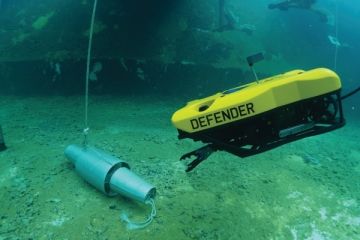
Vicor Provides 'PDN Solution' for VideoRay Underwater ROV
Remotely operated vehicles (ROVs) operating for extended periods in deep sea require the capability to secure operational space, thrust to withstand changing currents, and stability to provide stable video imagery. To achieve this, a high-density power distribution network (PDN) is necessary. Videolabs collaborated with Vicor to develop the 'Defender ROV' with these characteristics.
2021.03.10by 명세환 기자

Aveva Expands Support for Digital Transformation in Power Industry
Today, major leading companies in the power industry are leveraging big data analytics to find optimal energy source combinations, while accelerating the use of natural gas and renewable energy. Additionally, they are striving to reduce costs and carbon emissions by optimizing power plant operations and maximizing production through analytics technology, as well as developing new customer communication methods. In response, Aveva announced that it is expanding support for power suppliers seeking to strengthen their digital capabilities, improve their business models, and establish themselves as digital-based enterprises.
2021.07.21by 이수민 기자
The Ministry of Trade, Industry and Energy announced that the power semiconductor commercialization project achieved 39 billion won in results.
The Ministry of Trade, Industry and Energy conducted a review on the 21st of the commercialization project outcomes for power semiconductors aimed at creating new industries. The project has been carried out from 2017 through 2023 to establish a domestic industrial foundation for power semiconductors based on compound materials such as Si, SiC, and GaN. During this review, it was confirmed that commercialization results worth approximately 39 billion won were generated from 2019 through May of this year through product development by participating companies.
2021.07.21by 이수민 기자

Intel Unveils Next-Generation 'Core Ultra Series 3' and vPro Platform for Enterprise PCs
Intel has officially unveiled the "Intel Core Ultra Series 3" for next-generation enterprise PCs and the latest vPro platform, addressing a wide range of demands from enterprise notebooks to high-performance workstations.
2026.03.26by 배종인 기자
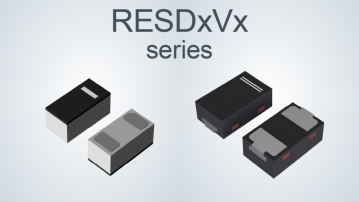
ROHM Launches ESD Protection Diode Compatible with High-Speed Interfaces of 10Gbps or Higher
Semiconductor specialist ROHM has developed the 'RESDxVx series' of ESD (electrostatic discharge) protection diodes capable of responding to next-generation high-speed data communication environments exceeding 10Gbps, simultaneously enhancing both signal quality maintenance required in high-speed interfaces and IC protection performance.
2026.03.26by 배종인 기자











