


Maxim Unveils IoT MCUs with Enhanced AI Inference Performance Using NN Technology
 Published2021.07.28 17:03
Maxim and Xiliant Develop Facial Recognition NN MCU
Power consumption is 1/250th that of existing embedded solutions.
Battery-powered AI systems that require facial recognition, such as industrial smart security cameras, home cameras, and retail cameras, require low-power solutions that operate for as long as possible.
Maxim Integrated Korea announced on the 28th that its 'MAX78000' ultra-low-power NN MCU has been enabled to recognize faces in edge video and images using AI specialist Xailient's Detectum neural network (NN) technology.
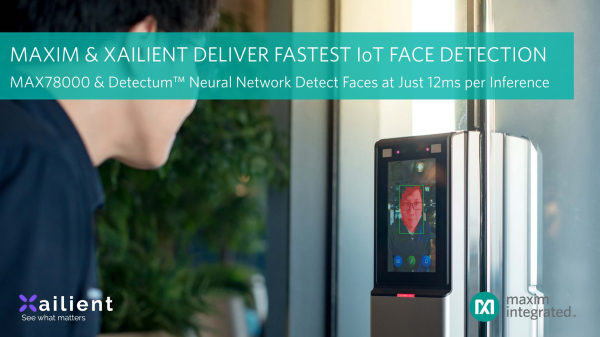
Maxim's MAX78000 MCU, paired with the Xyliant Detectum NN, not only supports standalone applications but also optimizes low-power sleep (listening) mode for hybrid edge/cloud applications that operate complex systems during facial detection, improving power efficiency and extending overall battery life. This extends the operating time of coin-cell-based hybrid edge/cloud applications by up to several years.
Faster AI inference speeds can improve accuracy through real-time or average multi-inference. Xyliant's NN consumes 1/250th the power of existing embedded solutions and recognizes faces at a processing speed of 12ms per inference. Additionally, the system incorporates focus, zoom, and wake word recognition technologies, enabling facial recognition in video and images at speeds comparable to or 76 times faster than existing software solutions. Furthermore, its flexible network allows for expansion into diverse applications, including livestock operation management and monitoring, parking recognition, and livestock counting.
“Thanks to Xiliant’s Detectum NN, the Maxim MAX78000 MCU can perform both classification and localization, enabling it to not only recognize faces in images or videos but also determine where those faces are located in the field of view,” said Robert Muchsel, senior analyst at Maxim Integrated. “It can also implement things like the number and presence of people, vehicles, and objects, obstacle recognition and path mapping, and customer flow heat maps.”
“AI is the second-largest carbon-emitting industry,” said Shivy Yohanandan, CTO and developer of Xyliant’s Detectum NN technology. “Replacing 14 legacy internet protocol cameras using traditional cloud AI with edge-based cameras powered by Maxim’s MAX78000 and Xyliant’s NN has the same carbon footprint as removing one gasoline vehicle from the road.”
Comments
Related news
MCU-based AI implementation "becomes the future of embedded industry"
AI technology makes IoT technology even more useful. General IoT devices only perform data collection and sharing, requiring human intervention. When AI functionality is added, the devices can independently analyze data, learn, make decisions, and take actions, which can significantly reduce cloud costs. AI is a technology that helps maximize the potential of IoT, and AIoT devices are products capable of interacting with their environment.
2021.07.26by 이수민 기자
The Ministry of Science and ICT is fostering intelligent IoT companies in five key sectors.
The Ministry of Science and ICT and NIPA are advancing a flagship project to promote the widespread application of intelligent IoT. The Ministry of Science and ICT will focus support on 7 representative projects centered on 5 strategic sectors: individuals and small business owners, digital healthcare, energy, logistics and transportation, and manufacturing. The 7 projects consist of 3 region-linked citizen-felt projects (6 billion won) and 4 leading services for productivity innovation (8 billion won).
2021.07.26by 이수민 기자
.jpg)
Cisco Unveils Infrastructure-Specific IoT Sensors and Smart Cameras
Even though facilities are equipped with safety equipment in compliance with facility regulations, accidents such as fires or flooding can occur due to sensor malfunctions or lack of real-time monitoring. Cisco has unveiled the new Meraki MT IoT sensor, which prevents safety accidents through enterprise facility and infrastructure monitoring, and has updated the functionality of the existing Meraki MV smart camera.
2021.07.27by 이수민 기자
[e4ds Tech Day 2026 ⑨] Sim Sang-gyu, Autocrypt CTO: "In the Physical AI Era, Automotive Security Must Extend Beyond the Vehicle"
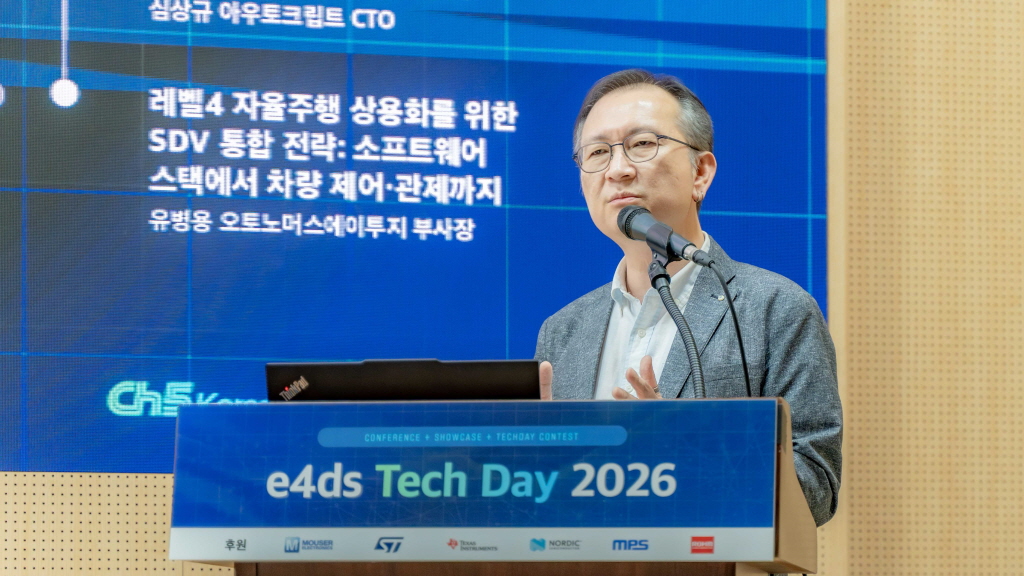
At e4ds Tech Day 2026, Sim Sang-gyu, CTO of Autocrypt, explained automotive cybersecurity strategies in the era of Physical AI and SDV (Software-Defined Vehicle). Automobiles are evolving as part of an ecosystem connected to AI, cloud, chargers, IoT, and robots, and he emphasized that the scope of security must expand beyond the vehicle interior to the entire connected environment. In particular, AI model tampering, adversarial attacks, OTA updates, and EV charger hacking were identified as major threats. He explained that response measures require zero trust, AI model integrity protection, intrusion detection, Security by Design and Default, and full lifecycle security management, and that proactive security system establishment beyond regulatory compliance is critical for securing future mobility competitiveness.
2026.10.12by 배종인 기자
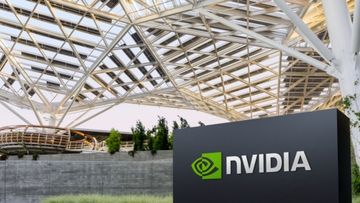
NVIDIA to Invest $1 Billion in U.S. Science Over Next Five Years
NVIDIA has announced plans to invest $1 billion over the next five years to strengthen U.S. scientific and technological competitiveness. The company will enhance cutting-edge artificial intelligence research and development capabilities in key areas including quantum computing, healthcare, and energy security, while expanding support for higher education research institutions and cloud service providers. NVIDIA is participating as a major industry partner in the White House Office of Science and Technology Policy's Genesis Mission, and is promoting supercomputer construction in collaboration with national laboratories including Argonne and Los Alamos.
2026.10.12by 배종인 기자











