


KIST Presents ML Model to Identify State of Next-Generation Semiconductor Materials
 Published2021.08.27 08:30
Development of a State-Defining Energy-Minimizing Variant Autoencoder
Presenting a solution to optimization problems using machine learning technology
An optimization problem refers to the problem of finding the most suitable solution to achieve a specific objective. While simple problems can be solved by examining all possible cases, complex problems involve an immeasurable number of possibilities and are therefore treated as representative difficult problems across various research fields.
Optimization problems also emerge in next-generation semiconductor research. A prime example is the field of spintronics, which develops low-power, high-performance semiconductors to overcome the integration limitations of silicon semiconductors. If the most stable state of the nanomagnet material is not identified and its properties are not understood in detail, the precise operating characteristics and range of the spin device cannot be designed.
A research team led by Dr. Heeyoung Kwon and Dr. Junwoo Choi of the Spin Fusion Research Group at the Korea Institute of Science and Technology (KIST) and Professor Changyeon Won of Kyung Hee University announced the development of the 'Energy-minimization Variational Autoencoder (E-VAE),' a generative machine learning model that estimates the spin structure appearing in the ground state, the most stable state of nanomagnets.
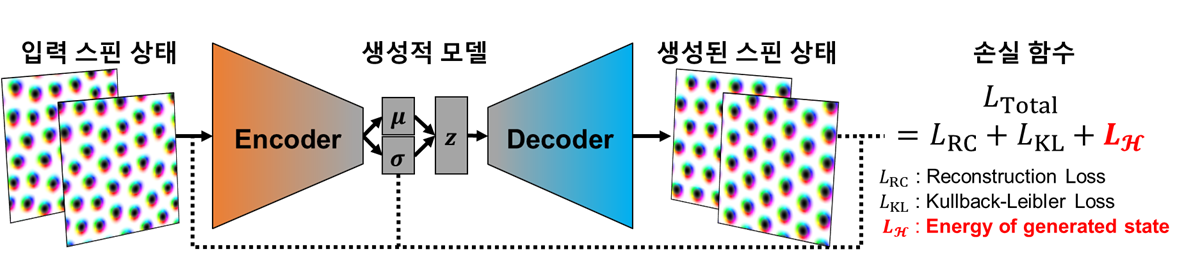
Conceptual diagram [Figure=KIST]
Generative machine learning techniques are used to learn from given data, extract its characteristics, and recombine them to generate new data. The research team confirmed that applying existing generative machine learning models to nanomagnets results in local noise and blurring effects, as well as the creation of conditions that violate the laws of physics.
In existing models, there was no process to lower the energy of the newly generated state compared to the input state, making it difficult to use for exploring the ground state of nanomagnets. The research team developed an E-VAE model that includes a process to minimize the energies of states generated in a Variational Autoencoder (VAE), an existing model, and succeeded in efficiently finding the optimal state that the spin structure of a nanomagnet can possess.
This demonstrated high efficiency and accuracy in finding the optimal state compared to the existing Simulated Annealing (SA) technique.
Dr. Hee-Young Kwon of KIST stated, “Optimization problems are important research topics not only in pure science and semiconductor research but also in the fields of mathematics and computer science,” adding, “The E-VAE model is expected to hold high academic value across various fields.” This research was conducted as part of a major KIST project supported by the Ministry of Science and ICT and a program to foster the next generation of scholars supported by the Ministry of Education. The research results were published in the June issue of the international journal Advanced Science.
Comments
Related news
Review of domestic companies producing deuterium for semiconductors
Deuterium (D2), one of the hydrogen isotopes used in ITER, an artificial sun development project, is emerging as having high potential for use in semiconductors, and it is known that several companies are currently conducting research for its production.
2021.08.10by 배종인 기자
KIMM Successfully Localizes 400nm-Class Lithography Equipment
The Korea Institute of Machinery and Materials (Director Park Sang-jin) under the Ministry of Science and ICT has successfully localized the manufacturing of a 400㎚ (nanometer)-class laser direct lithography equipment for the first time in Korea. The technology is drawing expectations as it can dramatically improve semiconductor productivity.
2021.08.13by 배종인 기자
Samsung's "Semiconductor Heat Reduction Material" Gains Global Recognition
Research on next-generation semiconductor materials conducted by domestic university research teams supported by Samsung's 'Future Technology Development Initiative' has been recognized for its achievements and published in an international academic journal.
2021.08.25by 배종인 기자
Schneider Aims for Building Energy Savings and Operational Stability with Next-Generation HVAC Drives
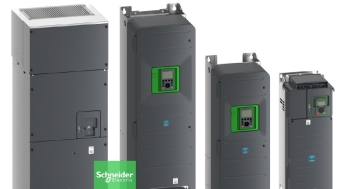
Schneider Electric has unveiled its next-generation HVAC drive product line 'Altivar HVAC'. The new product line's key features center on enhanced energy savings, system operational stability, and building management system integration. The products are divided into 'ATH200' for OEM and small equipment applications, and 'ATH600' for environments requiring continuous operation and advanced control. The company plans to expand the application scope from commercial buildings to facilities where HVAC system stability is critical, such as hospitals, airports, and data centers. The announcement includes over 30% energy savings, operation from -10°C to +60°C, Modbus and BACnet support, and compatibility with low global warming potential refrigerants.
2026.03.26by 명세환 기자
Ecolab Expands AI Data Center Cooling Business Through Acquisition of CoolIT
Ecolab has agreed to acquire CoolIT Systems, a liquid cooling company for AI data centers, for approximately $4.75 billion. The transaction is expected to close by Q3 2026, subject to regulatory approvals. CoolIT has been supplying direct-to-chip cooling-based coolant distribution units, cold plates, and manifolds, serving hyperscale data centers and colocation operators as customers. This acquisition is a measure to address the high-heat and high-density server environments created by AI proliferation. Ecolab plans to combine its water management and digital monitoring capabilities with CoolIT's hardware technology to expand its data center cooling business.
2026.03.26by 명세환 기자











