


e4ds Victory, the foundation for AMR development
 Published2021.09.30 15:28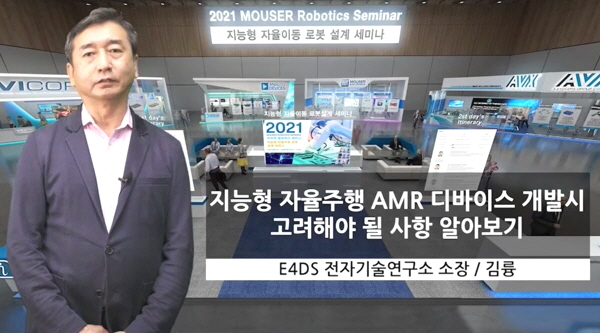
▲ Kim Ryong, director of the e4ds Electronics Technology Research Institute, is giving a presentation on the topic, “Things to consider when developing intelligent autonomous driving AMR devices.”
Development resources will be provided to ease the burden of development for mid-level and student developers.
"The e4ds Victory will contribute to the advancement of autonomous robots in Korea by developing an autonomous driving environment applicable to autonomous mobile robots (AMRs) for collecting and utilizing environmental data in the rapidly growing edge AI field. It will also suggest a direction for commercial robot development to reduce the development burden on small and medium-sized enterprises (SMEs) and students developing autonomous robots."
At the second day of the '2021 Mouser Robotics Seminar - Intelligent Autonomous Mobile Robot Design Seminar' held from September 29th to 30th, Kim Ryong, Director of the E4DS Electronics Technology Research Institute, gave a special lecture on the topic of 'Things to consider when developing intelligent autonomous AMR devices' and presented the development direction of the AMR 'e4ds Seungriho'.
In this presentation, Director Kim Ryong said that the AI edge area learns about phenomena occurring in the environment and space where we live, and based on the results, provides people with various functions that are safer and more convenient.He said that this is a very important part and that it is the market with the strongest growth in the near future.
He also said that while edge devices that collect and analyze data in fixed, specific locations are important, the existence of autonomous robots that can collect and utilize real-time changing environmental data in a mobile environment where people and objects move is essential.
On the other hand, the driving test environment during the development process of autonomous driving robots is not easy, and the risk of accidents for testers and observers, as well as the economic burden on small and medium-sized businesses and students, are even greater. To reduce these burdens, they said that they are creating scaled-down models and using them to test driving algorithms.
Here, the direction of commercial robot development was explained and considerations for AMR design were introduced.
When designing an AMR, it was mentioned that the following must be taken into consideration first: △structure/size suitable for the usage environment and purpose, △maximum load weight/speed, △drive type such as wheels and tracks, and △basic structure such as battery capacity/weight/volume.
He also explained the design process, from development requests to system design, prototypes, manufacturing, and completion, saying that the configuration management organization is important.
Regarding the drive system, he said that the parts that control the wheels have many control elements, and required a clear understanding of the design concept.
In particular, for service AMR, it must be below the running speed of a person, and when controlled at 150Hz, it moves 3.3mm per cycle, and when controlled at 500Hz or higher, it is said that control is possible in units of 1mm.
AMR has a basic hardware structure including a drive unit, sensor unit, ROS/SLAM/communication control unit, etc., and the basic software structure includes △open board OS △ROS/ROS2 △SLAM △open CV △motor control △IMU/sensor, etc.
AMR design considerations provide technical information for developers.He said that because of this, they are testing various environments and seeing which method is effective.
He also mentioned that when it comes to software development, performance depends on the PC used, and that ROS build time is slightly faster on VMware, and for Mac users, only Vbox is available for free.
Regarding ROS (Robot Operating System), he said that ROS does not support multiple robots with the same master node, so computing resources and onboard networking are required to achieve the best performance.
In contrast, ROS2 is capable of using DDS, provides a custom API to get all information about nodes and topics using the DDS distributed search mechanism, is compatible with Ubuntu, Windows 10, and OS X, can have default values when initializing the data type of message files, and supports real-time response with apt RTOS such as RTPREEMPT.
Lastly, the AMR 'e4ds Seungriho' from the E4DS Electronics Research Institute was introduced.
Director Kim Ryong said, “e4ds Victory Ho performs functions such as autonomous driving, vision recognition, route mediation, obstacle avoidance, air purification and deodorization, UV sterilization, plasma ion deodorization, and cigarette butt and small trash cleaning. It is important for it to drive safely and without accidents. After completion, we plan to continuously upgrade it by installing various sensors and software algorithms.” He added, “We will continue to test the technical aspects of each control part and the various solutions and devices used in the software algorithm architecture. Once the results are collected, we will disclose various technical data through the e4ds website.”
▲e4ds Victory Ho role

Comments
Related news
[Interview] Daehyun Kim, CEO of Qribo, “Leading Logistics Robots with Optimized Control Management”
Recently, Curio's CEO Kim Dae-hyun, who was interviewed by this publication, expressed confidence in logistics robot technology and stated his commitment to advancing and expanding the adoption of logistics robot technology going forward.
2021.08.17by 배종인 기자
Expansion of the Autonomous Robot Market Requires the Perfect Match of Sensors, Communications, and Legal Frameworks
To facilitate the expansion of the autonomous robot market, improvements in sensor and communication technologies for enhanced control and command technology are essential, as well as legal frameworks that align with societal norms and standards for practical application.
2021.08.17by 배종인 기자
Eugene Robot Showcases Autonomous Driving Robot Technology
Ujin Robot showcased autonomous driving robot technology equipped with its own LiDAR sensor, demonstrating its position as a leading player in the domestic autonomous driving robot market.
2021.09.15by 배종인 기자
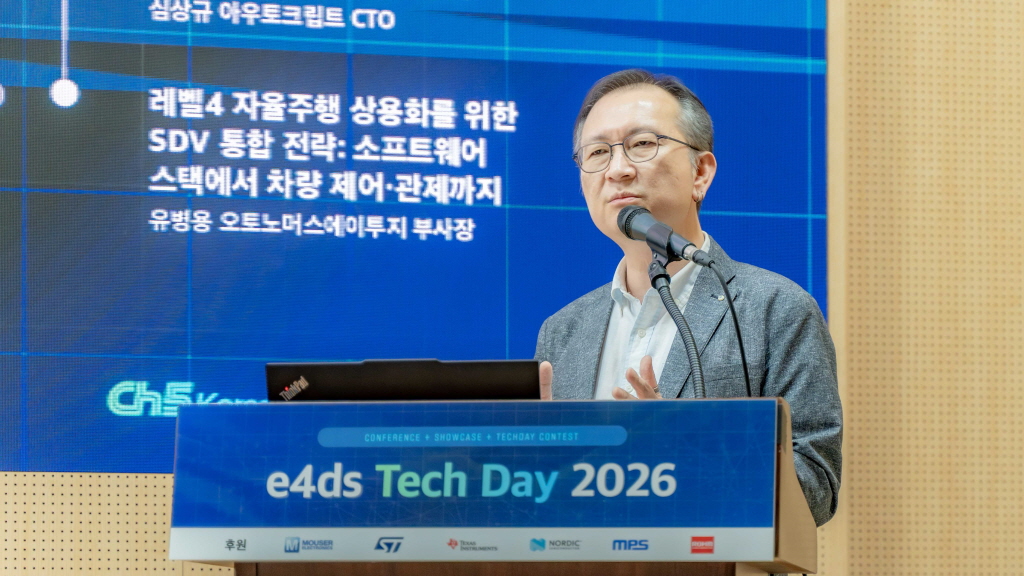
[e4ds Tech Day 2026 ⑨] Sim Sang-gyu, Autocrypt CTO: "In the Physical AI Era, Automotive Security Must Extend Beyond the Vehicle"
At e4ds Tech Day 2026, Sim Sang-gyu, CTO of Autocrypt, explained automotive cybersecurity strategies in the era of Physical AI and SDV (Software-Defined Vehicle). Automobiles are evolving as part of an ecosystem connected to AI, cloud, chargers, IoT, and robots, and he emphasized that the scope of security must expand beyond the vehicle interior to the entire connected environment. In particular, AI model tampering, adversarial attacks, OTA updates, and EV charger hacking were identified as major threats. He explained that response measures require zero trust, AI model integrity protection, intrusion detection, Security by Design and Default, and full lifecycle security management, and that proactive security system establishment beyond regulatory compliance is critical for securing future mobility competitiveness.
2026.10.12by 배종인 기자
NVIDIA to Invest $1 Billion in U.S. Science Over Next Five Years
NVIDIA has announced plans to invest $1 billion over the next five years to strengthen U.S. scientific and technological competitiveness. The company will enhance cutting-edge artificial intelligence research and development capabilities in key areas including quantum computing, healthcare, and energy security, while expanding support for higher education research institutions and cloud service providers. NVIDIA is participating as a major industry partner in the White House Office of Science and Technology Policy's Genesis Mission, and is promoting supercomputer construction in collaboration with national laboratories including Argonne and Los Alamos.
2026.10.12by 배종인 기자











