


Automotive semiconductor shortage to continue through 2022
 Published2021.10.28 15:24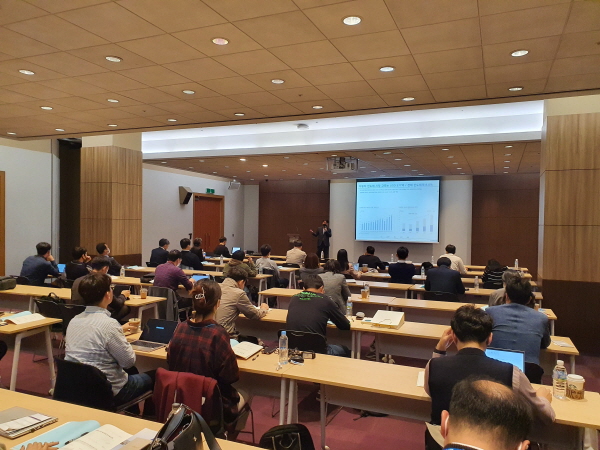
▲A view of the semiconductor market outlook seminar.
Power semiconductors and electric vehicle demand are expanding the market.
Wafer supply shortages, system and foundry difficulties
The automotive semiconductor shortage is expected to continue next year, following this year's shortage. Furthermore, the power semiconductor market is expected to continue expanding in the future due to rising demand for electric vehicles.
The Korea Semiconductor Industry Association and the Korea Semiconductor Research Association held a semiconductor market outlook seminar at COEX Room 317 on the 27th.
At this seminar, each speaker examined recent semiconductor issues and forecasted the semiconductor market for next year.
Ki-Hyeon Ahn, Executive Director of the Korea Semiconductor Industry Association, gave the first presentation on recent issues and prospects in the semiconductor industry. Executive Director Ahn Ki-hyun predicted that the automotive semiconductor market is experiencing an imbalance in supply and demand due to insufficient production capacity compared to the industry's average annual growth rate, and that the imbalance will not be resolved in the short term, and that the importance of foundries and manufacturing will increase.
In addition, the semiconductor market is expected to continue to grow, with memory semiconductors showing price stability driven by suppliers, but system semiconductors are expected to grow by an average of 4.1% per year until 2025, and significant growth is expected in the mobile, server, and automotive sectors.
In particular, the foundry market has grown at an average annual rate of 10.9% over the past five years and is expected to grow at an average annual rate of 9.7% through 2025.
Next, Lee Se-cheol, Managing Director of Citigroup, presented his outlook for the global memory market, while Yeon Won-ho, Associate Research Fellow at the Korea Institute for International Economic Policy, presented the US-China technological hegemony competition and China's semiconductor domestic production strategy.
In the fourth presentation, Noh Geun-chang, head of the Hyundai Securities Center, provided his outlook for the automotive semiconductor/power semiconductor market. He predicted that the automotive semiconductor market, which was valued at $37.7 billion in 2019, representing 8% of the overall semiconductor market, would grow to $40 billion by 2021.
The automotive semiconductor market is a competitive market with many companies, and Renesas and NXP are competing for first and second place in the automotive MCU market. Automotive semiconductors have traditionally been dominated by European companies, and the center of gravity in automotive sensors is shifting from the existing ultrasonic and temperature sensors to ADAS sensors.
Amid the recent supply shortage, companies such as TSMC are actively expanding production of automotive semiconductors, and foundries in the Greater China region have also increased their monthly capacity by 81,000 units.
Renesas is reported to have completely overcome the shock of the fire earlier this year and has significantly increased capacity by investing more than before the fire.
Automotive semiconductor companies have also begun construction and operation of new 12-inch power semiconductor plants, up from their existing 8-inch counterparts. STMicroelectronics has increased its SiC capacity tenfold, and Infineon has continued to see growth in both sales and profitability. NXP's automotive semiconductor profitability has also improved by 22%, and Renesas has also reportedly seen significant performance improvements despite the fire at its Nata plant.
Amidst this backdrop, the power semiconductor market is expected to expand alongside rising automotive demand. In particular, with demand for SiC and GaN expected to grow rapidly, STMicroelectronics announced a tenfold increase in SiC capacity and a shift in production from a 6-inch to an 8-inch process.
Meanwhile, it has been reported that efforts to domestically produce semiconductors for automobiles are continuing, and Samsung Electronics is also expected to seize opportunities in automotive memory semiconductors, as the automotive portion of its foundry sales is around 5%.
Finally, Kim Young-woo, head of the SK Securities Center, provided his outlook for the system semiconductor/foundry market. He predicted that the strong demand for IT devices has led to a boom in wafers, and that the combination of strong forward demand and conservative investment stances will exacerbate the wafer shortage. In particular, it was predicted that a war to secure supplies due to a shortage of wafer supply would be inevitable, and that failure to secure supplies would lead to a halt in production.
Furthermore, the supply of epitaxial wafers used in logic semiconductors is expected to struggle to keep pace with demand, and polished wafers used in memory semiconductors are also expected to see price increases and supply shortages. Consequently, a shortage of system semiconductors and foundries is forecast for 2022.

Comments
Related news
Automotive semiconductor shortages will likely persist for the foreseeable future.
An Ki-hyun, Executive Director of the Korea Semiconductor Industry Association, delivered a keynote presentation titled "Recent Issues and Responses in the Semiconductor Industry" at the 'e4ds Semiconductor Technology Conference 2021 Spring'. Executive Director An Ki-hyun projected that automotive semiconductor supply and demand imbalances will persist in the near term, as production capacity falls short relative to the year-over-year demand growth for automotive semiconductors.
2021.04.30by 배종인 기자

Semiconductor supply instability negatively impacts the performance of Korean auto parts manufacturers.
Multiple domestic automotive parts suppliers are facing management difficulties due to global instability in automotive semiconductor supply. According to an emergency survey conducted by KAIA on the 3rd and 4th of this month targeting 78 parts suppliers, which are first to third-tier partners of domestic automakers, 84.6% of surveyed companies (66 companies) responded that they are experiencing management challenges due to semiconductor supply and demand issues and resulting production delays by complete vehicle manufacturers.
2021.05.11by 이수민 기자
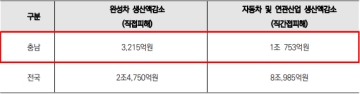
South Chungcheong Province suffers a loss of 321.5 billion won due to a shortage of automotive semiconductors.
The automotive industry in the Chungcheongnam-do region has suffered hundreds of billions of won in losses due to supply shortages of automotive semiconductors, but experts suggest that if the industry fails to respond to the future automotive restructuring involving electric vehicles and hydrogen fuel cell vehicles, it could lead to even greater losses, and therefore should be seized as an opportunity for structural improvement.
2021.08.10by 배종인 기자
Intel Unveils Next-Generation 'Core Ultra Series 3' and vPro Platform for Enterprise PCs
Intel has officially unveiled the "Intel Core Ultra Series 3" for next-generation enterprise PCs and the latest vPro platform, addressing a wide range of demands from enterprise notebooks to high-performance workstations.
2026.03.26by 배종인 기자
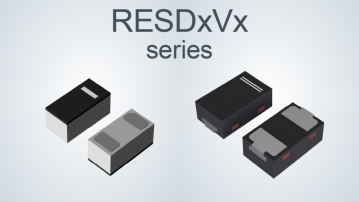
ROHM Launches ESD Protection Diode Compatible with High-Speed Interfaces of 10Gbps or Higher
Semiconductor specialist ROHM has developed the 'RESDxVx series' of ESD (electrostatic discharge) protection diodes capable of responding to next-generation high-speed data communication environments exceeding 10Gbps, simultaneously enhancing both signal quality maintenance required in high-speed interfaces and IC protection performance.
2026.03.26by 배종인 기자











