


"Gimpo Airport to Gangnam in 10 minutes by air taxi."
 Published2021.11.11 08:53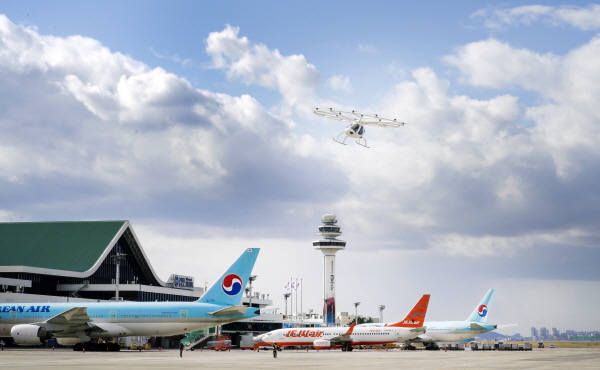
The 'K-UAM Dream Team', comprised of SK Telecom, Korea Airports Corporation, Hanwha Systems, and T Map Mobility, successfully completed a comprehensive demonstration of Korean-style UAM (Urban Air Mobility) that will drastically change the transportation culture in the metropolitan area, and is on track to commercialize it in 2025.
SK Telecom (CEO Yoo Young-sang), together with Korea Airports Corporation (CEO Son Chang-wan), Hanwha Systems (CEO Eo Seong-cheol), Korea Transport Institute (President Oh Jae-hak), and T Map Mobility (CEO Lee Jong-ho), unveiled an operational model for commercializing UAM in the metropolitan area on the 11th.
SKT and its partner companies comprehensively demonstrated core capabilities related to services, infrastructure, aircraft, and research of UAM, also known as "air taxis," through the "Korean Urban Air Mobility (K-UAM) Airport Demonstration" hosted by the Ministry of Land, Infrastructure and Transport at Gimpo International Airport.
On this day, SKT stably connected the UAM pilot and ground control center, who circled the airspace outside Gimpo International Airport for about three minutes, through air and ground mobile communication networks. This demonstration is necessary to build an integrated system that can safely control UAM takeoff and landing at airports where aircraft operate, and an information sharing system that enables services such as allowing UAM users to use airport facilities and quickly and conveniently transfer to other means of transportation.
SKT also succeeded in controlling autonomous drones linked to the K-Drone System, demonstrating that ICT technology can be used to comprehensively manage everything from aircraft and UAMs using the airport to unmanned aerial vehicles.
Along with this, T Map Mobility unveiled a next-generation mobility platform that conveniently connects urban transportation with UAM. The demonstration site featured a VR experience where a transfer vehicle assigned to a passenger in a UAM arrived at the same time as the passenger's landing time.
T Map Mobility believes that fast and convenient reservation methods and a safe boarding process will determine the quality of UAM services, and plans to introduce an integrated mobility platform based on the capabilities accumulated through T Map and Wooti.
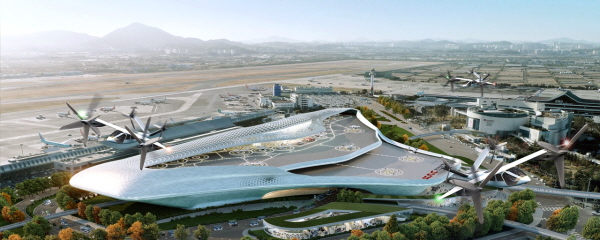
Korea Airports Corporation and Hanwha Systems, partners of the "K-UAM Dream Team" collaborating with SKT, also showcased their advanced technologies. Korea Airports Corporation conducted the first UAM airport demonstration in Korea and simultaneously implemented a UAM-aircraft integrated control system and a future vertiport utilizing a business aviation terminal. Hanwha Systems displayed a mock-up of its five-seater air mobility aircraft, "Butterfly," capable of safely and quickly flying at a maximum speed of 320 km/h.
UAM is an air mobility service based on electric-powered aircraft that is gaining attention as an eco-friendly means of transportation that can take off and land vertically in urban areas without a runway and can be connected to various ground transportation methods.
Accordingly, the government is accelerating the demonstration of an airport shuttle service in the metropolitan area with the goal of commercialization by 2025. The routes centered around Gimpo Airport will consist of T Map Mobility's app-based reservation and connected transportation boarding, and UAM operation and traffic management infrastructure utilizing SKT's airspace network communication technology.
As the UAM industry advances and operates in remotely controlled or autonomous modes, the construction and operation of air traffic communication networks will become increasingly important. SKT plans to continue to lead the way in communication technologies connecting the ground and the air, leveraging its stable network operation capabilities.
SK Telecom CEO Yoo Young-sang said, “Based on SKT’s advanced communications and digital infrastructure, we will play a key role in the development of the UAM industry, reducing social costs caused by traffic congestion and contributing to the establishment of eco-friendly transportation methods that do not emit greenhouse gases.”

Comments
Related news
.jpg)
"Drone taxis are taking off." The Ministry of Land, Infrastructure and Transport and the Seoul Metropolitan Government demonstrate 'UAM' in the city center.
Urban air mobility has recently drawn attention as an alternative to solve ground traffic congestion in major metropolitan areas. Leading countries worldwide are accelerating the development of electric-powered vertical takeoff and landing aircraft. The Ministry of Land, Infrastructure and Transport and Seoul City jointly held demonstration events for drone delivery and taxi services in Yeouido. The Ministry of Land, Infrastructure and Transport announced that it will smoothly implement the K-UAM roadmap through industry-academic-research-government collaboration, with the aim of commercialization in 2025 based on this demonstration.
2020.11.12by 명세환 기자
A consultative body has been launched to aim for commercialization of UAM services by 2025.
Urban Air Mobility (UAM) services utilizing electric-powered vertical takeoff and landing aircraft are an innovative urban living service that can reach destinations in approximately 20 minutes that would take around one hour by car, and can be integrated with various ground transportation modes. According to the Ministry of Land, Infrastructure and Transport, the UAM industry is projected to form a 731 trillion won global market by around 2040. In response, we have signed a memorandum of understanding with SK Telecom, Korea Airports Corporation, Hanwha Systems, and Korea Transport Institute for UAM commercialization.
2021.01.29by 명세환 기자
.jpg)
ANSYS Korea and Halla University Sign Memorandum of Understanding to Train Technicians in the Smart Mobility Field
ANSYS Korea has signed a memorandum of understanding with Halla University for nurturing human resources in the e-mobility field. This memorandum of understanding, aimed at producing approximately 400 personnel annually, establishes a common goal to promote the development of motor engineers specialized in e-mobility and UAM fields by leveraging both companies' technologies and infrastructure.
2021.11.04by 명세환 기자
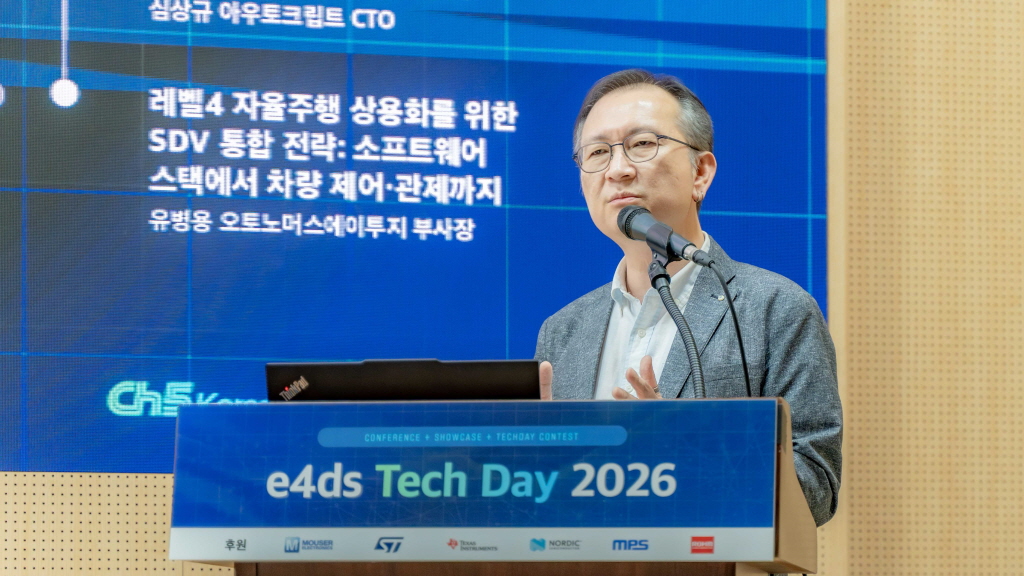
[e4ds Tech Day 2026 ⑨] Sim Sang-gyu, Autocrypt CTO: "In the Physical AI Era, Automotive Security Must Extend Beyond the Vehicle"
At e4ds Tech Day 2026, Sim Sang-gyu, CTO of Autocrypt, explained automotive cybersecurity strategies in the era of Physical AI and SDV (Software-Defined Vehicle). Automobiles are evolving as part of an ecosystem connected to AI, cloud, chargers, IoT, and robots, and he emphasized that the scope of security must expand beyond the vehicle interior to the entire connected environment. In particular, AI model tampering, adversarial attacks, OTA updates, and EV charger hacking were identified as major threats. He explained that response measures require zero trust, AI model integrity protection, intrusion detection, Security by Design and Default, and full lifecycle security management, and that proactive security system establishment beyond regulatory compliance is critical for securing future mobility competitiveness.
2026.10.12by 배종인 기자
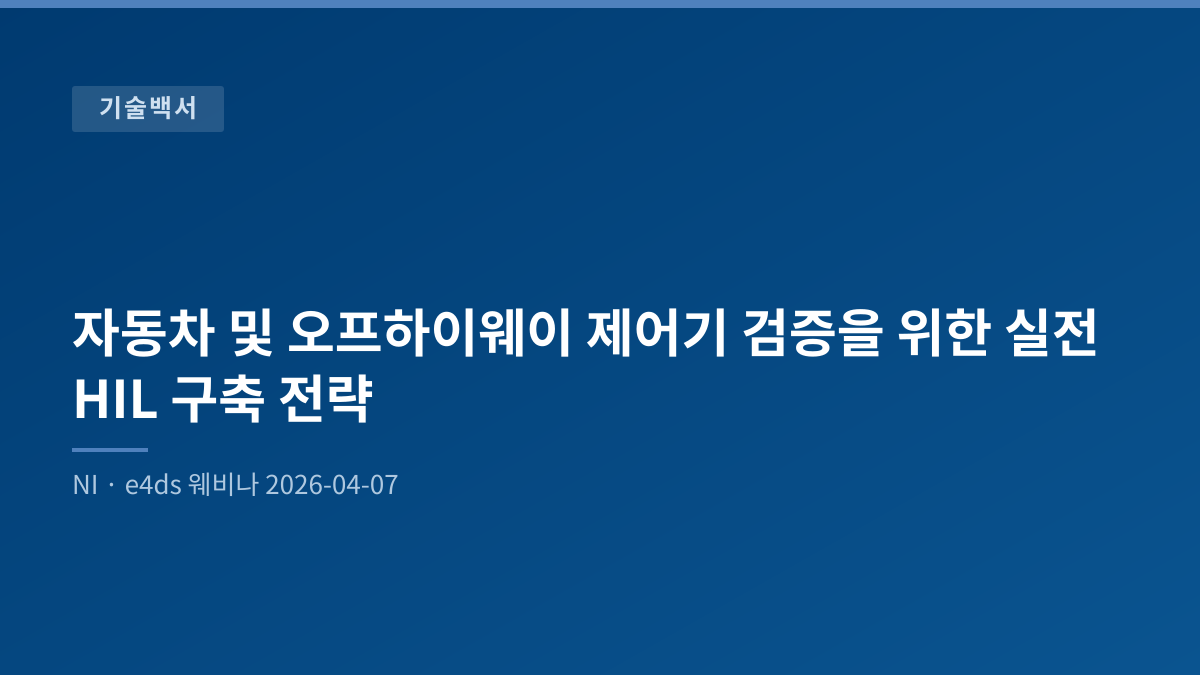
Practical HIL Construction Strategy for Automotive and Off-Highway Controller Validation
As vehicle E/E architecture transitions to zonal structures and shifts to software-defined vehicles (SDV), the number of controllers (ECUs) requiring validation and software complexity are surging dramatically. Meanwhile, real vehicle testing cannot provide repeated verification under identical conditions and entails lead time and safety concerns. This white paper explains the principles of HIL (Hardware-in-the-Loop) validation and the structure of the NI platform composed of PXI, SLSC, and VeriStand, and through two actual implementation cases—Camera Record & Replay HIL for In-Cabin Monitoring Controller (ICMU) and Forklift Controller (VCU) HILS—describes how controller-level regression testing becomes possible. Additionally, it explicitly states application boundaries and limitations, such as lack of A2B support.
2026.10.12by 편집부











