



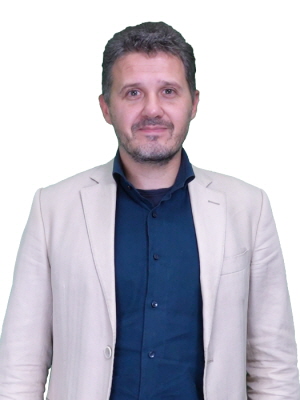
[Contribution] Matteo Maravita, ST Center Director: "Deep Edge: Overcoming AI's Limitations and Sustainable Growth"
 Published2021.11.26 14:36
Standalone, low-power, and embedded devices are expected to reach 2.5 billion by 2030, with rapid growth.
Low bandwidth, information protection, reduced latency, and local adjustment of current consumption
 Recently, the mass media has been presenting a variety of interesting solutions in various fields. Among them, artificial intelligence (AI) is frequently mentioned as the most advanced and cutting-edge technology.
In fact, AI is a concept that was conceived as early as the 1950s, and any technology that enables computers to mimic human behavior is AI. This concept is very general and covers a wide range of research and solution areas.
A subfield of AI is machine learning, which is a set of algorithms and methodologies that improve over time by learning from data.
Moreover, its subfield, deep learning, is the most complex advanced AI algorithm because it uses not only data but also a neural network-like structure imitating the human brain to make decisions.
On the other hand, defining these algorithms is complex, as there are too many variables and creating an effective application model is extremely difficult. This is where machine learning opens up new opportunities.
Currently, AI technology is being used in various fields. Self-driving cars are the most well-known implementation of AI, but the applications of AI are endless in every sector that collects data: smart homes that detect intrusions using impact measurement algorithms, smart industries that implement predictive maintenance, smart buildings that adjust their environments based on predicted and actual occupancy to save energy, and advertising engines that analyze customer preferences, interests, and behaviors.
But this AI also has limitations.
For a centralized approach that uses AI algorithms running in the cloud, data is fed from sensors to the cloud without intermediate analysis.
This raises security concerns because data is transmitted across multiple devices, gateways, networks, and companies.
Responsiveness is also poor because the latency from node to cloud is relatively long.
Efficiency issues also arise because sensor nodes have high bandwidth and consume significant amounts of power.
The solution to overcome this limitation is ‘Deep Edge.’
Deep Edge decentralizes computing and services from the cloud to the network edge.
Increasingly, intelligence is being embedded within the host microcontroller or sensor nodes themselves, enabling them to make decisions and become more responsive. This has the following benefits:
First, it consumes less bandwidth. Since all raw data is not transmitted directly to the cloud, bandwidth requirements are significantly reduced, maximizing efficiency.
Second, information protection is easy. Data does not necessarily have to pass through other networks and is processed locally, ensuring security.
Third, latency is reduced. Real-time communication without centralized communication shines in critical situations where every second counts. This responsiveness is crucial for the successful execution of real-time applications.
Fourth, the current consumption of sensors or sensor nodes can be locally adjusted. This feature is particularly useful in battery-powered applications.
Global shipments of these deep-edge AI devices are expected to reach 2.5 billion units by 2030.
Deep edge AI technologies are growing rapidly, especially in standalone, low-power, cost-effective embedded solutions.
STMicroelectronics, a leader in deep edge AI, anticipates continued growth in deep edge AI across three segments: condition monitoring, audio and sensing, and computer vision.
On the other hand, the requirements for AI architecture and computing performance used in each sector are very different.
Therefore, practical implementation of AI requires a wide range of solutions and expertise, from smart sensors to key tools and ecosystems.
This deep-edge technology will be a key way to gain an edge in the semiconductor market, where every nanometer is being fought over.
※ This article is a contribution by Matteo Maravita, Director of the AI Competence Center at STMicroelectronics.

Comments
Related news
.jpg)
ST Announces ML-Enhanced 'STM32Cube.AI 7.0' Development Environment
ST Microelectronics has announced an expansion of machine learning techniques available in the STM32Cube.AI development environment. The new STM32Cube.AI 7.0 version enables development of neural networks for edge inference on STM32 MCUs, and supports new supervised and semi-supervised methods that operate with smaller datasets and fewer CPU cycles.
2021.07.29by 강정규 기자
ST Launches STM32Cube Software and Evaluation Board
STMicroelectronics (ST), a global semiconductor company supporting diverse electronic applications and customers, is moving forward to support rapid development of the STM32U5 ultra-low-power microcontroller through expansion of the STM32 ecosystem.
2021.10.06by 명세환 기자
.jpg)
[Interview] Matteo Maravita, Director of ST's AI Competence Center: "ST Solutions Solve the Deep Edge AI Data Explosion"
We have arranged a session to hear from the head of ST Microelectronics' AI Competency Center about deep edge technology, machine learning, and AI processes that overcome AI limitations.
2021.11.19by 배종인 기자
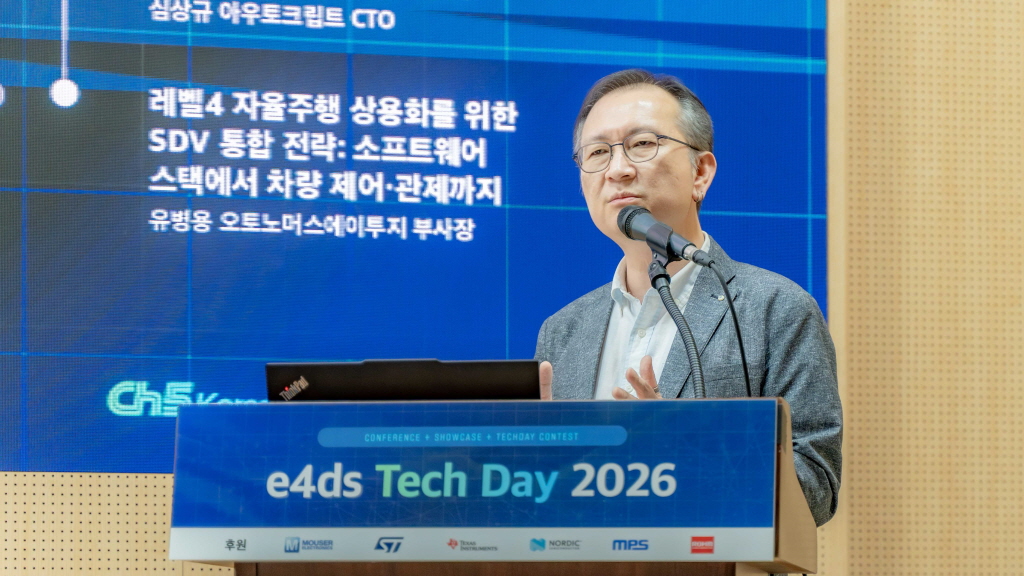
[e4ds Tech Day 2026 ⑨] Sim Sang-gyu, Autocrypt CTO: "In the Physical AI Era, Automotive Security Must Extend Beyond the Vehicle"
At e4ds Tech Day 2026, Sim Sang-gyu, CTO of Autocrypt, explained automotive cybersecurity strategies in the era of Physical AI and SDV (Software-Defined Vehicle). Automobiles are evolving as part of an ecosystem connected to AI, cloud, chargers, IoT, and robots, and he emphasized that the scope of security must expand beyond the vehicle interior to the entire connected environment. In particular, AI model tampering, adversarial attacks, OTA updates, and EV charger hacking were identified as major threats. He explained that response measures require zero trust, AI model integrity protection, intrusion detection, Security by Design and Default, and full lifecycle security management, and that proactive security system establishment beyond regulatory compliance is critical for securing future mobility competitiveness.
2026.10.12by 배종인 기자
NVIDIA to Invest $1 Billion in U.S. Science Over Next Five Years
NVIDIA has announced plans to invest $1 billion over the next five years to strengthen U.S. scientific and technological competitiveness. The company will enhance cutting-edge artificial intelligence research and development capabilities in key areas including quantum computing, healthcare, and energy security, while expanding support for higher education research institutions and cloud service providers. NVIDIA is participating as a major industry partner in the White House Office of Science and Technology Policy's Genesis Mission, and is promoting supercomputer construction in collaboration with national laboratories including Argonne and Los Alamos.
2026.10.12by 배종인 기자











