



[Interview] Honghui Yan, General Manager at Texas Instruments – “‘Minimizing IQ’ is Key to Battery Life”
 Published2021.11.29 14:48
Low constant power consumption, fast response time, and reduced form factor
LM43620-Q1 Optimized for Ultra-Low Static Current
[Editor's Note] As battery usage is expected to increase across industries as well as in the future, various studies are underway to extend battery life and increase battery capacity. One such method involves maintaining a low quiescent current. This approach aims to extend battery life and product lifespan without compromising system performance by maintaining extremely low current through strict power output management during the battery's standby mode. In this context, Texas Instruments (TI) recently announced that it has achieved ultra-low IQ by reducing form factor size and maintaining low constant power consumption and fast response times. Furthermore, the company recently launched the TPS61094 buck/boost converter, the LMR43620/Q1 and LMR43610/Q1 buck converters, and the LM7472X-Q1 ideal diode family as the industry's lowest IQ devices. Accordingly, this magazine arranged an interview with Hong-Hui Yen, General Manager of the Boost Controller and Converter Solutions Product Line at Texas Instruments, to hear about the relevant details.
 ■ Please introduce Texas Instruments.
Texas Instruments, a global semiconductor company, designs, manufactures, tests, and sells analog ICs and embedded processors for industrial, automotive, personal electronics, telecommunications equipment, and enterprise sectors.
For decades, TI has pursued technological innovations that provide higher reliability and efficiency so that semiconductors can be applied to all electronic devices, in accordance with the spirit of technological progress aimed at making a better world by creating more affordable electronic products through semiconductors.
I am curious why you focused on low quiescent current (low IQ ) among the five tasks for resolving power management challenges at the last press conference.
We can find batteries anywhere around us. As a result, the use of batteries is steadily increasing across our lives and various industrial sites, ranging from the cars we drive to the numerous sensors installed on factory floors.
On the other hand, since battery-powered systems spend most of their time in standby mode, quiescent current and IQ in standby and power-saving modes are critical to battery life, making them a major design challenge for engineers.
Therefore, TI focuses on low IQ power to extend battery life, aiming to lower total costs while providing more features and improved battery life.
■ I would like to know what TI focused on and what efforts it made to achieve a low IQ .
Following the industry trend of seeking increasingly lower current, 'minimization of IQ ' has also emerged as an important topic.
TI is approaching the achievement of low IQ from three perspectives.
First, battery life is extended by using process technology with extremely low leakage and an innovative control topology with low constant power levels.
Furthermore, by using a comparator that starts quickly with a fast response time and zero IQ feedback control, fast dynamic response is achieved without increasing power consumption.
Finally, there is the reduction in form factor size. Through technology that reduces the size of resistors and capacitors, integration into space-constrained applications is possible without affecting operating power.
■ I am wondering what the optimal methods are for using the TPS61094. Is simply using the TPS61094 effective for extending battery life, or are additional components required?
The TPS61094 is designed for ultra-low IQ to extend battery life.
The TPS61094 supports four operating modes (auto buck/boost mode, forced buck mode, forced bypass mode, and true shutdown mode) that can be configured with the EN pin and MODE pin.
It also requires almost no external components.
■ Precautions for vehicle design using LMR43620-Q1 and the benefits of application are
The LMR43620-Q1 provides several features for low EMI implementation, including a quasi-polarized spread spectrum, a low EMI HotRoad™ package, and an optimized pinout.
With TI's products that provide low EMI, customers can use a single EMC filter, minimize the overall solution size and cost, and shorten time-to-market.
The LM43620-Q1 is optimized for ultra-low quiescent current and can achieve an efficiency of over 89% at a 1mA load.
In addition, the LM43620 uses a 2mm × 2mm HotRoad™ package with wettable flanks and internal correction features.
■ I am curious about how TI's technical support is provided for overall power management and design work.
TI provides various resources, such as technical white papers, training videos, technical articles, design resources, and online support, to help engineers solve power supply design challenges.
In addition toYou can also find a wider variety of reference designs and related information on the official website, TI.com.
■ TI's future power semiconductor development direction is
While I cannot provide specific details, TI is a leading company in automotive and industrial semiconductor technology. Based on decades of accumulated expertise, we strive to understand industry trends, listen to our customers' challenges, and collaborate with them.
■ Finally, a word to the readers
We would like to express our gratitude for your continued interest in TI. TI plans to continue providing customers with industry-leading, future-oriented, and innovative technologies.

Comments
Related news
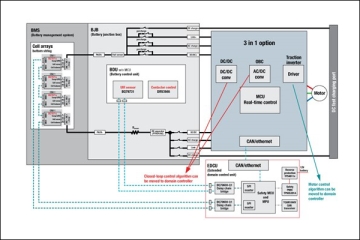
TI Announces Integrated Solutions for Electric Vehicle Powertrain Systems
The performance of electric vehicles is determined by the power efficiency and size of the powertrain. In response, Texas Instruments has announced an integrated powertrain system solution that enhances the economics and affordability of hybrid and pure electric vehicles while extending driving range.
2021.06.03by 이수민 기자
TI Halves Power Solution Reduction to Maximize EV Range
Texas Instruments (TI) has halved the size of power solutions and maximized driving range for hybrid and electric vehicles through an easy-to-use bias power module.
2021.09.30by 배종인 기자
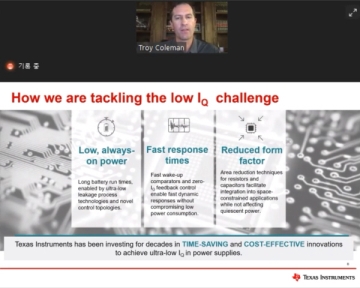
TI Achieves Extended Battery Life and Cost Reduction with Low IQ
Texas Instruments (TI) has announced a new product, achieving extended battery life and cost savings through a new DC/DC converter that achieves low quiescent current (IQ).
2021.11.03by 배종인 기자

Intel Unveils Next-Generation 'Core Ultra Series 3' and vPro Platform for Enterprise PCs
Intel has officially unveiled the "Intel Core Ultra Series 3" for next-generation enterprise PCs and the latest vPro platform, addressing a wide range of demands from enterprise notebooks to high-performance workstations.
2026.03.26by 배종인 기자
ROHM Launches ESD Protection Diode Compatible with High-Speed Interfaces of 10Gbps or Higher
Semiconductor specialist ROHM has developed the 'RESDxVx series' of ESD (electrostatic discharge) protection diodes capable of responding to next-generation high-speed data communication environments exceeding 10Gbps, simultaneously enhancing both signal quality maintenance required in high-speed interfaces and IC protection performance.
2026.03.26by 배종인 기자











