


Samsung Electronics Strengthens Automotive Semiconductors
 Published2021.12.01 11:27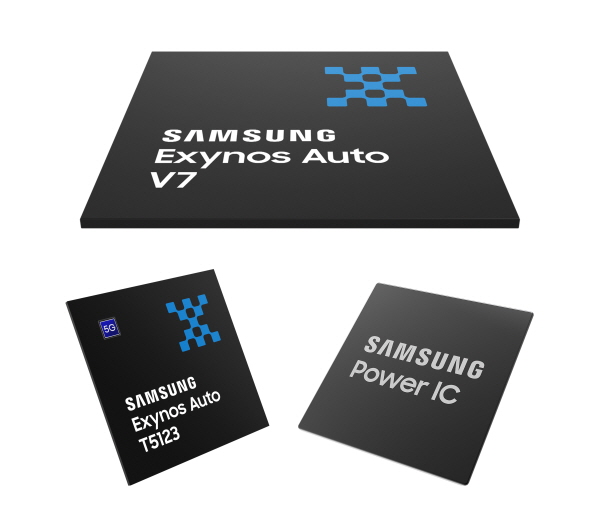
Equipped with Volkswagen ICAS 3.1 system, etc.
Samsung Electronics has strengthened its automotive semiconductor portfolio by unveiling three next-generation automotive system semiconductors: a communications chip, a processor, and a power management chip.
On the 30th, Samsung Electronics unveiled three types of system semiconductors: the 'Exynos Auto T5123' communication chip that provides 5G-based vehicle communication services, the 'Exynos Auto V7' infotainment (IVI: In-Vehicle Infotainment) processor that provides artificial intelligence computing functions, and the 'S2VPS01' power management chip (PMIC) that precisely and stably controls the power supplied to the vehicle infotainment processor.
“The importance of vehicle intelligence and connectivity for in-vehicle infotainment systems and driver safety is increasing,” said Park Jae-hong, Vice President and Head of the Custom SOC Business Team at Samsung Electronics’ System LSI Business Division. “In response, Samsung Electronics plans to strengthen its automotive electronics business by providing the latest 5G communication technology, processors with advanced artificial intelligence functions, and stable and proven power management chips.”
The Exynos Auto T5123 is the first automotive communication chip to provide 5G communication services, supporting ultra-high-speed downloads of up to 5.1 Gb (gigabit) per second. This allows users to download high-capacity, high-quality content without interruption even while driving.
In particular, this product is equipped with a multi-mode communication chip based on the latest 5G technology, supporting both SA mode (Stand Alone) that uses the 5G network exclusively and NSA mode (Non-Stand Alone) that uses the LTE network together. This allows users to send and receive data reliably and quickly, anytime, anywhere.
The Exynos Auto T5123 has two Arm Cortex-A55 cores and a built-in GNSS (Global Navigation Satellite System), making telematics system development easier.
Additionally, this product supports the high-speed interface 'PCI Express (PCIe)' and low-power, high-performance mobile DRAM 'LPDDR4X' so that the vehicle can efficiently process fast data transmitted and received via the 5G modem.
In addition, this product satisfies the Automotive Electronics Council-Q100 (AEC-Q100), a reliability evaluation standard for automotive components.
The 'Exynos Auto V7' was installed in the Volkswagen ICAS 3.1 infotainment system manufactured by LG Electronics' VS (Vehicle Component Solutions) division.
The product is equipped with a neural processing unit (NPU) for artificial intelligence calculations and provides virtual assistant services, voice, face, and motion recognition functions.
It also has built-in pixel and distortion correction technology for a clear screen, and image compression technology (DRC: Dynamic Range Compression), and supports users to enjoy music, movies, games, etc. with the best sound quality through three HiFi 4 audio processors.
To ensure stable operation of these functions, it supports LPDDR4X memory with a capacity of up to 32GB (gigabytes) and a bandwidth of 68.3GB (gigabytes) per second.
It also features Arm's Cortex-A75 processor, which runs at speeds up to 1.5GHz (gigahertz).It consists of 8 x)-A76 cores and 11 Mali-G76 graphics processing unit (GPU) cores, and can control up to 4 displays simultaneously, and supports up to 12 cameras.
In particular, the graphics processing unit (GPU) is divided into two groups and designed to enable each application, such as the digital instrument panel, the Center Information Display (CID), and the Head-Up Display (HUD), to operate stably and independently.
In addition, the Exynos Auto V7 is equipped with an independent security processor to secure data, safely store key information such as OTP (One-Time Programmable), and also provides physical unclonable function (PUF) technology.
'S2VPS01' performs a key function of precisely and stably controlling the power supplied to the processor for in-vehicle infotainment (IVI).
The S2VPS01 has achieved ASIL-B certification, a requirement considered essential by automotive OEMs and key partners. ASIL-B is a safety standard for automotive systems, categorized into four levels (A, B, C, and D) based on the likelihood of an accident, severity, and driver controllability. Infotainment systems typically require ASIL-B.
In addition, to enhance stability in environments where malfunctions may occur, it is equipped with protection functions against sudden changes in voltage and current, a heat-blocking function, and a self-diagnosis function.

Comments
Related news
Samsung Electronics Leads the Industry with Next-Generation Semiconductor Packaging Technology
Samsung Electronics is expanding its supply of high-performance semiconductors through next-generation semiconductor packaging technology.
2021.11.11by 배종인 기자
Samsung Electronics Strengthens Foundry's Cutting-Edge Process-Based Chip Implementation Solutions
Samsung Electronics is strengthening its foundry cutting-edge solutions with △3-nanometer design infrastructure △AI EDA technology △2.5D/3D packaging.
2021.11.19by 배종인 기자

Samsung Electronics to Invest $17 Billion in New Foundry in Taylor, Massachusetts
Samsung Electronics has decided on Taylor, Texas as the location for its new foundry investment in the United States. Samsung Electronics will invest $17 billion in Taylor with the goal of beginning operations in 2024.
2021.11.24by 배종인 기자

Intel Unveils Next-Generation 'Core Ultra Series 3' and vPro Platform for Enterprise PCs
Intel has officially unveiled the "Intel Core Ultra Series 3" for next-generation enterprise PCs and the latest vPro platform, addressing a wide range of demands from enterprise notebooks to high-performance workstations.
2026.03.26by 배종인 기자

ROHM Launches ESD Protection Diode Compatible with High-Speed Interfaces of 10Gbps or Higher
Semiconductor specialist ROHM has developed the 'RESDxVx series' of ESD (electrostatic discharge) protection diodes capable of responding to next-generation high-speed data communication environments exceeding 10Gbps, simultaneously enhancing both signal quality maintenance required in high-speed interfaces and IC protection performance.
2026.03.26by 배종인 기자











