


AI and drones are pioneering new demand for fisheries resource management.
 Published2021.12.13 15:07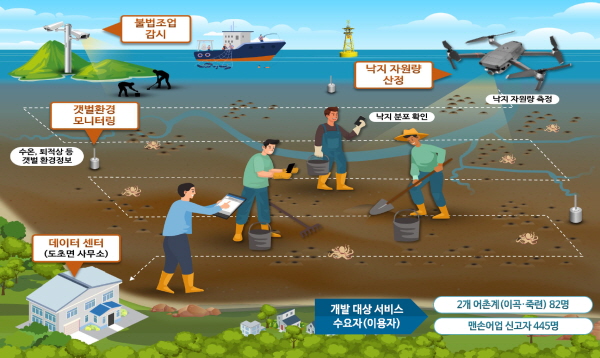
▲Overview of the Shinan County Smart Octopus Project Service
The use of cutting-edge technologies such as artificial intelligence (AI) and drones to manage fishery resources is emerging as a new field of technological application, and expectations are high that new demands for AI and other technologies will be actively developed, particularly in rural and fishing villages.
The Ministry of Science and ICT (Minister Lim Hye-sook), Sinan County, Jeollanam-do (Governor Park Woo-ryang), and the National Intelligence Information Society Agency (Director Moon Yong-sik, NIA) held a performance report meeting on the 13th for the ‘Tidal Flat Fishery Smart Octopus Operation Support and Resource Management Service’ in Sinan County (Docho-myeon), which was promoted as a smart village project this year, and conducted a final inspection of the construction contents, including an on-site demonstration.
The Smart Village Project is a project that has been promoted since 2019 to improve productivity, enhance safety, and discover convenient living services in rural and fishing villages by utilizing intelligent information technology (ICT). The Ministry of Science and ICT selected and promoted smart village projects in five regions, including the Shinan County project this year.
In the case of Shinan County, octopus is the main source of income for fishermen, but the catch has been continuously decreasing due to recent population decline, aging, marine pollution, and overfishing, making efficient management of octopus resources urgently necessary.
The Ministry of Science and ICT and Shinan County are using unmanned drone footage and artificial intelligence (AI) to solve the difficulties faced by fishermen and efficiently estimate and monitor octopus resources. We developed and promoted a ‘drone-based tidal flat octopus resource estimation’ service.
Specifically, after photographing the tidal flat fishing grounds using an unmanned drone, a precise topographic map of the octopus distribution was created, and an artificial intelligence learning data platform for approximately 60,000 octopus fragments was built.
By utilizing this, any fisherman can easily observe the tidal flat environment and check the distribution of octopus through the web and smartphone app (Smart Shinan).
In addition, we developed an 'Internet of Things-based illegal octopus fishing monitoring and alarm system construction' service and established an alarm system to monitor the activities of external illegal fishing vessels through intelligent CCTV.
By attaching IoT + GPS sensors to approximately 50 fishing boats belonging to the Docho-myeon fishing village, they will be able to identify unregistered vessels and send warning alarms when abnormal fishing operations are detected, and real-time monitoring will also be possible through the 'Smart Shinan' service.
Meanwhile, the Ministry of Science and ICT and Shinan County plan to expand and distribute the 'smart octopus service' discovered and proven through the smart village project throughout Shinan County in conjunction with the Ministry of Oceans and Fisheries' 'tidal flat coastal sea ranch creation project'.
Kim Haeng-gyu, a bare-handed octopus fisherman from Docho-myeon, said, “Currently, as fishermen are aging, octopus fishing is becoming increasingly difficult, and there is ongoing friction with local residents due to indiscriminate overfishing by non-local fishermen.” He added, “This government-supported project will allow us to easily check octopus production and eradicate illegal fishing, so local residents have high expectations.”
Park Yoon-gyu, Director of the Information and Communication Policy Bureau at the Ministry of Science and ICT, said, “The smart octopus service is a representative example of the regional digital new deal, and we will actively cooperate with related ministries and local governments, including the Ministry of Oceans and Fisheries, to improve the productivity of the entire tidal flat fishing grounds and expand it to other regions.” He said, “We plan to continue to discover tasks based on the needs of local residents to improve living conditions and increase productivity, focusing on rural areas that have been excluded from digital transformation.”

Comments
Related news
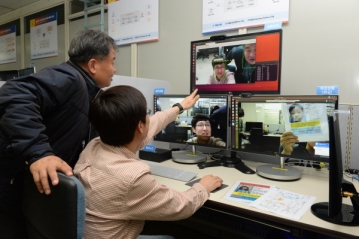
ETRI develops AI and network convergence platform
Domestic researchers have developed a next-generation networking platform that integrates artificial intelligence (AI) and network technology. The platform-based application service demonstration has also been successful, suggesting that the realization of a human-centered hyper-connected society, which has become the new normal following COVID-19, is within reach.
2021.11.03by 강정규 기자
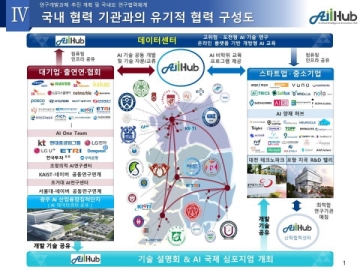
Bringing the nation's best AI capabilities together
Korea's top artificial intelligence (AI) capabilities are converging to tackle challenging and ambitious AI research projects.
2021.11.05by 배종인 기자

Gwangju Metropolitan City Breaks Ground on Core AI Hub… Investing 400 Billion Won
South Korea's first artificial intelligence (AI) integrated complex, which will establish itself as a key hub for the nation's AI infrastructure with a world-class data center featuring GPU-based processing capacity of 88.5 petaflops (PF) and storage capacity of 107 petabytes (PB), has broken ground.
2021.11.23by 배종인 기자
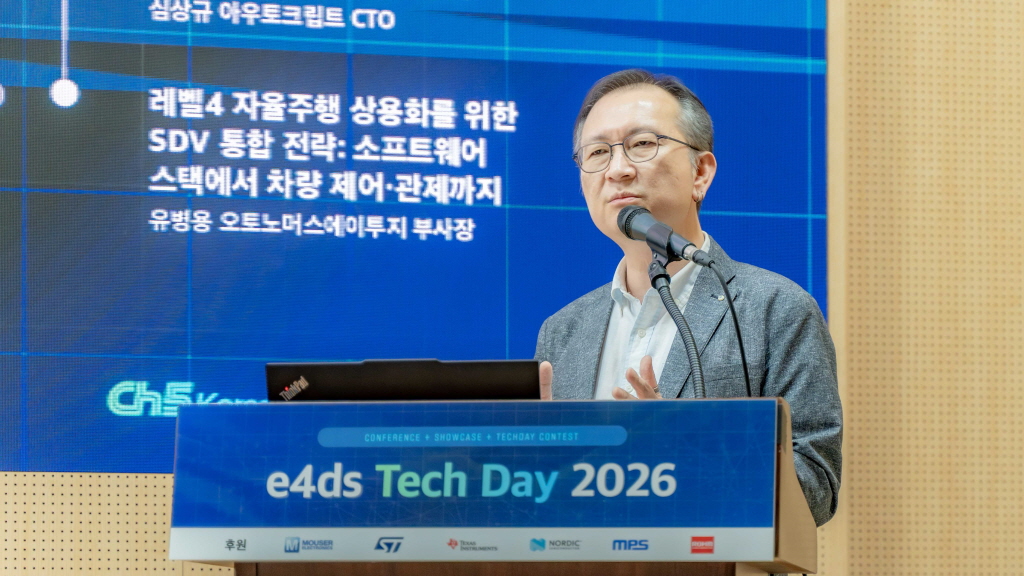
[e4ds Tech Day 2026 ⑨] Sim Sang-gyu, Autocrypt CTO: "In the Physical AI Era, Automotive Security Must Extend Beyond the Vehicle"
At e4ds Tech Day 2026, Sim Sang-gyu, CTO of Autocrypt, explained automotive cybersecurity strategies in the era of Physical AI and SDV (Software-Defined Vehicle). Automobiles are evolving as part of an ecosystem connected to AI, cloud, chargers, IoT, and robots, and he emphasized that the scope of security must expand beyond the vehicle interior to the entire connected environment. In particular, AI model tampering, adversarial attacks, OTA updates, and EV charger hacking were identified as major threats. He explained that response measures require zero trust, AI model integrity protection, intrusion detection, Security by Design and Default, and full lifecycle security management, and that proactive security system establishment beyond regulatory compliance is critical for securing future mobility competitiveness.
2026.10.12by 배종인 기자
NVIDIA to Invest $1 Billion in U.S. Science Over Next Five Years
NVIDIA has announced plans to invest $1 billion over the next five years to strengthen U.S. scientific and technological competitiveness. The company will enhance cutting-edge artificial intelligence research and development capabilities in key areas including quantum computing, healthcare, and energy security, while expanding support for higher education research institutions and cloud service providers. NVIDIA is participating as a major industry partner in the White House Office of Science and Technology Policy's Genesis Mission, and is promoting supercomputer construction in collaboration with national laboratories including Argonne and Los Alamos.
2026.10.12by 배종인 기자











