


SiC·GaN, Rapidly Emerging Key Automotive Power Semiconductors
 Published2022.02.15 09:50
인피니언·ST·울프스피드 등 연구·투자 집중
■ 車 전력반도체 수요 바탕 신규 투자 급증
자동차의 전동화 확산 및 자율주행, 차량내 컴퓨팅의 중요성이 높아지면서 자동차 배터리의 효율성과 전력 소비 최소화를 위한 SiC(실리콘카바이드)·GaN(갈륨나이트라이드) 등 화합물 전력반도체가 자동차의 핵심으로 급부상하고 있다. 향후 SiC 전력반도체는 2025년까지 연평균 72%의 고성장을 거듭할 것으로 기대된다.
최근 자동차용 반도체 업계에 따르면 자동차용 반도체 기업들이 화합물 전력반도체 분야에 연구와 투자를 집중하고 있는 것으로 나타났다.
SiC 웨이퍼 시장의 62%를 점유하고 있는 울프스피드(Wolfspeed)는 2024년까지 생산캐파를 2017년 대비 30배 이상으로 늘릴 계획으로 알려졌다.
또한 SiC 칩셋을 제조하는 ST마이크로일렉트로닉스도 2019년 관련 매출이 2억달러였는데, 2025년 관련 매출 10억달러로 목표를 잡은 것으로 알려졌으며, SiC 캐파를 10배 증설 및 현재 6인치 중심에서 8인치로 확대할 계획으로 알려졌다.
차량용 반도체 업계 1위인 인피니언의 경우 16억 유로가 투입된 오스트리아 팔라흐 신규 팹에서 12인치 웨이퍼 기반 SiC 반도체 생산을 시작한 것으로 알려졌다.
이와 같은 투자 확대는 전기차 보급 확대로 향수 화합물 전력 반도체 수요가 증가할 것이라는 분석에 기인한다.
국제에너지기구(IEA)는 지난해 ‘2021 글로벌 전기차 전망’ 보고서를 통해 전 세계 전기차 수가 2020년 약 1,100만대에서 2030년에 2억3,000만대로 증가할 것으로 예측했다.
또한 세계 자율주행차 시장 전망은 2035년 1조2,000억달러에 달할 것으로 예상되며, 연평균 성장률이 21.9%로 전망됐다.
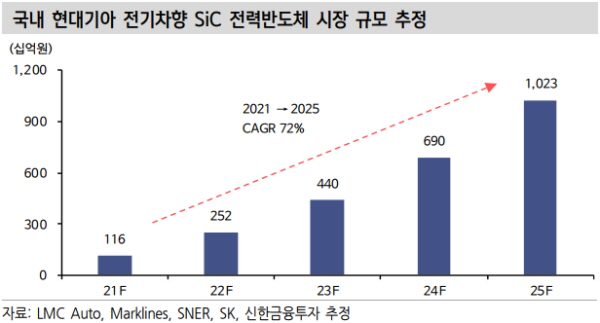
▲국내 현대기아 전기차향 SiC 전력반도체 시장 규모 추정(자료 : 신한금융투자)

신한투자금융은 지난해 2021년부터 2025년까지 국내 전기차향 SiC 전력반도체 시장 규모가 연평균 72% 성장해 2025년 국내 1조230억원 시장으로 성장할 것으로 전망했다.
NH투자증권도 SiC 웨이퍼 시장이 향후 5년간 연평균 30% 이상의 고성장을 할 것으로 전망한 바 있다.
■ 전력 효율 증가, 주행거리 향상·CO2 감축 기여
이와 같은 수요 증가는 전력 소비가 자동차 내에서 중요해 졌기 때문이다.
지난 1월 Mercedes-Benz는 CES 2022에서 VISION EQXX를 공개했는데, 100㎞당 10kWh 미만의 뛰어난 에너지 소비로 1회 충전으로 1,000㎞를 초과할 수 있는 최고의 에너지 효율성을 보여주기도 했다.
이런 에너지 효율성을 달성하기 위해서는 자동차 배터리의 용량 확대도 중요하지만 배터리의 전원을 효율적으로 사용하고, 전력 소비를 최소화하기 위한 전력 반도체 및 시스템 구성이 중요하다.
이에 배터리의 효율성과 전력소모량을 모두 잡을 수 있는 자동차용 전력반도체로 SiC, GaN이 주목받는 이유다.
두 화합물 전력반도체는 자동차 및 장비들의 전력 효율을 증가시켜, 주행거리 향상뿐만 아니라 상당한 규모의 CO2 감축 효과도 가져올 수 있다.
.jpg)
▲Si, SiC, GaN 물리적 특성 비교(자료 : IBK투자증권)
GaN은 자동차 분야에서 △하이브리드 자동차용 온보드 충전기 어댑터 △자동차용 DC-DC컨버터 △LIDAR용 드라이버에서 각광받고 있다.
GaN 차재 트랙션 인버터를 이용한 전기차는 기존 파워 반도체에 비해 전력 손실을 65% 줄였다.
이는 차내 충전기(OBC), DC-DC 컨버터와 메인 트랙션 인버터에 확실한 이점이며, 배터리 주행 거리 개선과 빠른 충전에도 유용하다.
GaN은 전기차의 배터리에서 구동력(drive train)에 이르는 전력 변환 효율을 높여 같은 소형 배터리를 사용해도 주행 거리가 늘어나 전기차의 고질적 문제인 주행 거리 불안을 덜어준다.
나아가 불필요한 전력 손실을 방지해 카본 뉴트럴(온신효과 가스 배출량 실질 제로)에 공헌에도 한 발자국 더 다가갔다.
지난해 e4ds가 진행한 ‘e4ds 반도체 기술 컨퍼런스 2021 spring’에서 이형석 한국전자통신연구원 책임연구원은 “Si 소자를 GaN 소자로 대체할 경우 저항손실이 1/1,000로 감소하고, 효율 유지가 DC-DC 95%, AC-DC 90%, DA-AC 99%로 Si 소자대비 2∼10%p의 효율이 상승했다”며 “자동차용으로 사용하기 위해서는 내구성, 안전성 등 철저한 검증 과정이 필요하다”고 밝힌바 있다.
SiC는 고전압과 고내열성을 띄고, 밴드갭이 Si 대비 3배가 높아 전기차 및 전력 변환 장치 사용에 용이하다.
테슬라 모델3 인버터에 적용된 SiC 모듈은 Si 대비 효율이 최대 10배 증가했으며 부피와 무게는 각각 43%, 6kg 감소했다.
이는 비슷한 시기 출시된 닛산 리프(11.15㎏)의 절반도 안 되는 무게다.
■ 차량 내 전력변환 필수, 수요 급증
이와 같은 화합물 반도체의 장점으로 인해 전력반도체 시장을 이끌 것으로 기대된다.
우선 전기차에서 기존 내연기관차와 차이인 동력 발생원 차이로 오는 차량 내 전력 변환장치(EPCU)에서 확대가 기대된다.
전기차는 배터리를 통해서 전력을 공급받기 때문에 직류전기(DC)를 교류전기(AC)로 변화해주는 인버터가 필요하다.
특히 배터리는 고전압인 반면에 전장 시스템은 12V인 저전압이기 때문에 직류, 직류간 전압 변환을 위한 컨버터도 필수다.
또한 전기차에는 OBC(On Board Charger)가 탑재돼 직류 전기를 OBC를 통해 교류전기로 바꿔 충전하기 때문에 전력반도체 탑재는 필수다.
이외에도 향후에는 전기차가 남아있는 전력으로 다른 대상을 충전시키는 양방향 충전에 활용될 것으로 전망되며, 교류·직류 양방향 전력 변환을 위한 전력반도체 수요가 증가할 것으로 보인다.
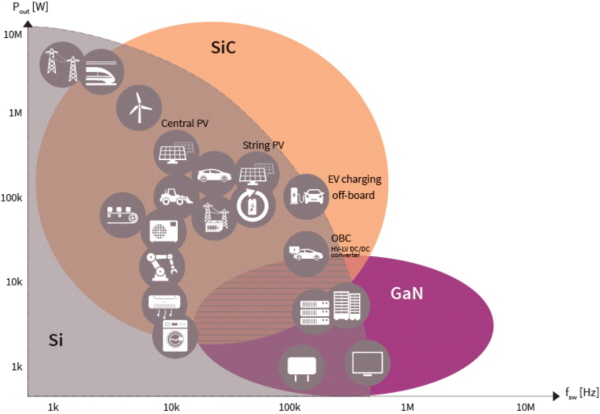
▲화합물 반도체 응용범위(자료 : 인피니언)
■ 車 업계 SiC 적용 본격화
테슬라는 2018년 모델3의 인버터에 ST마이크로일렉트로닉스의 SiC MOSFET 모듈 24개를 처음으로 탑재한 바 있다. 기존 Si대비 효율은 10배 증가하고, 부피는 43% 감소, 무게는 6㎏을 감소하는 효과를 본 것으로 알려지고 있다.
테슬라의 SiC 채택 이후, 현대차, BYD, 토요타, 르노, BMW 등 여타 완성차 업체들의 SiC 전력반도체 장착이 늘고 있다.
현대자동차는 SiC 전력반도체를 직접 설계하기도 했는데, 지난해 2월 공개한 ‘아이오닉 5’에 탑재된 인버터 파워모듈에 독자 개발한 SiC 반도체가 탑재됐다. 이를 통해 전력 효율은 2∼3%, 주행거리는 5% 개선했다.
현대모비스는 현대오트론 반도체 사업 인수 결정으로 차량용 반도체 수급을 내재화하고 자체적인 반도체 관련 기술을 보유할 것으로 보인다.
특히 E-GMP 모듈관련 사업에 중점을 두고 있는 만큼 그 핵심부품인 화합물 반도체 기술 내재화에 집중한다.
※ 공동취재
성유창 기자(yoochang@e4ds.com)
김예지 기자(lucy@e4ds.com)
Comments
Related news
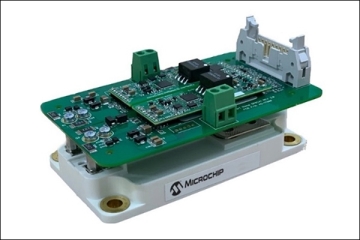
SiC products for next-generation power systems require verification of reliability and robustness.
Demand for SiC technology continues to grow steadily. However, SiC products are not a direct replacement for Si products, and not all products are equal. To realize the potential of SiC technology, it is necessary to carefully evaluate product and supplier options based on quality, supply, and support, and to understand how to optimize the integration of innovative SiC power components and end-to-end systems.
2021.09.16by 이수민 기자
Automotive Power Optimization, SiC Market Explosion
The electrification of automobiles and mobility, adoption of autonomous driving systems, and increasing incorporation of in-vehicle electrical equipment such as entertainment systems are making power management within vehicles increasingly important, and the automotive SiC compound semiconductor market is projected to experience explosive growth.
2022.01.11by 배종인 기자
“Efficient systems can be implemented using SiC devices.”
A venue has been established to share the advantages of silicon carbide (hereinafter SiC), which transcends the physical property limitations of silicon (hereinafter Si), the current primary semiconductor material. The E4ds ee webinar held a webinar on the 18th titled 'Future EV, Green Energy, and Power System Design and Implementation Using Wolfspeed SiC' presented by Lee Tae-hun and Ham Jung-ho, directors at Wolfspeed.
2022.01.19by 성유창 기자
[e4ds Tech Day 2026 ⑨] Sim Sang-gyu, Autocrypt CTO: "In the Physical AI Era, Automotive Security Must Extend Beyond the Vehicle"
At e4ds Tech Day 2026, Sim Sang-gyu, CTO of Autocrypt, explained automotive cybersecurity strategies in the era of Physical AI and SDV (Software-Defined Vehicle). Automobiles are evolving as part of an ecosystem connected to AI, cloud, chargers, IoT, and robots, and he emphasized that the scope of security must expand beyond the vehicle interior to the entire connected environment. In particular, AI model tampering, adversarial attacks, OTA updates, and EV charger hacking were identified as major threats. He explained that response measures require zero trust, AI model integrity protection, intrusion detection, Security by Design and Default, and full lifecycle security management, and that proactive security system establishment beyond regulatory compliance is critical for securing future mobility competitiveness.
2026.10.12by 배종인 기자

Practical HIL Construction Strategy for Automotive and Off-Highway Controller Validation
As vehicle E/E architecture transitions to zonal structures and shifts to software-defined vehicles (SDV), the number of controllers (ECUs) requiring validation and software complexity are surging dramatically. Meanwhile, real vehicle testing cannot provide repeated verification under identical conditions and entails lead time and safety concerns. This white paper explains the principles of HIL (Hardware-in-the-Loop) validation and the structure of the NI platform composed of PXI, SLSC, and VeriStand, and through two actual implementation cases—Camera Record & Replay HIL for In-Cabin Monitoring Controller (ICMU) and Forklift Controller (VCU) HILS—describes how controller-level regression testing becomes possible. Additionally, it explicitly states application boundaries and limitations, such as lack of A2B support.
2026.10.12by 편집부











