



[2022 IIoT Innovation DAY] Lee Soon-yeol, CEO of I2: “Industrial Digital Transformation Requires Industrial Reliability”
 Published2022.04.14 16:27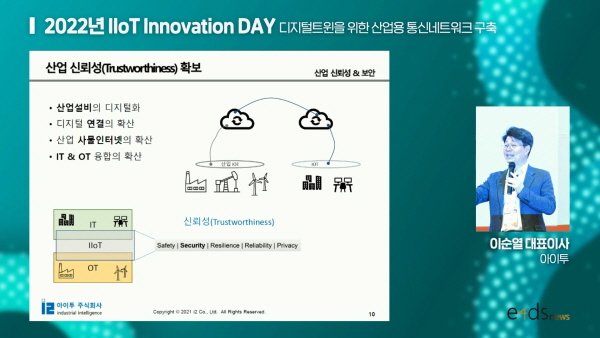
IT and OT Security Are Different… A Comprehensive Approach Is Essential
Security requirements must be assessed through pre-assessment
e4ds held the '2022 IIoT Innovation DAY' seminar at the '2022 Smart Factory & Automation Industry Exhibition' held at COEX on the 8th.
At this seminar, held to share information on smart factory trends and industrial communication networks for implementing a true digital twin in the post-COVID era, I2 CEO Lee Soon-yeol gave a presentation on the topic of "The Importance and Preparation for Securing Industrial Reliability for Industrial Digital Transformation."
Typical manufacturing site networks are structured hierarchically. They consist of Level 0 (Machines, Equipment), Level 1 (PLC, DCS), Level 2 (SCADA/HMI, EWS, OWS), Level 3 (MES/MOM), and Level 4 (ERP). When a process issue occurred, data had to pass through all of these layers to be updated in the ERP system.
Hierarchies will disappear in the era of the Internet of Things. If AI immediately recognizes a phenomenon, makes a judgment, and takes action, it moves beyond intelligence to achieve autonomy.
There are many challenges remaining before reaching this stage. There is a difference between what is technically feasible and what can be utilized in the industrial field.
CEO Lee stated, “In order to be reliable in industrial settings and commercially utilized, reliability and security must be supported,” adding, “Industrial reliability requires safety, security, resilience, and the protection of personal information and intellectual property; if these are not guaranteed, it is difficult to utilize even the best technology.”
In the case of manufacturing security, both IT and OT security have different characteristics and requirements, necessitating a comprehensive approach. However, excessive security reinforcement may restrict essential functions required in industrial settings. It is crucial to secure security capabilities without interfering with essential functions.
In response to a question regarding the extent to which security should be strengthened cost-effectively—as security measures are directly linked to costs but their effects are not immediately apparent—CEO Lee Soon-yeol replied that the first step is to evaluate the appropriate security level for the company through a preliminary diagnosis. He recommended significantly strengthening security if there is a high probability of a security incident in a particular area and if it occurs would be severe, and lowering the security level in the opposite case.
IEC 62443, an industrial security standard designed to mitigate risks in industrial communication networks, has become a cybersecurity standard across industries. It applies to product and component suppliers, system integrators and suppliers, and asset owners. While Korea presents the standard as a guideline for general manufacturing, it is not yet mandatory. The CEO stated, “We are currently in the guidance phase because mandating it before preparations are complete would hinder economic activity.”
Comments
Related news
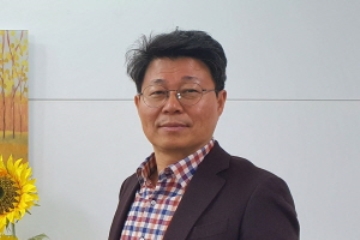
[Interview] Lee Soon-yeol, CEO of iTu Co., Ltd.: "Industrial digital transformation must be implemented in stages with a long-term perspective."
Met with Lee Soon-yeol, CEO of A2 Corporation, an expert in factory automation, smart factory, and industrial digitalization, to gain insights on industrial digital transformation.
2022.03.10by 배종인 기자
.jpg)
A place to share new technologies in industrial communication networks
e4ds news will hold the '2022 IIoT Innovation Day' event at COEX D Hall starting at 10:00 AM on April 8th.
2022.03.22by 배종인 기자
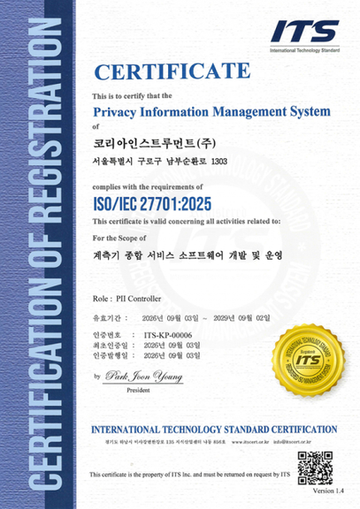
Korea Instrument, KOLAS Accredited Calibration Agency First to Simultaneously Acquire ISO/IEC 27,001·27,701
Korea Instrument has become the first among KOLAS accredited calibration agencies to simultaneously acquire ISO/IEC 27,001 and ISO/IEC 27,701 certifications. Through its proprietary platforms CWIZ Enterprise and CWIZ Partners, the company has embedded information security and personal data protection requirements across all business processes including customer information, equipment data, and calibration reports, with plans to continuously advance its management system through regular audits and security inspections.
2026.10.12by 배종인 기자
TeamViewer One, IT Incident Automation Workflow and Resolution Center Enhanced
TeamViewer has added IT incident automation capabilities and an advanced Resolution Center to its integrated digital workplace management platform 'TeamViewer ONE'. Recurrent service disruptions, configuration errors, and capacity shortages are automatically handled according to preset policies, and device status verification through script deployment can be managed in a unified interface, significantly reducing repetitive tasks for IT teams.
2026.10.12by 배종인 기자
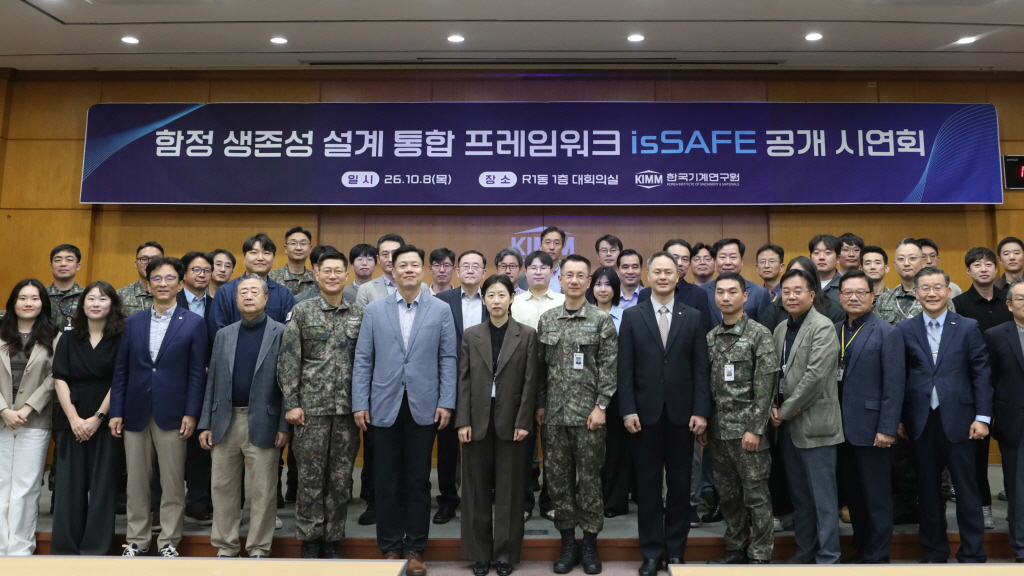
KAERI Develops Domestically-Produced SW 'isSAFE' for Integrated Warship Survivability Analysis
The Korea Institute of Machinery and Materials has developed domestically-produced software 'isSAFE' that comprehensively analyzes warship survivability. This design framework integrates the entire process—from warship modeling to hit scenario generation, vulnerability analysis, and results analysis—into a single platform, establishing an independent technology foundation in the defense technology sector that had previously relied on foreign software.
2026.10.08by 배종인 기자











