


[2022 IIoT Innovation DAY] Jihoon Kang, Team Leader at Ericsson-LG: "5G networks are beyond the reach of general IT personnel."
 Published2022.04.18 16:26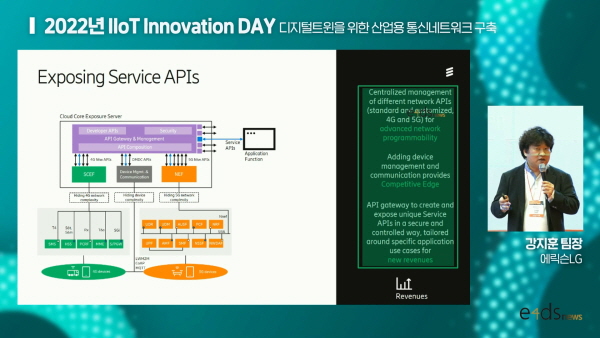
5G requires existing workforce operations… API solutions
NEF: A Key Feature for 5G Applications in the Industrial Sector
Jihoon Kang, Team Leader of Ericsson-LG, presented on industrial communication networks under the topic of '5G Exposure for Convergence of OT/IT and CT and Service Commercialization' at the '2022 IIoT Innovation DAY' seminar hosted by e4ds.
Team Leader Kang said, “In order to apply 5G to industry, new communication technologies must be integrated with the existing IT and OT infrastructure,” adding, “Since replacing it with a new infrastructure is impossible, we must find an efficient method.”
Factories often use not just a single AGV, but dozens or even hundreds of them. Manually managing each AGV's IP address and routing table is nearly impossible. Furthermore, when AGVs are used across multiple factories, it's time-consuming to install new data each time they're moved to a new location. 5G is a technology that can dramatically reduce this time.
Assuming a contract with LG U+, the AGV and camera will be connected to the LG U+ network. The LG U+ network will then notify the factory to connect to the required network. The modems of both devices will then connect to the APN (DNN in 5G), and their IP bands will change. This entire process is automated, a key feature of 5G technology.
Until now, IT and OT infrastructure has been built around IP addresses. For factory security, even when a laptop is connected, network access control defines the IP address for that device. However, as temperature, vibration, and magnetic field sensors proliferate and various devices become interconnected, manually managing them all becomes nearly impossible.
5G networks are beyond the reach of general IT personnel. SKT is deploying 30,000 people to manage its network infrastructure. Deploying dozens of people to manage 5G in a typical factory is no easy feat. Team Leader Kang stated that operational methods and GUIs must change to ensure that 5G can be managed by existing personnel in the industry, and that APIs could be the solution.
Infrastructure that enables API-based management of connections from 2G to 5G has been incorporated into 5G. The Network Exposure Function (NEF) is the most critical feature for implementing 5G in the industry.
NEF functions like an app store for networks. When connecting AGVs and AI vision servers, it's difficult for managers to understand and develop the entire network infrastructure. The API developer portal provides a simple structure where developers can contract for API use and use it. NEF is an API standardized by the 3GPP, the global communications protocol management group, and will work regardless of the carrier.
Companies like NVIDIA will be pushing the direction of creating packages and releasing APIs, and then bundling those APIs together to create new APIs as a service, so that you don't have to create APIs every time you input what action to take when a certain event occurs.
Team Leader Kang added, “Pure 5G services will be available starting this year or next year,” and “SA will be supported to implement functions required by the industry, and will support ultra-low latency and industrial 5G configurations.”
When asked whether the 5G network frequency bands used in industrial use should be designated separately or whether the networks allocated to telecommunications companies should be used, Team Leader Kang said that two frequency policies are maintained in Korea.
The first is the frequency bands (3.5 GHz, 28 GHz) used by telecommunications companies, known as commercial networks. When telecommunications companies provide services to businesses, they use commercial network frequencies, but there are private commercial networks that can only be used by those businesses. Creating an APN provides logical network separation.
Second, there's the specialized 5G network launched by the government in November of last year. This is a frequency band (4.7 GHz, 28 GHz) that businesses can apply for and use, regardless of their telecommunications carrier. This is a model where companies apply directly or request specialized network operators (such as LG CNS) to handle applications or provide rental services.
In the case of specialized networks, permission was given to use them in factories, and in cases where they need to travel across the country, such as trucks, it was answered that it was right to use the telecommunications company's commercial network.
Meanwhile, the '2022 IIoT Innovation DAY' seminar was held by e4ds at the '2022 Smart Factory & Automation Industry Exhibition' held at COEX on the 8th. It was a place to look into smart factory trends and industrial communication networks to build them, and answered the questions of participants both online and offline.
Comments
Related news
[2022 IIoT Innovation DAY] Lee Soon-yeol, CEO of I2: “Industrial Digital Transformation Requires Industrial Reliability”
At this seminar, held to share information on smart factory trends and industrial communication networks that will implement digital twins in the true sense in the post-Corona era, Lee Soon-yeol, CEO of i2, presented on the topic of "The Importance and Preparation of Securing Industrial Reliability for Industrial Digital Transformation."
2022.04.14by 성유창 기자
Korea Instrument, KOLAS Accredited Calibration Agency First to Simultaneously Acquire ISO/IEC 27,001·27,701
Korea Instrument has become the first among KOLAS accredited calibration agencies to simultaneously acquire ISO/IEC 27,001 and ISO/IEC 27,701 certifications. Through its proprietary platforms CWIZ Enterprise and CWIZ Partners, the company has embedded information security and personal data protection requirements across all business processes including customer information, equipment data, and calibration reports, with plans to continuously advance its management system through regular audits and security inspections.
2026.10.12by 배종인 기자
TeamViewer One, IT Incident Automation Workflow and Resolution Center Enhanced
TeamViewer has added IT incident automation capabilities and an advanced Resolution Center to its integrated digital workplace management platform 'TeamViewer ONE'. Recurrent service disruptions, configuration errors, and capacity shortages are automatically handled according to preset policies, and device status verification through script deployment can be managed in a unified interface, significantly reducing repetitive tasks for IT teams.
2026.10.12by 배종인 기자
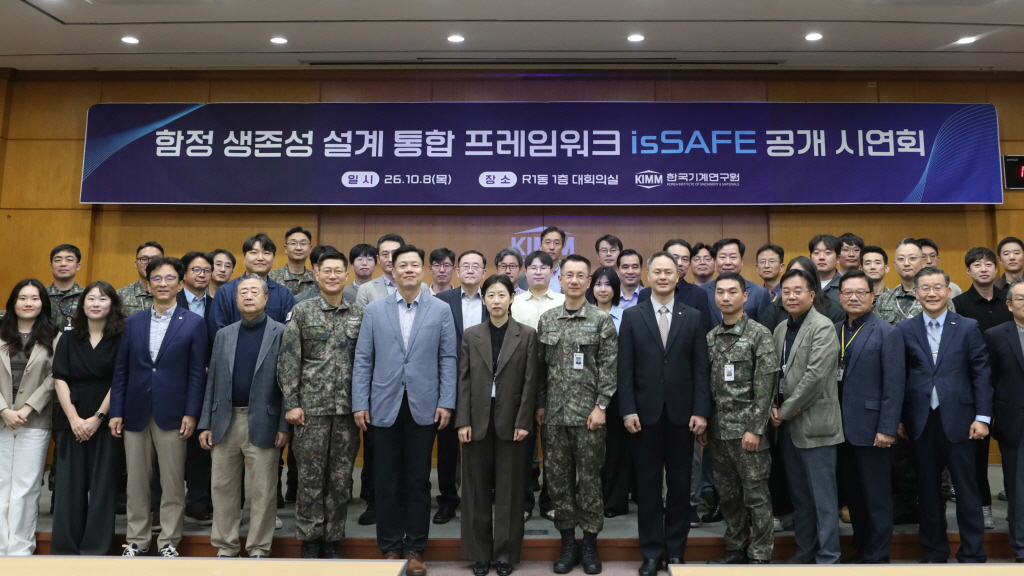
KAERI Develops Domestically-Produced SW 'isSAFE' for Integrated Warship Survivability Analysis
The Korea Institute of Machinery and Materials has developed domestically-produced software 'isSAFE' that comprehensively analyzes warship survivability. This design framework integrates the entire process—from warship modeling to hit scenario generation, vulnerability analysis, and results analysis—into a single platform, establishing an independent technology foundation in the defense technology sector that had previously relied on foreign software.
2026.10.08by 배종인 기자
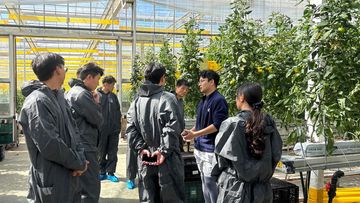
ioCrops Shares AI Smart Farm Operations Case Study
About 20 cultivators from the Agricultural Cooperative's Smart Agriculture Support Centers visited ioCrops' smart farm in Jincheon, North Chungcheong Province. They directly confirmed how data collected through substrate weight sensors, drainage weight sensors, and soil moisture sensors is applied to tomato cultivation, as well as the greenhouse pest control process using the AI-based autonomous spraying robot 'HERMAI'. By sharing on-site operational case studies combining data and automation technology, the adoption of smart farms in agricultural fields is being promoted.
2026.10.07by 배종인 기자











