


Intel Announces Expansion of Discrete GPUs... Preparing for Next-Gen ZetaScale
 Published2022.04.20 12:28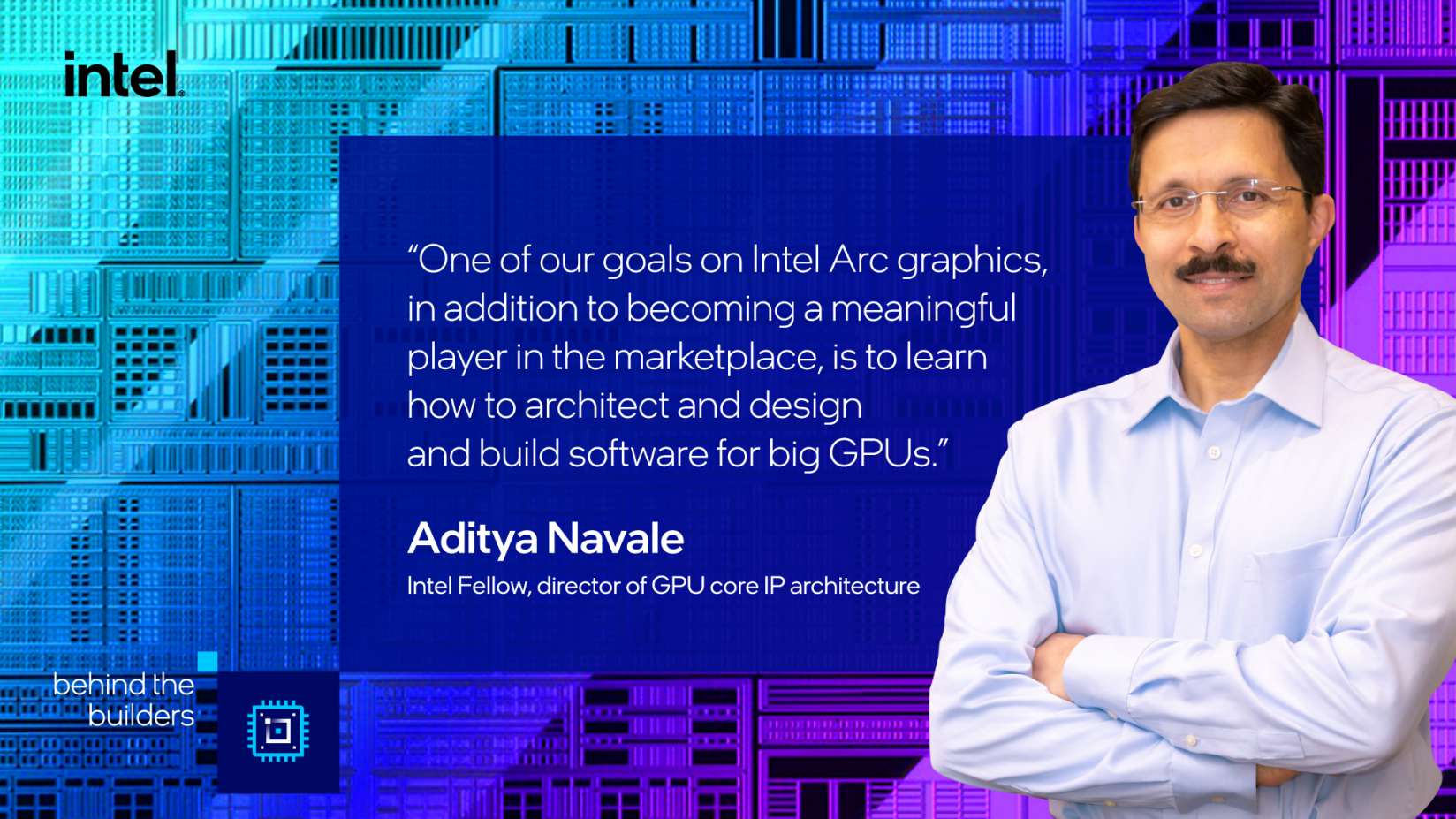
▲ Intel Fellow Aditya Navale
Increased GPU parallel data utilization, synergy effect
System package required for ZetaScale implementation
I have always hoped that Intel would enter the discrete graphics field.
Just like Intel Fellow Aditya Navale, who has dedicated more than 20 of her 30 years at Intel to graphics technology, Intel employees have also been looking forward to Intel expanding into the external GPU field, just as the whole world has been hoping.
The recently released Intel Arc discrete graphics product for laptops marks the first step in meeting these expectations and has taken the first step in Intel's long history in the graphics field. Intel subsequently announced that it plans to release the desktop version of Intel Arc within the year.
The team led by Fellow Nawala Nawala of the Accelerated Computing Systems and Graphics Group plays a pivotal role in Intel's GPU division by developing core IP architectures that serve as the foundation for multiple generations of Intel GPUs, including the Intel Arc A-series.
Including integrated graphics running on the same die as the CPU, Intel has already secured the lead in PC graphics market share. Nawale stated, “The journey from integrated graphics to discrete graphics is a big leap,” adding, “The task is very complex and a major challenge.”
Since 2019, Intel's integrated graphics gaming performance has increased by approximately four times. The Intel Arc GPU leverages this underlying technology to boost performance once again; currently, Intel integrated graphics support up to 96 Execution Units (EUs), while Intel Arc Graphics provides up to 512 Xe Vector Engines.
"This increase in units by more than five times leads to the challenge of maximizing performance under given power conditions," Nawale said.
He added, “One of Intel Arc Graphics’ goals is not only to establish itself as a significant player in the discrete graphics market but also to acquire the know-how to design and build software for large GPUs.”
To provide a competitive product as a new player in the market, it is necessary to offer not only excellent features and performance but also support a wide range of games and applications. Nawalle said, “Intel’s architecture has always taken a software-first approach.”
■ From Pixel Representation to Deep Learning
The reason why graphics performance several times greater than what is currently provided by the laptop is due to vibrant color contrast.
The primary role of the GPU is to perform graphics rendering acceleration, which generates 2D and 3D images on the 2D monitor the user is viewing. Simply put, the GPU supports drawing pixels on the screen. While the CPU is designed to process one or two complex tasks at a time, the GPU is designed to perform many small tasks in parallel, such as drawing pixels.
When reading text, the pixels visible on the screen hardly move. Therefore, the GPU does not need to perform many tasks. However, in the case of 3D games boasting photorealistic graphics, pixels constantly move and change.
To render fine details such as fur swaying in the wind or multiple light sources and shadows, more work is required to draw each pixel. Additionally, to render such scenes more smoothly, the work must be done quickly.
Nawala said at the time, “The higher the realism provided by the game, the more work the GPU performs.”
■ The game is just the beginning.
The use of GPU parallel data processors in applications such as cryptocurrency mining and artificial intelligence is increasing explosively. GPUs are being utilized beyond pixels for artificial intelligence, deep learning, and high-performance computing (HPC), handling humanity's most complex computing tasks.
While developing chips for such diverse tasks can be complex, Nawala explained that GPU-based software helps maintain a "system in chaos."
He added, “Intel has a software ecosystem that must integrate these new requirements,” stating, “GPUs must evolve in a synergistic way because they must consider HPC, AI, gaming, and much more. Numerous considerations are needed regarding the architecture, and it must be developed carefully.”
■ GPU demand heading toward Zetascale
The increase in GPU demand is just the beginning. As the need for flexibility and new design approaches to take GPU performance to new levels emerges, Nawale emphasized, “The way Intel IP is designed and implemented takes into account that the IP can be utilized as an embedded GPU or a massive discrete GPU,” adding, “This scalability is inherent. Furthermore, multiple parameterizations can be utilized to enable easy and rapid expansion.”
Nawala argued that “more scalability is needed” to realize the next-generation ZetaScale supercomputer. This means going beyond doubling the performance of individual semiconductors to manufacturing multiple semiconductors into a single system-in-package.
Ponte Vecchio can implement 47 individual tiles on a single GPU, and he noted, “This expansion is already partially underway at Ponte Vecchio and is gaining momentum and drive.”

Comments
Related news

Applied Proves Strengthening Partnership with Intel
Intel, pursuing a restructuring of the global materials, components, and equipment supply chain through aggressive semiconductor facility investments, has achieved results demonstrating strengthened partnership with Intel among global supply chain partners, particularly with Applied Materials.
2022.04.12by 명세환 기자

Intel Declares Pledge for Net-Zero Greenhouse Gas Emissions
Intel has committed to developing solutions in collaboration with customers and industry partners that can reduce greenhouse gas emissions across the entire technology ecosystem.
2022.04.14by 성유창 기자
Intel and QuTech to Produce Large-Scale Silicon Qubits
As major IT companies like Google and IBM are accelerating their quantum computer development, Intel has achieved progress in the quantum computer development competition by successfully manufacturing silicon qubits on a large scale.
2022.04.15by 명세환 기자

Intel Unveils Next-Generation 'Core Ultra Series 3' and vPro Platform for Enterprise PCs
Intel has officially unveiled the "Intel Core Ultra Series 3" for next-generation enterprise PCs and the latest vPro platform, addressing a wide range of demands from enterprise notebooks to high-performance workstations.
2026.03.26by 배종인 기자
ROHM Launches ESD Protection Diode Compatible with High-Speed Interfaces of 10Gbps or Higher
Semiconductor specialist ROHM has developed the 'RESDxVx series' of ESD (electrostatic discharge) protection diodes capable of responding to next-generation high-speed data communication environments exceeding 10Gbps, simultaneously enhancing both signal quality maintenance required in high-speed interfaces and IC protection performance.
2026.03.26by 배종인 기자











