



[Semiconductor Digital Forum] US-China Semiconductor Hegemony Competition Intensifies
 Published2022.04.25 15:47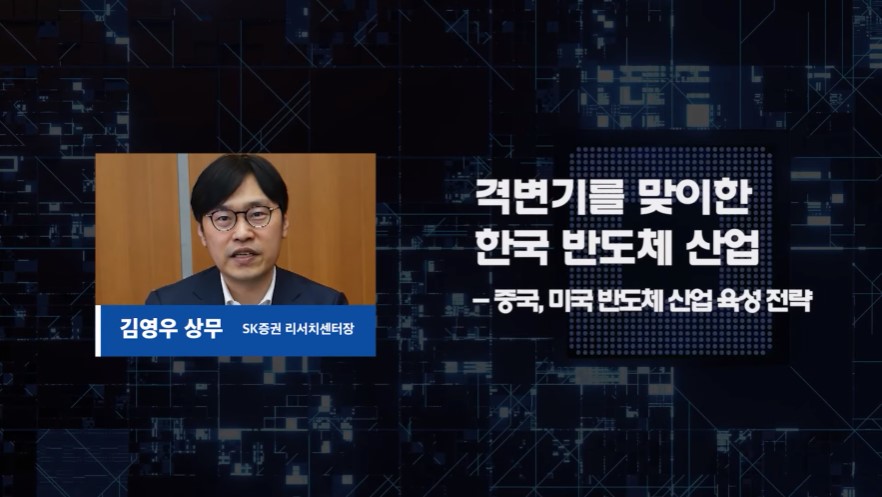
▲Kim Young-woo, Head of SK Securities Research Center (Video capture - Semiconductor Digital Forum)
Kim Young-woo, head of SK Securities' Center, says, "Robots and drones are a threat to national security."
The gap between China's semiconductor self-sufficiency and China's is widening, and US sanctions are expected to intensify.
The semiconductor industry is undergoing a deepening restructuring of the global supply chain. With China's semiconductor rise and the US expanding investment and imposing sanctions on China, both countries are staking their energies on fostering the semiconductor industry, making response to this shift increasingly crucial.
The Korea Semiconductor Industry Association (KSA) held its "Semiconductor Digital Forum" on the 20th. Kim Young-woo, head of SK Securities' Research Center, hosted an online seminar on the topic of US and Chinese semiconductor industry development strategies in a rapidly changing Korean semiconductor industry.
Some believe that China's semiconductor expansion has effectively failed due to U.S. government sanctions, but a cautious view that China still poses a threat as it continues to expand its semiconductor industry by making large-scale investments in it is also a meaningful interpretation.
Amidst this, Center Director Kim emphasized, “In the future battlefield, robots and drones are emerging as key industries, and in this regard, semiconductors are connected not only to industrial security but also to national security.” He explained that although the semiconductor development agenda was not mentioned at all in the last National People's Congress, semiconductors are essential for robots and drones, and are directly linked to national security, making them an industry that China cannot afford to give up.
While China has declared a policy of transitioning to a digital economy, its semiconductor self-sufficiency remains sluggish, creating a significant gap. Due to US sanctions, HiSilicon has disappeared from the AP market, and domestic production of memory semiconductors is also reportedly sluggish. Director Kim noted that Chinese companies' share of mobile semiconductors remains minimal, and that semiconductors remain China's Achilles' heel.
China is implementing the Dongshui-Seosan Project to develop infrastructure, with an estimated annual investment of 400 billion yuan (approximately 74 trillion won). A key focus is shifting data centers, currently concentrated in the east, to the west, with plans to build ten national data center clusters in eight regions. Major Chinese ICT companies, including Alibaba, Tencent, Huawei, and China Mobile, have participated in this project as potential investors.
An analysis of individual companies predicted strong growth for CXMT (Changxin Memory Technology), a leading Chinese DRAM manufacturer. With major Chinese IT companies such as Alibaba, Tencent, and Xiaomi as investors, the company hints at its goal of establishing a supply chain within the domestic memory semiconductor industry. CXMT is expected to gradually increase its share of the domestic low-cost DDR4 memory market, aiming for independent supply of 17nm DDR5 DRAM.
Director Kim also predicted that China will pursue a strategy to foster fabless and foundry businesses through automotive semiconductors. He analyzed that China, which faces challenges securing not only EUV exposure equipment but also DUV equipment, is seeing new momentum in automotive semiconductors capable of operating at 20-55nm. Accordingly, SMIC, which has seen its global market share in the smartphone and tablet markets decline along with Huawei's decline, is expected to make a leap forward through automotive semiconductors.
SMIC plans to double its 12-inch fab by 2024, and as semiconductors used in automotive semiconductors can also be used in drones and robots, China is expected to emerge as a key nurturing business for internalizing automotive semiconductors.
Director Kim noted that the US is likely to target export restrictions on Chinese memory semiconductors as its next target. He added, "The US also needs to foster its robotics and drone industries, and we anticipate increased demand for automotive semiconductors as a result," citing equipment shortages stemming from foundry development. He added that amidst competition for limited equipment supplies, China could be restricted from using not only EUV and DUV, but also argon fluoride immersion (ArFi) technology. He also noted that there is talk within the US of restricting photomasks and photo registries to China.
Referring to the domestic semiconductor industry, Director Kim stated, "Korea's share of the global AP market is declining." He explained that Samsung has not been able to recoup the losses suffered by China's HiSilicon due to US government sanctions. He also expressed concern, saying, "Samsung is also showing a downward trend in the global foundry market share."
Director Kim stated, “The semiconductor alliance between the U.S. and the EU can be seen as strengthening, and as new markets are reorganized and the bloc economy is formed, opportunities will arise in equipment and materials.” He added, “In mid- to long-term plans, we must consider global expansion and expanding overseas customers.”

Comments
Related news
.jpg)
Russia-Ukraine War Hits Parts Shortage Directly
As the war between Russia and Ukraine prolongs and sanctions from Western countries including the United States and EU become a reality, it is anticipated that component shortages will intensify further due to rising raw material prices and increased currency exchange rate volatility.
2022.03.15by 배종인 기자
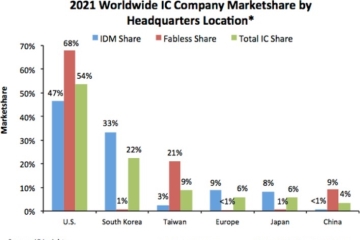
South Korea's fabless market accounts for just 1% of global semiconductor production, with the US dominating, and Taiwan gaining ground.
South Korea, despite securing the second-largest position in the global semiconductor market while striving to establish its standing as a semiconductor powerhouse amid the U.S.-led global semiconductor market dominated by Qualcomm and Nvidia, is facing concerns due to assessments that it remains highly vulnerable in the fabless IC sector.
2022.04.11by 명세환 기자
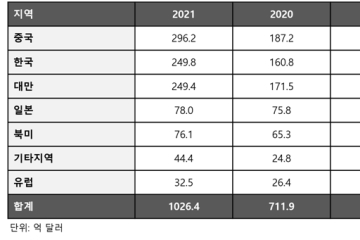
Global semiconductor equipment sales increased 44% last year
As semiconductor demand surges, production lines are operating at full capacity, and semiconductor companies across various countries are making aggressive investments in production facilities, resulting in a significant increase in global semiconductor equipment sales.
2022.04.15by 명세환 기자
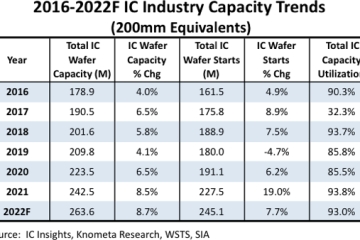
This year's wafer production up 8.7%... Impact of expansion by SK, TSMC, etc.
As the semiconductor supply shortage continues, forecasts indicate that global wafer production capacity will increase this year, drawing attention to whether the supply deficit can be resolved.
2022.04.22by 명세환 기자

Intel Unveils Next-Generation 'Core Ultra Series 3' and vPro Platform for Enterprise PCs
Intel has officially unveiled the "Intel Core Ultra Series 3" for next-generation enterprise PCs and the latest vPro platform, addressing a wide range of demands from enterprise notebooks to high-performance workstations.
2026.03.26by 배종인 기자











